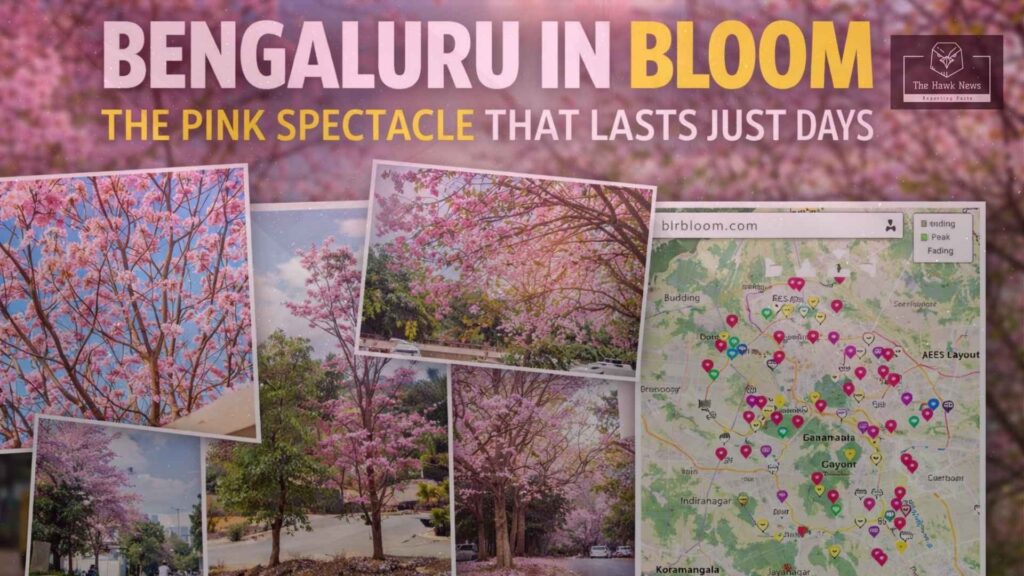
“Some cities grow louder with time. Bengaluru blooms softer.”
Every year, for a brief and almost dreamlike window, Bengaluru transforms into a canvas of soft pink.
Streets, parks, and quiet neighborhoods are suddenly lined with blooming Tabebuia rosea, often called the city’s own version of cherry blossoms.
But unlike their famous counterparts, these blooms come and go in a matter of days—making them one of the most fleeting natural spectacles in urban India.
A Beauty That Doesn’t Wait
The bloom cycle of Tabebuia rosea is remarkably short. From the first signs of budding to the final fall of petals, the entire transformation lasts about 9–10 days.
The most stunning phase—the full pink bloom—barely stretches 3 to 5 days.
Miss it, and you wait another year.
“The beauty of these trees lies not in how long they bloom—but in how briefly they stay.”
This fleeting nature is what makes the experience so special. It’s not just a seasonal change—it’s a moment you either catch… or lose.
Where the City Turns Pink
Some parts of Bengaluru have become iconic for these blossoms. Areas like:
- Cubbon Park
- Indiranagar
- Jayanagar
- Koramangala
- AECS Layout
turn into pink corridors, drawing photographers, nature lovers, and curious residents alike.
These aren’t curated gardens—they are everyday streets transformed into visual poetry.
“In Bengaluru’s pink season, hesitation is the only way to miss it.”
Mapping a Moving Phenomenon
In 2026, a new digital initiative—blrbloom.com—changed how residents experience this seasonal event.
Built on a tree census of over 20,000 trees, the platform allows users to:
- Pin blooming locations in real time
- Track stages: budding, peak, fading
- Navigate an interactive city-wide bloom map
What makes it powerful is its community-driven model. Since the bloom window is so short, crowdsourced updates help people catch the trees at their most vibrant stage.
“Between deadlines and traffic, the city still finds a way to remind you to look up.”
Roots Beyond Bengaluru
Though now synonymous with the city, Tabebuia rosea is not native to India. It originates from Central America and was introduced during the colonial period.
“What was planted as greenery decades ago now blooms as memory.”
Its large-scale presence in Bengaluru is credited to horticulturist S. G. Neginhal, who led plantation efforts in the 1980s to expand the city’s green cover.
Decades later, those decisions have turned into one of the city’s most photogenic natural events.
More Than Just a Bloom
The pink trumpet trees represent more than visual beauty. They reflect:
- The impact of long-term urban planning
- The role of citizen participation in environmental tracking
- The emotional connection between people and public spaces
In a fast-moving city defined by traffic and tech, these trees force a pause.
“When a moment is this short, it takes a community to capture it.”
Final Thought
Bengaluru’s pink bloom is not just something you see—it’s something you catch. A reminder that not all beauty is permanent, and not all moments can be scheduled.
“Bengaluru doesn’t just bloom in pink—it reminds you that not everything beautiful is meant to last.”
For a few days each year, the city softens.
And if you’re lucky enough to be there at the right time—you don’t just witness it, you remember it.