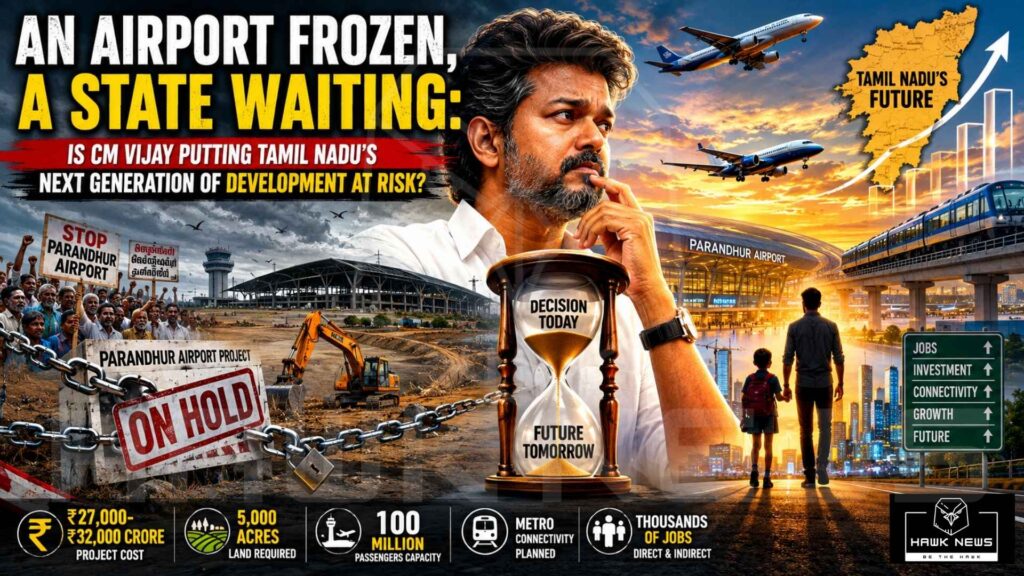
For nearly two decades, Tamil Nadu’s policymakers, aviation planners, and industrial stakeholders have agreed on one thing: Chennai will eventually need a second major airport.
Successive governments studied multiple locations. Committees were formed. Surveys were conducted. Land acquisition processes began. Thousands of crores were committed. The project was presented not merely as an airport, but as one of the largest infrastructure investments in Tamil Nadu’s modern history.
Today, however, the project stands frozen.
The reason is no longer technical.
It is political.
The same Vijay who stood alongside Parandur protesters before entering Fort St. George now faces a difficult question as Chief Minister: can a government continue to oppose a project that many believe is critical to Tamil Nadu’s future growth?
The answer could shape the state’s economy for decades.
The Scale of the Project Was Never Small
Parandur was not conceived as another regional airport.
It was designed to become Chennai’s second international aviation hub and one of India’s largest greenfield airports.
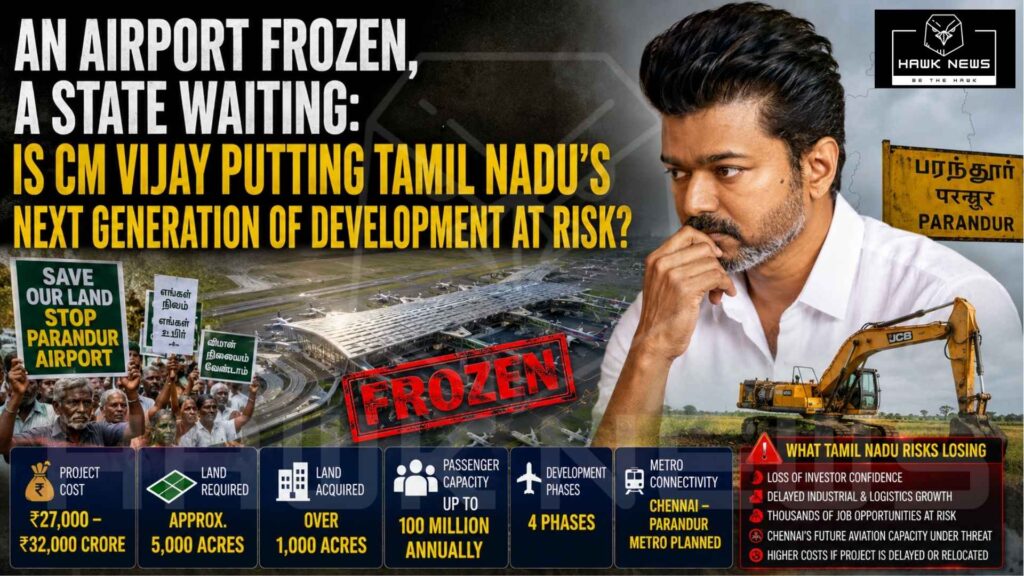
| Component | Estimated Figure |
|---|---|
| Total Project Cost | ₹27,000 crore to ₹32,000 crore |
| Land Requirement | Approximately 5,000 acres |
| Planned Passenger Capacity | Up to 100 million passengers annually |
| Development Phases | Four |
| Strategic Purpose | Chennai’s Second International Airport |
The numbers alone explain why the project attracted national attention.
This was expected to become a long-term economic engine capable of transforming western Chennai and neighbouring districts.
How Much Progress Had Already Been Made?
Contrary to the belief that Parandur existed only on paper, significant groundwork had already been completed.
Government records and reports indicate substantial progress in land acquisition and project preparation.
| Progress Indicator | Status Reported |
| Land Acquired | Over 1,000 acres |
| Land Under Government Control | Around 1,500 acres |
| Compensation Process | Initiated |
| Social Impact Assessments | Conducted |
| Environmental Studies | Advanced Stages |
| Metro Connectivity Planning | Under Preparation |
Years of administrative work had already been invested before the current pause.
Every delay now carries financial, legal and policy implications.
Why Airports Are About More Than Flights
Many discussions around Parandur focus only on aircraft and runways.
That misses the larger picture.
Modern airports do not simply move passengers.
They attract investment.
Around the world, major airports have become magnets for logistics parks, manufacturing clusters, export facilities, warehouses, hotels, convention centres and commercial developments.
When companies evaluate investment destinations, connectivity often becomes a deciding factor.
A city with stronger air connectivity gains a competitive advantage.
A city without future aviation capacity risks losing opportunities to competing regions.
This is why Bengaluru expanded.
This is why Hyderabad expanded.
This is why Mumbai continues to expand.
The question now being asked by many industry observers is simple:
Can Chennai afford not to expand?
The Chennai Capacity Question
The original logic behind Parandur emerged from concerns over Chennai’s long-term aviation capacity.
Passenger traffic has steadily increased over the years.
Cargo movement continues to grow.
Business travel remains critical to Tamil Nadu’s economy.
Even if the existing Chennai airport continues to operate efficiently, planners have repeatedly argued that future growth will require additional capacity.
Parandur was selected after multiple site evaluations because it was believed capable of accommodating future demand at a scale that alternative solutions could not easily provide.
Stopping the project does not eliminate the need.
It merely postpones the question.
And postponed infrastructure challenges often become more expensive to solve later.
What Happens If Parandur Is Cancelled?
This is where the debate becomes serious.
Supporters of cancellation often focus on what Tamil Nadu saves.
Less attention is given to what Tamil Nadu may lose.
Potential consequences include:
Loss of Investor Confidence
Large infrastructure projects require long-term policy consistency.
If projects that have already crossed multiple approval stages can be reversed after political transitions, investors may become cautious about future commitments.
Predictability matters in investment decisions.
Delayed Industrial Expansion
Airport corridors often become industrial corridors.
Without the airport, many of the associated logistics and industrial developments may never materialise.
Reduced Competitive Advantage
Tamil Nadu competes directly with Karnataka, Telangana and Maharashtra for investment.
Infrastructure is often the deciding factor.
Any delay in expansion can strengthen competing states.
Missed Employment Opportunities
Large airport ecosystems generate jobs far beyond aviation.
Construction, logistics, hospitality, warehousing, transportation, maintenance and commercial sectors all benefit.
Thousands of direct and indirect employment opportunities could be affected.
Rising Future Costs
Infrastructure rarely becomes cheaper with time.
Land prices rise.
Construction costs increase.
Compensation packages become more expensive.
A project delayed today may cost significantly more tomorrow.
The Protest That Became Government Policy
Before entering government, Vijay’s position was clear.
He stood with protesters.
He visited affected villages.
He publicly questioned the project.
Many residents viewed him as their most influential political supporter.
That political support helped strengthen opposition to the airport.
But opposition politics and governance operate under different realities.
As opposition leader, the priority was supporting affected residents.
As Chief Minister, the responsibility extends to the entire state.
The challenge now is balancing local concerns with statewide economic interests.
That balance is proving far more difficult than leading a protest.
The Environmental Argument Cannot Be Ignored
The concerns raised by residents are not imaginary.
Questions surrounding water bodies, agricultural land, displacement and ecological impact deserve serious examination.
Any government pursuing infrastructure development must address these issues transparently.
Development cannot become an excuse for environmental negligence.
At the same time, environmental concerns and economic development are not always mutually exclusive.
The real challenge is finding solutions that minimise damage while preserving long-term growth opportunities.
The debate should not be framed as farmers versus development.
The real question is whether Tamil Nadu can achieve both.
A Decision That Could Define Vijay’s Government
Every government faces one defining infrastructure decision.
For previous administrations, it was metro expansion, industrial corridors and expressways.
For CM Vijay, it may be Parandur.
Because the consequences extend beyond one airport.
This decision will send a signal about how the new government views growth, investment, infrastructure and policy continuity.
The airport may be frozen today.
But the larger question remains unresolved.
Can Tamil Nadu afford to pause one of its biggest planned infrastructure projects at a time when competing states are accelerating theirs?
The answer may determine not only the future of Parandur, but the future direction of Tamil Nadu itself.