“The stars did not disappear. We simply brightened the world until we could no longer see them.”
There was a time when the night sky was a shared inheritance.
Long before smartphones illuminated our faces and city lights painted the horizon in an endless glow, people looked upward and saw stories written among the stars. Farmers read the seasons in the heavens. Sailors navigated by constellations. Children lay on rooftops and counted shooting stars until sleep overtook them.
Today, for millions around the world, that celestial spectacle has quietly faded. Not because the stars have vanished, but because artificial light has grown so abundant that it obscures them from view.
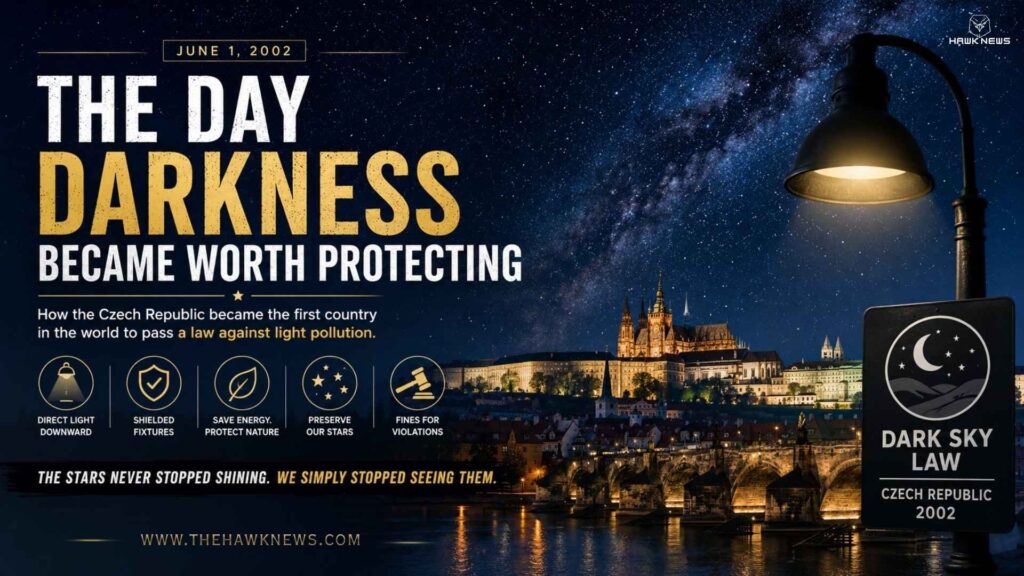
On June 1, 2002, the Czech Republic made history by becoming the first nation to enact a national law specifically aimed at tackling this often-overlooked environmental issue. Known informally as the “Dark-Sky Law,” the legislation marked a groundbreaking recognition that darkness itself was a natural resource worthy of protection.
More than two decades later, the law remains a reminder that progress and preservation need not be enemies and that sometimes protecting nature means simply turning the lights down.
The Pollution We Rarely Notice
When people hear the word “pollution,” they usually think of smog-filled skies, contaminated rivers, or plastic-choked oceans.
Light pollution rarely enters the conversation.
Yet it has become one of the fastest-growing forms of environmental alteration worldwide.
Light pollution occurs when artificial lighting is excessive, poorly directed, or unnecessary. Street lamps, floodlights, illuminated billboards, office buildings, stadiums, and residential lighting all contribute to a phenomenon known as skyglow, the bright halo that hangs above urban areas and obscures the stars.
Unlike litter or smoke, light pollution is easy to overlook because many people associate more light with progress, safety, and development.
But every beam of light that escapes upward instead of illuminating the ground represents wasted energy and a diminished view of the night sky.
As cities expanded and technology advanced, humanity slowly began losing touch with one of its oldest companions the darkness of night.
A Historic Decision Under the Stars
Recognizing the growing problem, the Czech Republic took an unprecedented step.
On June 1, 2002, amendments to the country’s environmental legislation came into force, making it the first nation in the world to address light pollution through national law.
The principle behind the legislation was remarkably simple.
Outdoor lighting should illuminate what needs to be seen, not the sky.
The law encouraged the use of shielded fixtures and lighting designs that directed light downward rather than allowing it to spill upward into the atmosphere. By reducing unnecessary light emissions, the legislation aimed to improve energy efficiency while preserving the natural darkness of the night.
Organizations and individuals who failed to comply with the regulations could face penalties, underscoring the seriousness with which the issue was being treated.
At the time, the move attracted international attention.
Many viewed it as a bold experiment. Others questioned whether light pollution deserved legislative attention at all.
Yet the Czech Republic had recognized something profound: the night sky was disappearing not through neglect, but through excess.
The Cost of Losing the Night
The consequences of light pollution extend far beyond stargazing.
Scientists have long documented the effects of artificial lighting on ecosystems and wildlife.
Many bird species rely on natural light patterns for migration. Bright urban lighting can disorient them, causing collisions with buildings or disrupting migration routes.
Insects, particularly moths and other nocturnal pollinators, are drawn toward artificial lights, altering feeding and reproductive behaviors. Since insects play a crucial role in ecosystems, their disruption can ripple through entire food chains.
Nocturnal mammals face challenges as well. Animals that evolved to hunt, forage, or navigate in darkness often find their habitats transformed by relentless illumination.
The impact reaches humans too.
For thousands of years, human biology evolved around the natural cycle of daylight and darkness. Exposure to excessive artificial light at night can interfere with circadian rhythms, the internal clock that regulates sleep and numerous physiological processes.
Modern life has blurred the distinction between day and night, creating environments where true darkness is increasingly rare.
As author and naturalist Henry Beston once observed:
“Our fantastic civilization has fallen out of touch with many aspects of nature.”
The night sky may be one of the most significant casualties of that disconnect.
The Stars We No Longer See
Perhaps the most emotional consequence of light pollution is the loss of wonder.
For countless generations, the Milky Way stretched visibly across the night sky like a luminous river.
Today, many children grow up in cities where they may never witness that sight.
Astronomers often point out that some urban residents can see only a fraction of the stars visible from truly dark locations.
What was once a universal human experience has become a destination attraction, requiring travel to remote deserts, mountains, or protected dark-sky reserves.
The irony is striking.
Humanity has developed telescopes capable of peering billions of light-years into space, yet many people can no longer see the stars directly above their own homes.
As one popular saying puts it:
“We are the first generation to light the night so brightly that we have hidden the universe from ourselves.”
Darkness Is Not the Enemy
The Czech Republic’s legislation was never about plunging cities into darkness.
Nor was it about rejecting modernity.
Instead, it promoted a concept that has gained increasing acceptance worldwide: smarter lighting.
A well-designed lighting system provides visibility where it is needed while minimizing waste and environmental impact.
Shielded fixtures, motion sensors, lower-intensity lighting, and warmer-colored lights can significantly reduce light pollution without compromising safety.
In many cases, these measures also lower energy consumption and operating costs.
The lesson is simple but powerful.
The goal is not less light.
The goal is better light.
A Movement That Reached Beyond Borders
What began as a pioneering effort in the Czech Republic helped spark broader conversations about preserving dark skies.
Over the years, communities around the world have embraced initiatives aimed at reducing unnecessary illumination.
Protected dark-sky parks and reserves have emerged across various countries, offering visitors opportunities to experience the night sky much as their ancestors once did.
Astronomers, environmentalists, conservationists, and public health advocates have increasingly found common ground on the issue.
The movement reflects a growing understanding that darkness is not merely the absence of light, it is an ecological condition with value in its own right.
Just as societies protect forests, wetlands, rivers, and wildlife habitats, many now argue that natural darkness deserves similar consideration.
Looking Up Again
Perhaps the most remarkable aspect of the Czech Republic’s dark-sky legislation is the question it invites us to ask.
When was the last time we truly looked up?
In an age of constant illumination, darkness has become something many people instinctively avoid. Yet some of nature’s most breathtaking experiences reveal themselves only when artificial light fades away.
A clear night sky offers perspective.
It reminds us that our daily worries unfold beneath a universe immeasurably larger than ourselves. It reconnects us with generations who gazed at the same stars long before electric lights transformed the landscape.
The stars still appear every evening.
The Milky Way still stretches across the cosmos.
The universe continues its silent performance above our heads.
Whether we see it often depends on the choices we make here on Earth.
A Legacy Written in Darkness
When the Czech Republic enacted its pioneering law in 2002, it did more than regulate outdoor lighting.
It challenged a deeply rooted assumption that brighter is always better.
By recognizing light pollution as an environmental concern, the nation opened a conversation that continues to grow around the world today.
More than twenty years later, its message remains as relevant as ever.
Darkness is not a void to be conquered.
It is a natural part of the world—a backdrop against which stars shine, ecosystems thrive, and human beings find wonder.
Sometimes protecting the future does not require building something new.
Sometimes it begins with preserving what has always been there.
And sometimes, the most profound way to see more is simply to turn off the light. ✨
“The night belongs to everyone. The stars shine for all. Protecting darkness is, in many ways, protecting our connection to the universe itself.”