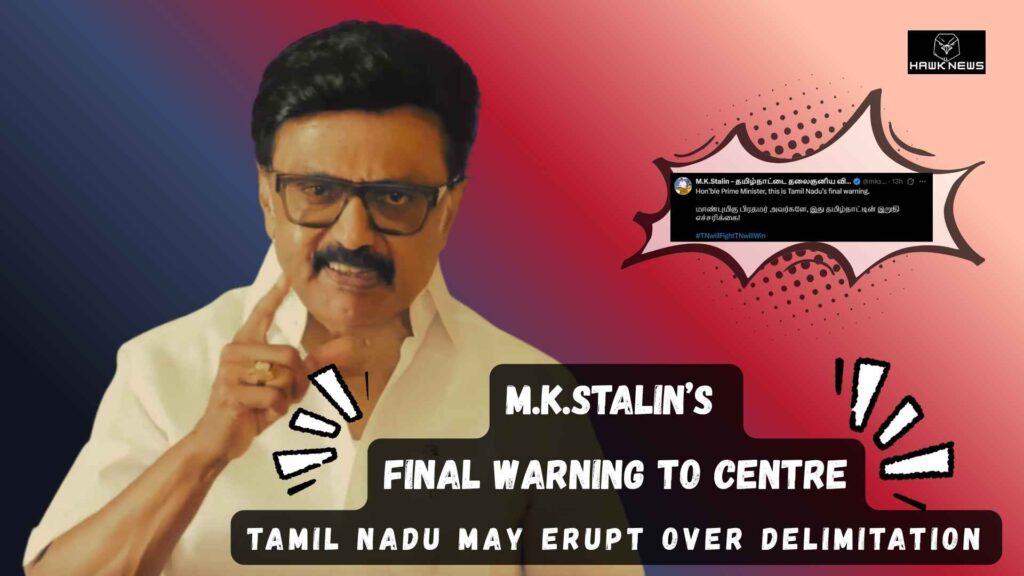
A warning, not a statement
Tamil Nadu Chief Minister M. K. Stalin did not issue a routine political remark. He chose his words carefully and framed them as a “final warning” to the Union government led by Narendra Modi.
This was not a disagreement over policy. It was positioned as a direct confrontation, with Stalin making it clear that Tamil Nadu will not quietly accept decisions that alter its political weight.
What triggered this escalation
The immediate trigger lies in the growing concern over the upcoming delimitation exercise. With the freeze on constituency redistribution expected to end, the Centre is seen as preparing for a major restructuring of parliamentary seats.
Stalin has alleged that discussions are being pushed without transparent consultation. The suspicion that a constitutional move could be rushed through Parliament has added urgency to his response.
The fear behind delimitation
At the core of this confrontation is a structural fear. Delimitation, by definition, reallocates parliamentary seats based on population.
States with higher population growth stand to gain more seats. States like Tamil Nadu, which have effectively controlled population growth, risk losing relative representation in Parliament.
“Punished for discipline”
Stalin’s sharpest political line is simple and strategic. Tamil Nadu followed national policy directions on family planning and population control.
Now, if representation is recalculated purely on population, those very states may lose influence. The argument he is pushing is blunt: discipline is being penalised, while demographic expansion is being rewarded.
A question of fairness
This is not just a numbers debate. It is being framed as a question of fairness in governance.
If political power shifts purely based on population, then states that invested in human development, healthcare, and education could find themselves with a weaker voice in national decision-making.
From policy to protest
Stalin did not stop at criticism. He escalated the issue into a potential mass movement.
His warning that “every family” could take to the streets signals a shift from institutional resistance to public mobilisation. This is not about party cadres alone, but a call for broader societal participation.
The language of escalation
The tone of the statement matters as much as its content. Stalin explicitly said his words should not be mistaken for a threat, but understood as a warning.
This distinction is deliberate. It signals that the situation has crossed from negotiation into confrontation, with consequences that could spill onto the streets.
Federalism under strain
Stalin has framed delimitation as an assault on federal principles. According to this argument, the balance between states is at risk of being structurally altered.
If representation tilts heavily toward certain regions, the federal structure itself could become uneven, reducing the negotiating power of states like Tamil Nadu.
North-South fault line
This issue has reignited a long-standing political tension. The divide between northern and southern states is no longer just economic or cultural.
It is now being positioned as a battle over representation. The fear is that delimitation could permanently shift political dominance toward the north.
A political calculation?
There is also an underlying political accusation. Critics, including Stalin, suggest that delimitation could benefit regions where the ruling party has stronger electoral presence.
If that perception gains traction, the exercise risks being seen not as administrative reform, but as a calculated political move.
Historical memory returns
The language used by Stalin carries echoes of past movements. Tamil Nadu has a history of mass mobilisation when it perceives threats to its rights or identity.
By invoking large-scale protest, Stalin is tapping into that political memory. It signals readiness to revive resistance politics if required.
Not just Tamil Nadu
Although the warning is issued from Chennai, the implications go beyond one state. Other southern states share similar demographic patterns and concerns.
If the issue escalates, it could lead to a broader regional alignment, turning delimitation into a national political flashpoint.
The Centre’s silence
So far, there has been no detailed public clarification addressing these concerns in a way that satisfies critics.
This silence is being interpreted by opposition leaders as either strategic ambiguity or unwillingness to engage with state-level apprehensions.
Numbers versus governance
At the heart of the debate is a fundamental question. Should representation be tied only to population, or should governance performance and policy compliance matter?
This is the ideological battleground Stalin is trying to define. It shifts the debate from arithmetic to accountability.
The risk of escalation
If the Centre proceeds without consensus, the risk is not just political opposition. It is the possibility of widespread protests that could disrupt governance.
Stalin’s warning suggests that the issue has the potential to move beyond legislative halls into public spaces across Tamil Nadu.
A test of political will
For Stalin, this is also a test of leadership. By taking a strong stand early, he is positioning himself as a defender of Tamil Nadu’s rights.
For the Centre, it becomes a test of whether it can push through structural reforms without triggering regional backlash.
The road ahead
Delimitation is not an immediate overnight change, but the groundwork being laid now will shape future political realities.
The decisions taken in the coming months could redefine how power is distributed across India for decades.
The larger question
Beyond politics, this raises a deeper constitutional question. How should a diverse country balance representation with equity?
If that balance is perceived to be broken, the consequences may not remain confined to one policy debate.
Conclusion: a line has been drawn
Stalin’s “final warning” is not just rhetoric. It is a signal that Tamil Nadu is prepared to resist what it sees as an unjust restructuring of power.
Whether this turns into negotiation or confrontation now depends on how the Centre responds. But one thing is clear: the line has been drawn, and the next move will define the scale of the conflict.