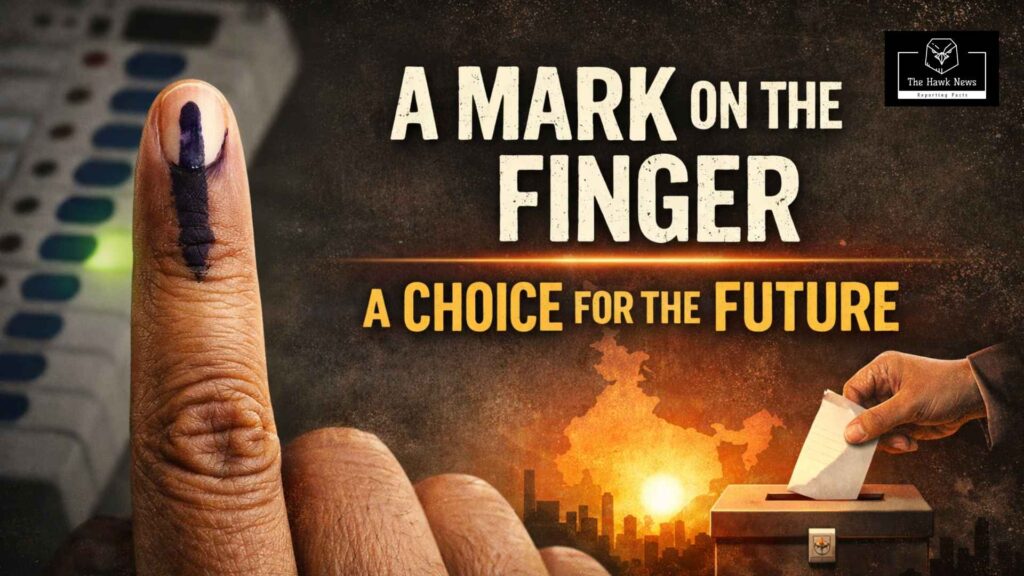
The mark is small. A quick press, a brief stain of ink on the finger and it fades within days. But what it represents does not fade so easily.
That single act, often treated as routine, carries the quiet force to shape economies, influence freedoms, and define the direction of a nation.
Voting is frequently reduced to participation. Show up. Stand in line. Cast your vote. Leave. In many ways, that ritual has become the visible face of democracy.
But beneath that simplicity lies a far more demanding responsibility one that requires not just presence, but clarity.
Because a vote is not just an action. It is a decision.
The Illusion of Simplicity
At first glance, voting appears straightforward. A list of candidates. A symbol. A choice.
But what seems simple on the surface is layered with complexity underneath policy implications, governance records, ideological positions, and long-term consequences.
Yet, many voters approach this moment carrying assumptions rather than understanding. Information is often secondhand. Opinions are inherited. Decisions are made not after evaluation, but out of habit.
The danger is not in voting. The danger is in voting without thinking.
The Noise That Shapes Us
Modern elections are saturated with messaging. Campaigns are no longer just speeches and manifestos; they are ecosystems of influence social media narratives, targeted advertisements, viral content, and emotionally charged rhetoric.
Every message is crafted to provoke something; anger, pride, fear, hope.
But emotion, while powerful, is rarely precise. It simplifies complex realities into easy reactions. It turns governance into spectacle. And in doing so, it shifts focus away from what truly matters: performance, accountability, and capability.
A voter surrounded by noise often mistakes familiarity for truth.
Clearing that noise is the first step toward meaningful choice.
Beyond Identity
One of the most persistent forces in voting behavior is identity. Religion, caste, language, region—these markers shape how people see themselves and, often, how they vote.
Identity is deeply personal. But governance is profoundly practical.
A government does not operate on identity alone; it functions through decisions—on infrastructure, education, healthcare, economy, and law. When voting becomes an extension of identity rather than an evaluation of leadership, accountability weakens.
The question shifts from “Who can govern well?” to “Who belongs to me?”
And that shift comes at a cost.
A thoughtful voter steps beyond identity and asks:
- What has this candidate done?
- What do they stand for beyond rhetoric?
- Can they deliver under pressure?
Because representation without capability is a fragile foundation.
Memory as a Democratic Tool
Election cycles often reset public memory. Promises take center stage, while past performance quietly recedes into the background.
But governance leaves a trail.
Policies implemented, projects completed or abandoned, transparency maintained or compromised—these are not abstract ideas. They are measurable realities.
A voter who remembers is harder to persuade with empty promises.
Before looking forward, a responsible voter looks back:
- Were commitments fulfilled?
- Was governance consistent?
- Did actions match words?
In a system where narratives are constantly rewritten, memory becomes a form of resistance.
The Misinformation Trap
We live in a time where information is abundant, but reliability is uneven. Misinformation is not always obvious, it often comes packaged in confidence, repetition, and emotional appeal.
A forwarded message, a clipped video, a trending claim – these can shape perceptions faster than verified facts.
And once a perception is formed, it is difficult to undo.
A careful voter does not consume information passively. They question it:
- Who is the source?
- Is there evidence?
- Does it hold up under scrutiny?
Clarity requires effort. But without that effort, choice becomes vulnerable to manipulation.
The Comfort of Conformity
Voting is personal, but it rarely feels that way. Family expectations, community pressures, and social circles often create an invisible framework around individual choice.
It is easier to align than to question.
But democracy is not strengthened by uniformity. It is strengthened by independent thinking.
A vote should not be an echo. It should be a conclusion.
And sometimes, that means stepping away from the comfort of collective opinion and engaging in personal evaluation.
The Weight of the Future
Most elections are fought on immediate concerns – prices, employment, local issues. These are real and urgent. But voting is also about the future, often in ways that are not immediately visible.
Education policies shape generations. Economic decisions influence stability for decades. Environmental choices determine sustainability far beyond the present moment.
A short-term decision can create long-term consequences.
When you vote, you are not just responding to today, you are quietly endorsing a version of tomorrow.
Thinking as Responsibility
Thinking is often underestimated because it is invisible. There is no public display, no visible marker. But it is the most critical part of the democratic process.
It requires time, attention, and a willingness to engage with complexity. It demands that we question our own biases and remain open to evidence that may challenge our assumptions.
In a fast-moving world, where quick reactions are rewarded, deliberate thinking becomes rare and therefore powerful.
A thoughtful voter is not easily swayed. Not easily rushed. Not easily reduced to a single narrative.
The Meaning of the Mark
The ink on your finger is often worn with pride and rightly so. It signifies participation in a system that grants equal voice to every citizen.
But that mark should represent more than presence.
It should represent clarity.
It should stand for a decision made after reflection, not reaction. After evaluation, not assumption.
Because a vote cast without thought is not empowerment it is uncertainty expressed with confidence.
A Quiet Moment Before the Choice
Before stepping into the polling booth, there is a moment brief, almost unnoticed. It is the space between influence and action.
That moment matters.
It is where noise can be set aside. Where assumptions can be questioned. Where clarity can emerge.
And in that moment, the responsibility becomes real.
Not as a voter in a crowd, but as an individual making a decision that contributes to something far larger.
The mark will fade.
But the future shaped by that choice will not.
And that is why, before you carry the mark on your finger, you must first carry clarity in your mind.