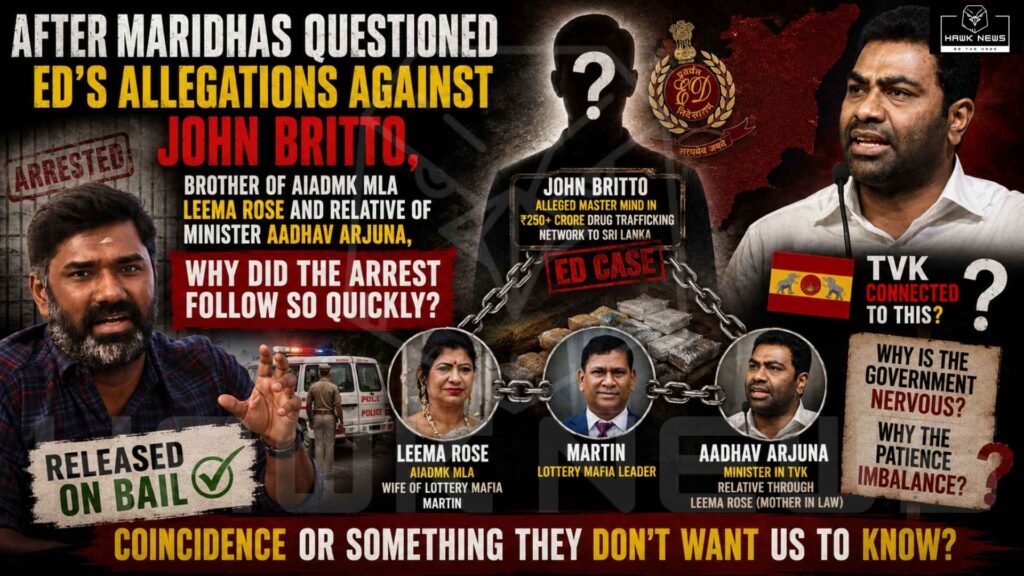
The release of political commentator Maridhas has not ended the controversy surrounding his arrest. In many ways, it has intensified it. What began as a cyber crime case has now evolved into a larger political debate about power, influence, free speech, and the timing of state action against critics.
The central issue is no longer whether Maridhas was arrested. The central issue is why the arrest happened when it did, particularly after he began discussing a subject that was already generating significant public attention across Tamil Nadu.
The Arrest May Be Over, But The Questions Have Just Begun
When Maridhas was taken into custody by the Cyber Crime Wing, government supporters argued that the action was connected to alleged violations arising from his online content. Critics, however, immediately pointed to the timing of the arrest and questioned whether there was more to the story than a routine cyber crime investigation.
Those questions have only become louder after his release. If the case was strong enough to justify an immediate arrest, many observers are now asking why continued custody did not become a larger factor in the legal proceedings. While courts and police operate under different standards, the sequence of events has inevitably attracted public scrutiny.
Why Did The John Britto Investigation Suddenly Become A Political Talking Point?
The controversy cannot be understood without examining the wider backdrop. In recent weeks, the Enforcement Directorate’s investigation into an alleged Sri Lanka-linked narcotics and money laundering network drew significant attention after officials identified John Britto as an alleged key figure in the case.
According to information released during the investigation, authorities alleged that narcotics worth more than ₹250 crore were trafficked through maritime routes connecting India and Sri Lanka. Investigators further alleged that the network involved international channels, financial transactions, and organised logistics that extended beyond a local operation.
As details emerged, the case quickly became one of the most discussed enforcement investigations in Tamil Nadu.
The Political Relationships Became Part Of The Debate
Public attention expanded beyond the investigation itself when discussions began focusing on political and family relationships connected to individuals mentioned in the case. It was in this environment that Maridhas started raising questions through his videos and commentary.
Among the relationships repeatedly discussed in political circles was the fact that John Britto is the brother of AIADMK MLA Leema Rose. Political commentators and social media users also began examining wider family connections involving Minister Aadhav Arjuna, leading to a broader conversation about whether public figures should address questions being raised in the public domain.
The existence of these discussions does not establish wrongdoing by any political figure. However, it does explain why the issue rapidly moved from an enforcement investigation into a politically sensitive controversy.
Questions Were Being Raised, But Answers Were Not Following
One reason the controversy gained momentum is that the public debate began producing more questions than explanations. Critics of the government argue that when politically connected names become part of a major public discussion, transparency becomes more important than silence.
Several commentators argued that the most effective response would have been direct clarification, public engagement, or factual rebuttal. Instead, attention shifted toward the arrest of one of the individuals discussing the issue, creating a perception among some sections of the public that the focus had moved away from the questions themselves.
Whether that perception is fair or not, it has become part of the political narrative surrounding the case.
The Real Issue Is Not Maridhas Alone
Reducing this controversy to one YouTuber would ignore the larger democratic concerns that have emerged. The debate now extends to journalists, commentators, political activists, and ordinary citizens who routinely question governments and public officials.
Every democratic government has the authority to act against content it believes violates the law. At the same time, democratic governments are also expected to demonstrate that criticism alone is not the reason for enforcement action. Maintaining that balance is essential to preserving public trust.
The challenge facing the government today is not merely legal. It is also political. It must convince the public that enforcement decisions are being driven solely by evidence and law rather than by the discomfort created by criticism.
Why The Timing Continues To Matter
The timing of events remains the most discussed aspect of the controversy. First came the ED investigation and the resulting public discussion. Then came videos and commentary questioning relationships and political connections. Shortly afterwards came the arrest of Maridhas.
No publicly available evidence currently proves that one event directly caused the other. However, the sequence has become impossible for many observers to ignore. As long as that sequence remains unexplained, questions about motive and timing will continue to dominate public discussion.
Political controversies often survive not because of what is known, but because of what remains unanswered.
The Government Now Faces A Different Test
The immediate legal battle surrounding Maridhas may be over, but the political debate is far from settled. The government now faces a larger challenge: addressing the growing perception that critics are being watched more closely than the issues they are raising.
Whether that perception is accurate or not, it has gained traction because of the way events unfolded. The burden now lies on those in power to demonstrate that democratic criticism remains protected, even when it becomes uncomfortable.
Until then, the questions surrounding John Britto, Leema Rose, Aadhav Arjuna, the ED investigation, and the timing of the Maridhas arrest are likely to remain part of Tamil Nadu’s political conversation for a long time to come.