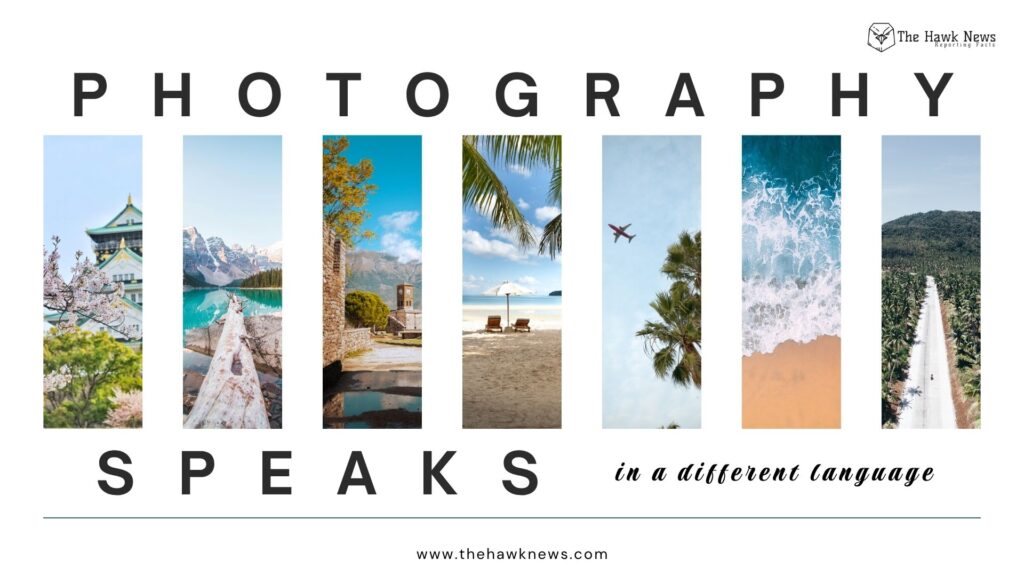
Why a Single Image Can Communicate More Than a Thousand Carefully Chosen Words
“Before we learned to write, we learned to see. Long before language divided humanity into thousands of tongues, images spoke a language everyone understood.”
A child does not learn the alphabet first. A child learns faces. Before words acquire meaning, eyes begin reading emotions, expressions, movements, and patterns. Long before humanity etched symbols onto clay tablets or inked stories onto paper, we communicated through images. In many ways, photography is not merely an invention; it is a return to our oldest language.
Today, we live in a world overflowing with words. News articles, text messages, emails, captions, and comments compete relentlessly for our attention. Yet amidst this endless stream of language, a single photograph can stop us in our tracks. It can make us smile, grieve, hope, or remember within a fraction of a second.
There is a reason for this. Photography speaks in a language that does not require translation.
“A picture is a poem without words.” — Horace
The First Language of Humanity
Before civilization learned to write history, it learned to draw it. Ancient cave paintings, some tens of thousands of years old, tell stories of hunts, animals, and daily life. Their creators left behind no written explanations, yet their messages remain understandable even today.
A photograph works in much the same way.
A photograph of a mother holding her child in India can evoke the same emotions in someone living in Brazil, Canada, or South Africa. A sunset requires no dictionary. A smile needs no subtitles. A tear does not ask for interpretation.
Visual language bypasses the barriers that words often create. It travels directly from one heart to another.
“The eye sees what the mind is prepared to comprehend.” — Robertson Davies
Why We Remember Pictures Better Than Words
Think back to your childhood.
You may struggle to recall the exact words spoken during a family gathering years ago. Yet you can often remember the photograph taken that day. You remember who stood where. You remember the expressions. You remember the colors and details.
Scientists often refer to this as the “picture superiority effect,” the tendency of humans to remember images more easily than text. Our brains are remarkably efficient at processing visual information. Images are not merely seen; they are experienced.
This is why photographs become anchors for memory.
A wedding album does not simply document an event. It preserves laughter. It safeguards affection. It stores moments that time would otherwise quietly erase.
As the writer Milan Kundera once observed:
“Memory does not make films, it makes photographs.”
How true that feels when we look back at our lives.
Images That Changed History
Some photographs become more than pictures. They become turning points.
History is filled with images that altered public opinion, inspired action, and shaped collective memory. Often, people forget the accompanying articles or speeches, but the image remains.
Why?
Because photographs condense complex realities into a single moment.
One frame can capture courage. Another can reveal injustice. Yet another can preserve hope in the midst of despair.
Words often require time to persuade. Images frequently arrive with their meaning already intact.
The camera has witnessed revolutions, wars, celebrations, scientific breakthroughs, and humanitarian crises. It has become one of humanity’s most trusted storytellers.
“Photography is the story I fail to put into words.” — Destin Sparks
The Emotional Power of Visual Storytelling
Not every photograph changes history. Some changes only for us.
A weathered fisherman staring toward the horizon.
An elderly couple holding hands.
A child chasing pigeons through a public square.
These images may never appear in textbooks, yet they possess extraordinary power. They remind us of experiences we share despite our differences.
Photography excels at capturing what words sometimes struggle to articulate: longing, wonder, nostalgia, anticipation, solitude, and joy.
A skilled photographer does more than document a scene. They translate feeling into form.
The camera records light, but the photograph records meaning.
“What the camera sees is not always what the heart remembers. Great photography brings the two together.”
A Universal Language in a Divided World
Humanity speaks thousands of languages. We live under different skies, follow different customs, and tell different stories.
Yet photographs often create unexpected connections.
A traveler standing before a mountain range.
A family gathered around a dinner table.
A child looking through a rainy window.
These moments resonate because they reflect experiences that transcend geography and culture. Photography reminds us that while our circumstances differ, many of our emotions remain remarkably similar.
In an increasingly fragmented world, photographs continue to serve as bridges.
They connect strangers.
They preserve cultures.
They encourage empathy.
They invite us to see ourselves in the lives of others.
As photographer Dorothea Lange famously said:
“The camera is an instrument that teaches people how to see without a camera.”
Perhaps that is photography’s greatest gift.
The Photographer’s Quiet Superpower
Every day, countless moments pass unnoticed.
Most people walk by them.
Photographers stop.
A shadow stretching across an empty street.
The reflection of a city skyline in a puddle.
The brief smile exchanged between strangers.
Photography is, at its heart, an act of attention.
The photographer asks a simple but profound question:
“What is worth remembering?”
Every click of the shutter becomes an answer.
This is why photography reveals as much about the observer as it does about the subject. Two people can stand in the same place and capture entirely different worlds because each notices different things.
“We don’t see things as they are; we see them as we are.” — Anaïs Nin
More Than a Thousand Words
The old saying tells us that a picture is worth a thousand words.
Perhaps that is true.
Yet the finest photographs often do something even more remarkable. They leave us speechless. They communicate not because they contain answers, but because they awaken questions.
They invite us to linger.
To reflect.
To feel.
To remember.
In an age where words arrive faster than ever, photography reminds us of the power of simply seeing.
Because sometimes the most profound conversations are not spoken at all.
They are framed.
Captured.
And quietly understood.
“Photography speaks in a different language not because it avoids words, but because it reaches places where words can no longer go.”