Introduction
A necklace is rarely just a necklace.
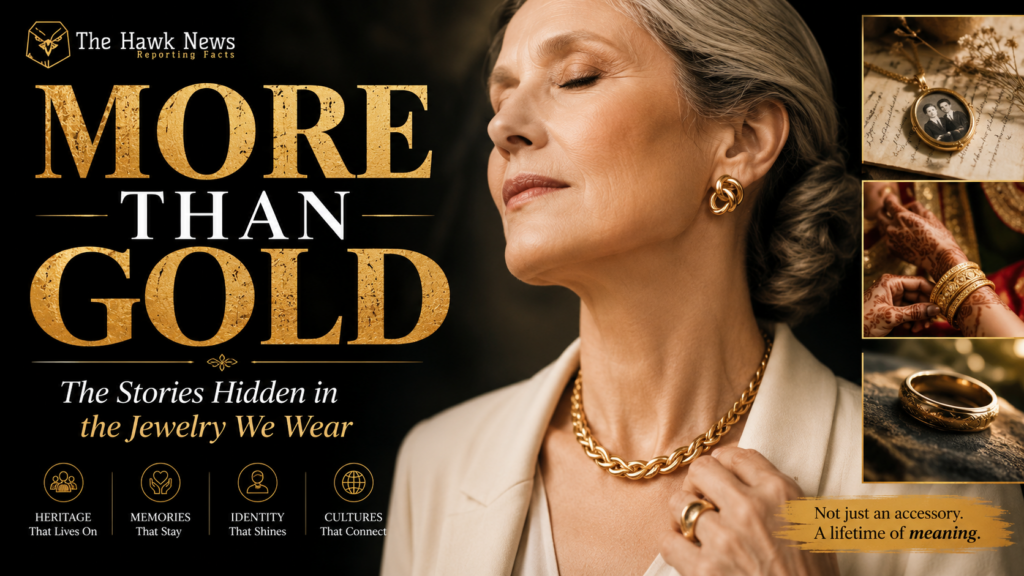
A wedding ring is not merely metal shaped into a circle. A grandmother’s pendant is not simply an accessory tucked away in a jewelry box. An heirloom bracelet may carry more family history than an old photograph.
Across cultures and centuries, jewelry has served a purpose far greater than decoration. It has been a language of identity, memory, status, faith, and love. While fashion trends come and go, jewelry remains one of humanity’s oldest and most enduring forms of self-expression.
In many ways, jewelry is the punctuation mark of personal style. It completes a look, but more importantly, it completes a story.
Humanity’s Oldest Accessory
Long before luxury brands existed, people adorned themselves with shells, stones, beads, and carved bones. Archaeologists have uncovered jewelry dating back tens of thousands of years, suggesting that humans have always sought ways to communicate meaning through what they wear.
Ancient Egyptians wore elaborate ornaments as symbols of power and spirituality. Roman citizens used jewelry to display social rank. In India, jewelry became deeply intertwined with tradition, family heritage, and religious ceremonies.
The materials changed with time, but the message remained remarkably consistent.
People wear jewelry because they want to say something about themselves.
The Emotional Value of Adornment
The true worth of jewelry often has little to do with its market price.
A simple ring passed from a father to his daughter may hold greater emotional value than a diamond worth thousands. A chain gifted by a loved one can become a daily reminder of a relationship. Earrings worn on a special occasion may forever carry memories of that moment.
This emotional attachment explains why jewelry is often among the most treasured possessions people own.
Unlike many consumer products, jewelry accumulates meaning as it ages.
Every scratch tells a story.
Every repair marks a chapter.
Every generation adds another layer to its history.
Why Jewelry Makes Us Feel Different
Psychologists have long observed that clothing influences behavior and self-perception. Jewelry often functions similarly.
A carefully chosen watch may project confidence.
A wedding ring may reinforce commitment.
A treasured pendant may provide comfort during difficult times.
These objects become extensions of personal identity. They are small enough to wear daily but powerful enough to influence how people see themselves.
In this sense, jewelry is not simply something we put on.
It becomes part of who we are.
A Symbol in Every Culture
Few objects carry such universal significance.
Across continents and traditions, jewelry marks life’s most important milestones.
Births.
Coming-of-age ceremonies.
Weddings.
Religious celebrations.
Achievements.
Even mourning.
These moments remind us that jewelry is not merely connected to fashion. It is connected to memory and meaning.
While styles differ from one culture to another, the underlying purpose remains remarkably similar: to celebrate, remember, and communicate.
The Age of Minimalism
Modern fashion has embraced simplicity. Clean lines, neutral colors, and minimalist wardrobes dominate social media feeds and designer collections.
Yet jewelry has not disappeared.
If anything, its role has become more important.
When outfits become simpler, the accessories people choose become more intentional. A single necklace can transform an otherwise understated look. A pair of earrings can reveal personality without saying a word.
In a world increasingly filled with visual noise, carefully chosen jewelry often speaks the loudest.
Beyond Luxury
For decades, jewelry advertising focused heavily on wealth and prestige.
Today, consumers are seeking something different.
Younger generations increasingly value authenticity over status. They want pieces connected to stories, craftsmanship, sustainability, and personal meaning.
The question is no longer:
“How expensive is it?”
The question has become:
“What does it represent?”
This shift reflects a broader cultural movement toward individuality and emotional connection.
Conclusion
Jewelry has survived every fashion revolution because it fulfills a uniquely human need.
The need to remember.
The need to belong.
The need to express ourselves.
Gold may shine. Diamonds may sparkle. Precious stones may capture attention.
But the true power of jewelry lies elsewhere.
It lives in the stories attached to every piece.
After all, an outfit may introduce a person.
But jewelry often tells the story that follows.