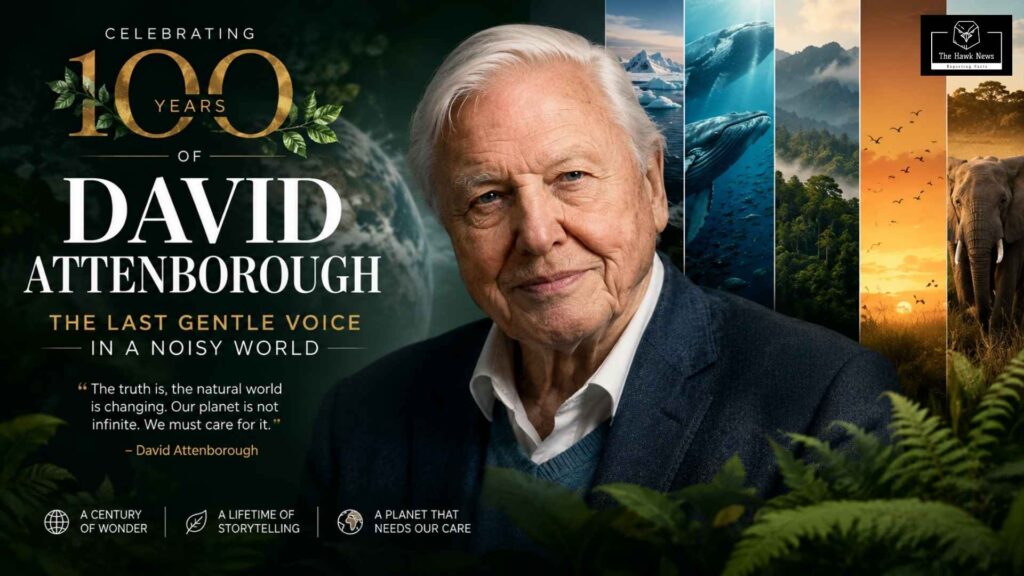
The Voice That Raised Generations
There are voices the world recognizes instantly.
Not because they are loud, but because they have lived long enough inside human memory to feel almost eternal.
For generations, the voice of David Attenborough has floated through living rooms, classrooms, late-night television screens, and quiet childhood afternoons with the calmness of a trusted storyteller.
Forests breathed through him. Oceans spoke through him. The Earth itself, for many, became understandable because he narrated it.
On May 8, the world celebrated 100 years of David Attenborough, a man who did not merely document nature but changed humanity’s relationship with it.
“No one will protect what they don’t care about; and no one will care about what they have never experienced.” — David Attenborough
A Man Born Before the Modern World
Born in 1926 in Isleworth, Attenborough has lived through a century of astonishing transformation.
He witnessed the rise of modern television, the collapse of empires, the arrival of the internet age, and perhaps most tragically, the slow unraveling of ecosystems that once seemed immortal.
Yet through all of it, he remained remarkably unchanged.
Measured! Curious!! Gentle!!!
In a world increasingly shaped by outrage, speed, and noise, Attenborough became something unexpectedly rare: a public figure people trusted without hesitation.
Long before social media algorithms learned how to trap human attention, David Attenborough held entire generations captive with patience alone. There were no dramatic interruptions in his storytelling.
No manufactured controversy. No urgency is designed for clicks. Only observation, wonder, and an almost childlike reverence for life.
Perhaps that is why his work endured.
He never treated nature as a spectacle alone. He treated it as an inheritance.
When Nature Became Emotional
“The natural world is the greatest source of excitement, the greatest source of visual beauty, and the greatest source of intellectual interest.”
Through groundbreaking documentaries like Planet Earth, Blue Planet, and Our Planet, Attenborough transformed wildlife filmmaking into something deeply emotional.
Penguins were no longer distant animals on ice sheets. Whales became symbols of intelligence and grief. Rainforests ceased to be geography and became living cathedrals.
For millions of children across decades, his documentaries were their first experience of awe.
He made the planet feel alive.
There is something deeply poetic about the way Attenborough approached storytelling. He did not speak over nature. He listened to it first.
In many ways, that is what separated him from modern media personalities.
He understood that silence itself could carry meaning.
The Calm in an Age of Noise
Today’s world rewards interruption.
Attention spans shrink while outrage expands. Everything competes to be louder, faster, and more extreme. Public conversation has become a performance. Patience has become rare.
Yet Attenborough’s calmness never felt outdated.
It felt necessary.
“He never shouted to be heard. The world simply became quiet when he spoke.”
In an age where people fight endlessly for attention, Attenborough reminded audiences that gentleness could still hold authority.
That may be his rarest achievement of all.
From Storyteller to Witness
As the decades passed, the tone of his documentaries slowly changed. The wonder remained, but another emotion entered the frame: grief.
The forests grew thinner. Coral reefs lost color. Species disappeared silently. Oceans filled with plastic. Ice began retreating from places where it had stood for centuries.
And Attenborough, once simply a narrator of the natural world, became one of its final witnesses.
Unlike many activists, he rarely relied on anger. His warnings carried sorrow rather than spectacle. That quiet sadness made his message more powerful.
When he spoke about climate change, it did not sound political.
It sounded personal.
“If working apart we are a force powerful to destabilize our planet, surely working together we are powerful enough to save it.”
Why the World Still Trusts Him
Even at 100, Attenborough’s credibility remains almost untouched in a deeply skeptical age.
Part of that comes from consistency.
Another part comes from humility.
He never positioned himself as the hero of his documentaries. The animals, the forests, the oceans, they remained at the center.
He understood something modern culture often forgets: the storyteller does not always need to stand in front of the story.
That restraint gave his work dignity.
There is also something symbolic about Attenborough reaching 100 at this particular moment in history.
Humanity today lives in an age of technological brilliance and environmental anxiety simultaneously. We are more connected than ever before, yet increasingly detached from the natural world that sustains us.
A child can identify smartphone logos faster than bird species.
Rivers disappear while screens become permanent.
And amid all of this stands Attenborough, calm as ever, still reminding humanity to look closely at the Earth before it becomes unrecognizable.
“The truth is: the natural world is changing. And we are totally dependent on that world.”
The Gentle Voice
Not many broadcasters become moral voices across generations.
Attenborough did!
Not because he demanded authority, but because he earned trust slowly, year after year, decade after decade.
His century is not merely the story of television. It is the story of humanity’s changing relationship with nature itself.
He documented the beauty of the Earth when it was abundant.
He documented its fragility when it began to fade.
And through both, he reminded people that nature was never simply a resource to consume. It was a miracle to protect.
At 100 years old, David Attenborough is no longer just a broadcaster or natural historian. He has become something far rarer, a quiet conscience for a restless planet.
Perhaps that is why his voice still matters.
In a civilization growing louder by the day, David Attenborough reminds the world that listening is also a form of wisdom.