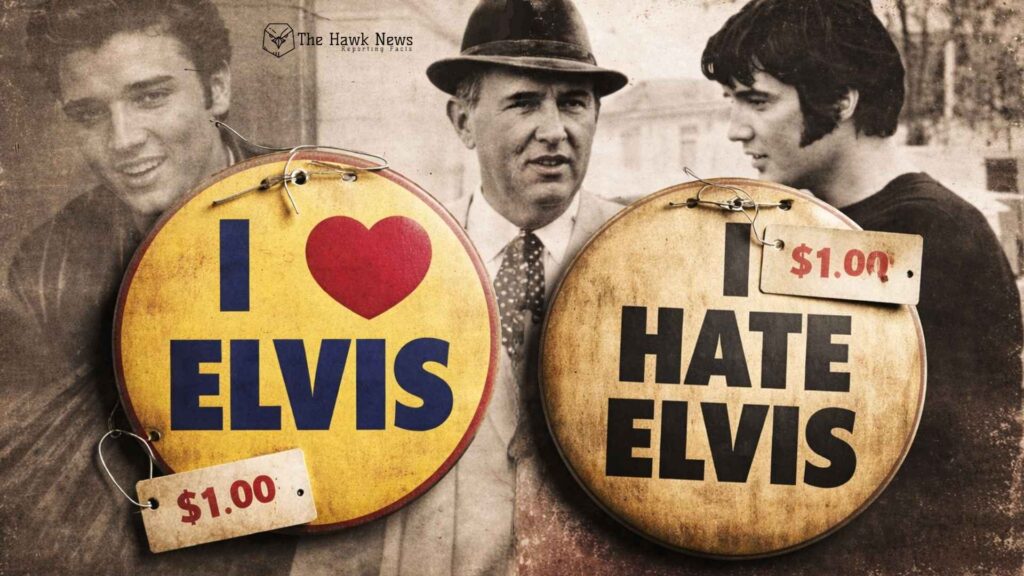
When Colonel Tom Parker sold “I Hate Elvis” buttons to Elvis Presley’s critics, he wasn’t just making money he was writing the first chapter of the emotional economy that drives today’s media.
The Day Hate Became a Product
The 1950s were the dawn of a cultural quake.
Elvis Presley with his swagger, his voice, his defiance was adored and despised in equal measure.
Parents called him vulgar. Preachers called him dangerous. Teenagers called him freedom.
But Colonel Tom Parker, Elvis’s razor-sharp manager, saw something others missed: outrage was not opposition it was opportunity.
So while the fans bought “I Love Elvis” badges, Parker started selling “I Hate Elvis” buttons.
He realized both emotions adoration and disdain led to the same destination: his cash register.
That moment, was a quiet revolution.
It was when the world learned that emotion could be monetized, and outrage could be profitable.
“Parker didn’t silence the critics, he sold to them.”
Editorial reflection, The Hawk News
Turning Emotion into Economy
Parker’s move was radical because it broke a sacred business rule: that you win only when everyone likes you.
He proved the opposite that controversy doesn’t shrink a brand; it inflates it.
This was not just marketing. It was early behavioral economics.
He tapped into a universal truth people don’t buy what they love or hate; they buy what they feel something about.
Emotion, not approval, became the currency.
In that sense, Parker was decades ahead of his time.
He anticipated the entire architecture of modern media a world where visibility, not virtue, determines value.
The Blueprint of Modern Media
Fast-forward to the 21st century.
Parker’s philosophy now fuels the algorithms that rule our lives.
Social media doesn’t care if you agree or disagree only that you engage.
- Outrage drives clicks.
- Disagreement drives discussion.
- Controversy drives visibility.
From influencers who thrive on “cancel culture” to politicians who weaponize division, the principle remains:
If you can’t control emotion, commercialize it.
“The internet didn’t invent outrage. It just automated it.”
The “I Hate Elvis” button has become every viral tweet, every rage-bait headline, every product marketed with polarity.
We live inside the echo of Parker’s gamble where even disdain becomes demand.
The Morality of Marketing
Here lies the danger,
When outrage becomes the foundation of profit, we begin to blur the line between influence and infection.
Brands, media houses, and even newsrooms learn to provoke rather than inform because calm doesn’t sell, chaos does.
And that’s the tragedy behind the brilliance:
what began as clever commerce became cultural corrosion.
“We learned to sell emotions, and forgot to feel them.”
Editorial reflection, The Hawk News
Reflection: The Gospel of the Goat and the Gospel of the King
Colonel Parker turned rebellion into business.
Elvis turned sound into shockwaves.
And the world turned attention into an altar.
Today, we see the same spirit everywhere in politics, pop culture, and platforms that monetize anger one click at a time.
But perhaps the real lesson isn’t to reject this truth it’s to recognize it.
Awareness, not outrage, is our only defense.
Because the moment we understand that we’re being played by our own passions, the machine loses its power.
So the next time something online makes your blood boil or your heart race, pause and ask:
Who’s selling this emotion and what are they gaining from it?
“The cleverest salesman in history sold even his critics the proof of his genius.”