On a day like today, Labour Day the rhythm of our daily lives feels worth examining.
We wake, we work, we rest, and somewhere in between, we try to live. But how much of that “living” actually belongs to us?
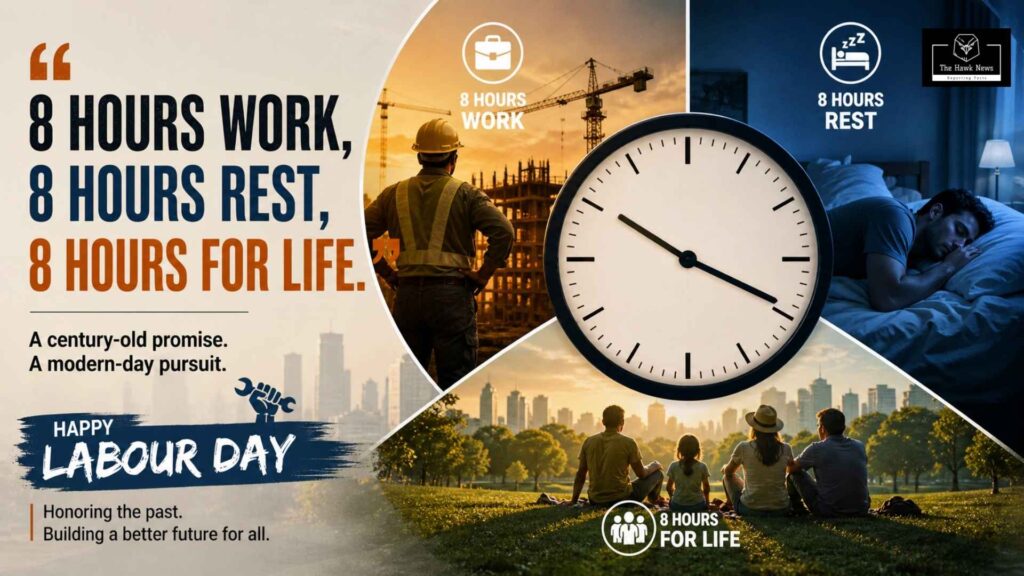
More than a century ago, workers across industries rallied behind a simple but powerful idea: “8 hours work, 8 hours rest, 8 hours for life.” It wasn’t just a slogan it was a demand for dignity. And despite all the technological progress and evolving workplaces, the message still feels surprisingly unfinished.
The Birth of a Balanced Day
In the late 19th century, factory workers often labored for 10, 12, even 16 hours a day under harsh conditions. There was little concept of “work-life balance” only survival.
The push for an 8-hour workday emerged as a radical idea, led by labor unions and reformers who believed that human beings deserved more than endless toil.
As one early labor activist famously put it, “We are not machines to be wound up and set in motion without pause.”
The idea was simple arithmetic but profound in its implications:
- 8 hours to work
- 8 hours to sleep
- 8 hours to live as a human being
This philosophy became a cornerstone of labor movements worldwide, eventually influencing laws and workplace norms in many countries.
Labour Day: More Than a Holiday
Labour Day is not just a day off it’s a reminder. It commemorates the struggles and sacrifices of workers who fought for basic rights we often take for granted today: fair wages, safe conditions, and reasonable hours.
Yet, in many ways, the spirit of Labour Day remains unfinished business.
While the 8-hour workday is standard in many sectors, the reality is more complicated. Overtime, gig work, and the “always-on” digital culture blur the boundaries between work and personal life. Emails don’t stop after office hours. Notifications follow us into our homes, our weekends, even our sleep.
As the saying goes, “Technology was meant to free us, not chain us in invisible ways.”
The Modern Workday: Progress or Illusion?
At first glance, it may seem like we’ve achieved the dream. Offices are more comfortable, remote work is possible, and automation has reduced physical labor in many industries.
But look closer.
A growing number of workers report burnout, stress, and lack of personal time. The lines between “work” and “life” are increasingly blurred. For many, the 8-8-8 model has quietly shifted into something more like:
- 9–10 hours of work (including commute or extended hours)
- 6–7 hours of sleep
- Whatever remains often fragmented for life
That’s not balance that’s compromise.
A recent cultural shift has even glorified overwork. Hustle culture tells us that success demands sacrifice long hours, constant productivity, and little rest. But at what cost?
As author and entrepreneur Tim Ferriss once noted, “Being busy is a form of laziness lazy thinking and indiscriminate action.”
Why “8 Hours for Life” Matters Most
The most overlooked part of the slogan isn’t work or rest it’s life.
What does “8 hours for life” actually mean?
It means time to connect with family, friends, and community.
It means space to grow through hobbies, learning, and reflection.
It means the freedom to simply exist without being productive.
In today’s fast-paced world, this part often gets squeezed out first.
We optimize our schedules, track our productivity, and measure our worth through output. But life doesn’t fit neatly into productivity charts.
As the philosopher Bertrand Russell once argued, “The time you enjoy wasting is not wasted time.”
The Global Reality
It’s also important to acknowledge that the 8-hour ideal is still far from reality for millions of workers worldwide.
In developing economies, including parts of India, many workers in informal sectors still face long hours, low wages, and minimal protections. Daily wage laborers, delivery workers, and gig economy participants often work far beyond eight hours just to make ends meet.
For them, the slogan isn’t history it’s an unfulfilled promise.
Labour Day, then, becomes not just a celebration, but a call to action.
Rethinking Work in the 21st Century
The conversation around work is evolving. Concepts like flexible hours, four-day workweeks, and remote work are gaining traction globally. Some companies are experimenting with shorter workweeks without reducing pay and seeing increased productivity and employee satisfaction.
This raises an important question: Was the 8-hour workday ever the final goal, or just a step toward something better?
As society changes, so should our understanding of work.
We now have tools and technology that previous generations couldn’t imagine. The challenge is not just to work more efficiently but to live more meaningfully.
A Personal Reflection
Pause for a moment and ask yourself:
- How many hours of your day truly belong to you?
- When was the last time you felt rested not just physically, but mentally?
- Are you living your “8 hours for life,” or just surviving your workday?
These aren’t easy questions but they’re necessary ones.
Because the original slogan wasn’t just about dividing time it was about reclaiming humanity.
The Takeaway
“8 hours work, 8 hours rest, 8 hours for life” is more than a relic of labor history. It’s a mirror reflecting how we choose to live today.
Labour Day reminds us that rights are rarely given they are fought for, protected, and reimagined over time.
In a world that constantly demands more more work, more speed, more output the real challenge might be learning to demand less, and value more.
More rest.
More presence.
More life.
Because at the end of the day, the question isn’t how many hours we worked but how well we lived them.
And perhaps that’s the most powerful message this century-old slogan still has to offer.