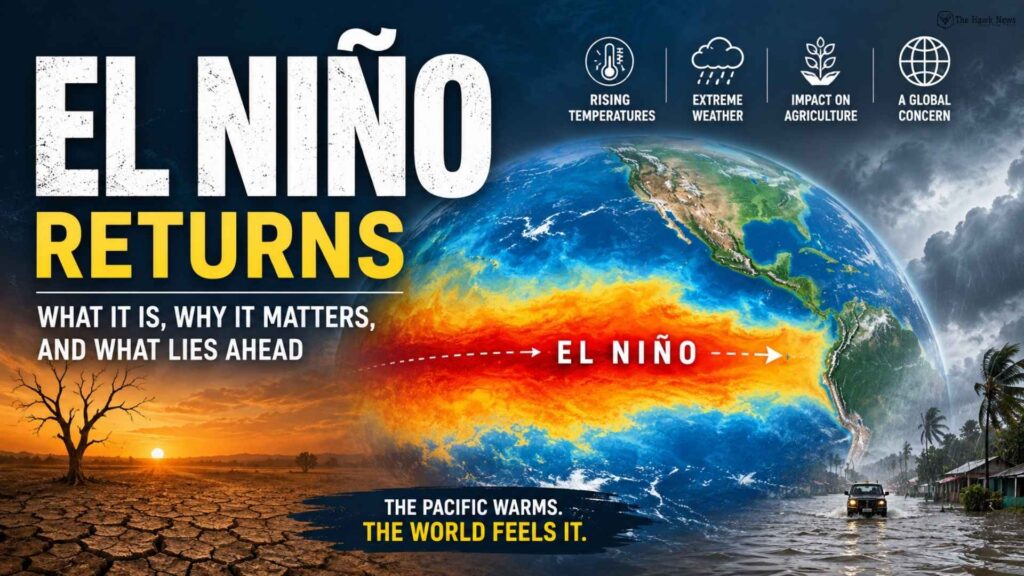
The Pacific Ocean is speaking once more.
Far from the crowded cities and fertile farmlands of the world, a vast stretch of ocean water is warming. To many, it may seem like a distant event occurring thousands of kilometers away. Yet history has shown that when El Niño awakens, its effects ripple across continents, influencing rainfall, agriculture, food prices, wildfires, and even political stability.
In recent weeks, climate scientists and meteorological agencies have been sounding a familiar alarm. El Niño has returned, and forecasts suggest it could strengthen significantly during the second half of 2026. The renewed attention has sparked headlines around the world and raised important questions about what lies ahead.
What Exactly Is El Niño?
El Niño is a natural climate phenomenon that occurs when surface waters in the central and eastern tropical Pacific Ocean become unusually warm.
Normally, trade winds push warm water westward toward Asia and Australia. During an El Niño event, these winds weaken. Warm water spreads eastward, disrupting weather patterns across the globe.
Scientists refer to this broader system as the El Niño-Southern Oscillation (ENSO), one of the most powerful climate drivers on Earth. It influences weather patterns from the Americas to Africa and from Australia to India.
Why Is There So Much Buzz Now?
The excitement and concern come from the strength of the forecasts.
The World Meteorological Organization reported in early June that there is roughly an 80% chance of El Niño conditions during the middle of 2026 and a very high probability that the event will continue through the end of the year. Many climate models suggest it could become moderate to strong.
Meanwhile, meteorological agencies in several countries have noted rapid warming in the Pacific Ocean. Some forecasts indicate that this event could rival some of the strongest El Niño episodes observed in recent decades.
As a result, governments, farmers, disaster-management agencies, and economists are watching closely.
Why Does El Niño Matter?
Because the weather affects everything.
A strong El Niño can alter rainfall patterns around the globe:
- Some regions experience severe drought.
- Others receive excessive rainfall and flooding.
- Agricultural production can suffer.
- Food prices may rise.
- Heatwaves often become more intense.
In previous El Niño years, parts of Africa endured droughts, sections of South America experienced flooding, and Australia faced extreme heat and bushfire risks.
The phenomenon does not create identical outcomes every time, but it often tilts the odds toward weather extremes.
What Could It Mean for India?
Whenever El Niño appears, Indians naturally think of one thing—the monsoon.
Historically, many El Niño years have been associated with weaker Indian summer monsoons. Less rainfall can affect agriculture, reservoirs, hydropower generation, and rural livelihoods.
However, modern climate research shows the relationship is more complex than once believed. Not every El Niño automatically causes drought in India. Other factors, including the Indian Ocean and regional atmospheric conditions, also play important roles.
Still, meteorologists pay close attention because even a modest reduction in monsoon rainfall can have significant economic consequences in a country where millions depend on agriculture.
The Climate Change Factor
What makes this year’s discussions especially significant is the backdrop of global warming.
El Niño is a natural event. Climate change is a human-driven trend.
When the two occur together, they can amplify one another.
Scientists warn that an El Niño developing in an already warming world may contribute to higher global temperatures, stronger heatwaves, increased wildfire risks, and greater stress on vulnerable ecosystems.
Think of it this way:
Climate change is raising the baseline temperature of the planet.
El Niño then adds another temporary boost on top of that baseline.
The result can be a year that feels exceptionally hot.
The Human Story Behind the Science
Weather maps and climate charts tell only part of the story.
For a farmer waiting for rain, El Niño is not a scientific term; it is a season of uncertainty.
For families living in drought-prone regions, it can mean crop failures and rising food costs.
For governments, it may mean preparing for floods in one region and water shortages in another.
This is why international organizations are urging countries to strengthen early warning systems and disaster preparedness plans before the strongest impacts arrive.
A Reminder From the Pacific
The recent buzz surrounding El Niño is a reminder of how interconnected our world has become.
A warming patch of ocean near the equator can influence harvests in India, rainfall in Africa, wildfires in Australia, and food prices in distant markets.
Nature often works quietly, beneath the surface, long before its effects become visible.
Today, scientists are watching the Pacific with growing attention. Whether this El Niño becomes moderate, strong, or even historic remains to be seen. But one thing is certain: the world is listening because experience has taught us that when the Pacific changes its rhythm, the entire planet feels the beat.
“The oceans may seem distant, but their whispers often become tomorrow’s headlines.”