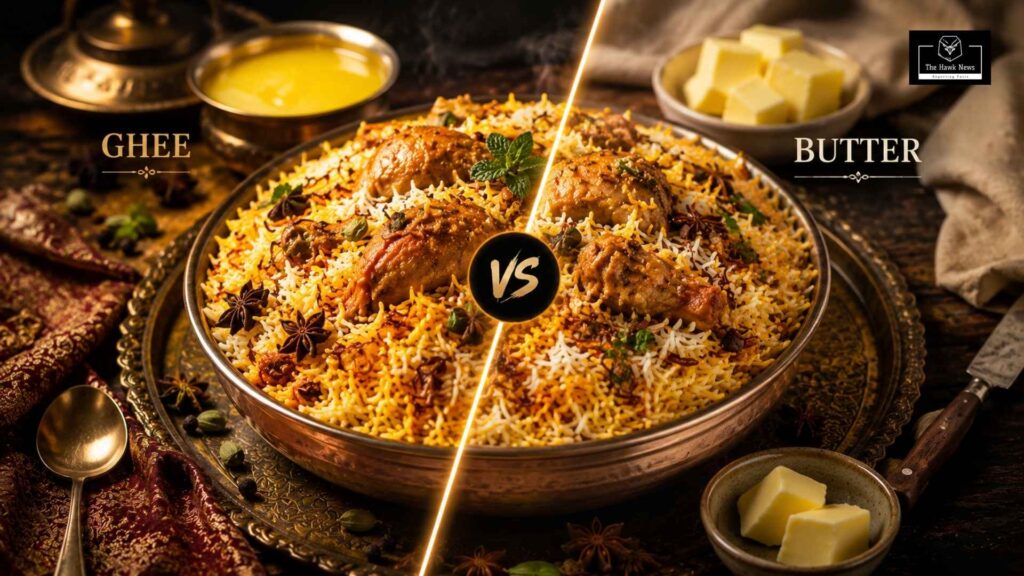
There is a reason biryani is spoken about with emotion rather than mere appetite. Long before the first bite touches the tongue, the aroma already begins its work.
The fragrance escapes slowly from the dum pot-saffron, fried onions, cardamom, cloves, mint, meat, smoke, all rising together like memory itself.
Every household has its own ritual around biryani. Some argue over the rice. Some over the masala. Some argue whether potatoes belong inside it at all.
But hidden beneath all those layers is a quieter debate that cooks have wrestled with for generations:
Should biryani be made with ghee or butter?
And strangely enough, this one ingredient changes almost everything.
The Royal Ingredient That Built Traditional Biryani
For centuries, Ghee has been tied to royal kitchens and celebratory cooking. Mughal feasts, Hyderabadi dum biryanis, Lucknowi kitchens all leaned heavily on ghee not simply for richness, but because it carried aroma in a way few other fats could.
Traditional cooks often say the quality of biryani can be judged before the lid is even opened.
Indian chef Sanjeev Kapoor once remarked:
“Good biryani begins with fragrance.”
And ghee creates precisely that.
The moment hot ghee touches whole spices, something changes in the kitchen atmosphere. Cinnamon releases warmth. Cardamom blooms. Cloves deepen. The air itself begins smelling fuller, richer, and somehow ceremonial.
This is one reason why ghee became inseparable from classic biryani traditions.
Not because it was fashionable.
Because it worked.
Butter Enters with a Different Personality
Butter, however, speaks a different culinary language.
Where ghee is bold and aromatic, butter is softer and creamier. It melts gently into food and rounds off sharper flavors. Western cuisine built entire traditions around butter because of the smoothness and comfort it brings to dishes.
Legendary chef Julia Child famously said:
“With enough butter, anything is good.”
And honestly, she was not wrong.
Butter can make biryani feel luxurious in a completely different way. The rice feels softer. The spice edges mellow slightly. The overall dish becomes silkier and gentler on the palate.
But biryani was never traditionally meant to be gentle.
It was meant to be layered, dramatic, and deeply aromatic.
That is where the science begins, separating the two.
The Science Hidden Beneath the Aroma
Biryani is an intense cooking process. There is onion frying, meat searing, spice blooming, layering, steaming, and slow dum cooking. Every stage places stress on the cooking fat.
Butter contains:
- Water
- Milk proteins
- Milk sugars
- Fat
Ghee, on the other hand, is mostly pure butterfat because the milk solids and water have already been removed during clarification.
This changes how each behaves under heat.
Butter begins burning relatively quickly because the milk solids carbonize. Once that happens, bitterness develops, and the flavor becomes slightly sharp and smoky in an unpleasant way.
Ghee survives far higher temperatures without breaking down.
Scientifically, that stability matters enormously in biryani because spices release their aromatic oils best when heated properly without scorching. Ghee allows those oils to bloom gradually and evenly.
In food chemistry, fat is often described as a “flavor carrier.” Aromatic compounds dissolve into fat and spread across the dish more efficiently.
And few fats carry spice aromas as beautifully as ghee.
Why Ghee Makes Biryani Smell So Addictive
Anyone who has walked past a biryani shop late in the evening knows this feeling.
The aroma reaches before the signboard does.
That signature fragrance largely comes from how ghee interacts with spices, onions, and saffron. When heated, ghee releases naturally nutty and toasted aromatic compounds that create depth in the dish.
The scent becomes warm rather than merely buttery.
Rich rather than simply creamy.
Turkish chef Nusret Gökçe once said:
“Flavor is memory.”
And perhaps that explains why the smell of biryani stays in people’s minds for years.
A truly good biryani is remembered by its fragrance first.
The Rice Tells the Truth
Every serious biryani lover notices the rice before anything else.
Are the grains separate?
Do they fall apart lightly?
Or does the rice clump together?
Perfect biryani rice should feel elegant and independent, with every grain carrying flavor while still standing on its own.
Ghee helps achieve this because pure fat coats the rice evenly without adding extra moisture.
Butter contains water, and during dum cooking, that additional moisture can slightly soften the rice structure. The difference may sound small, but in biryani, tiny details decide whether the final result feels refined or heavy.
Old biryani ustads understood this long before modern food science explained it.
Digestion, Heaviness, and the Human Body
Many people assume butter is easier on the stomach because its flavor feels softer, but surprisingly, some bodies digest ghee better.
Since most milk solids and lactose are removed from ghee, it can feel lighter for people sensitive to dairy proteins. Ghee also contains butyric acid, a compound often associated with digestive health.
Butter still contains lactose and milk proteins, which some stomachs struggle with during heavy meals.
But moderation matters more than either ingredient itself.
As an old Persian saying wisely puts it:
“Even honey becomes poison in excess.”
And biryani certainly teaches that lesson quickly.
Why Many Modern Chefs Quietly Use Both
Interestingly, many professional chefs no longer choose one side entirely.
Instead, they combine both fats strategically.
Ghee is used during cooking because it handles heat beautifully and builds aromatic depth. Butter is added at the very end in small amounts to introduce softness and creamy top notes.
One creates structure.
The other creates comfort.
This layering is why restaurant biryanis often feel richer and more rounded than homemade versions.
Cooking, after all, is rarely about extremes. It is about balance.
The Final Verdict
If the goal is authentic dum biryani with deep aroma, separated rice, strong spice character, and traditional richness, ghee remains unmatched.
Not simply because tradition says so.
Because the science supports it too.
Its chemistry aligns perfectly with the architecture of biryani cooking.
Butter still has its place, especially in fusion biryanis and modern creamy interpretations, but classic biryani belongs to ghee in the same way smoke belongs to charcoal and saffron belongs to celebration.
Perhaps that is why the aroma of a ghee biryani lingers long after the meal is over.
Butter comforts quietly.
Ghee leaves an impression.
And great biryani was always meant to leave one.