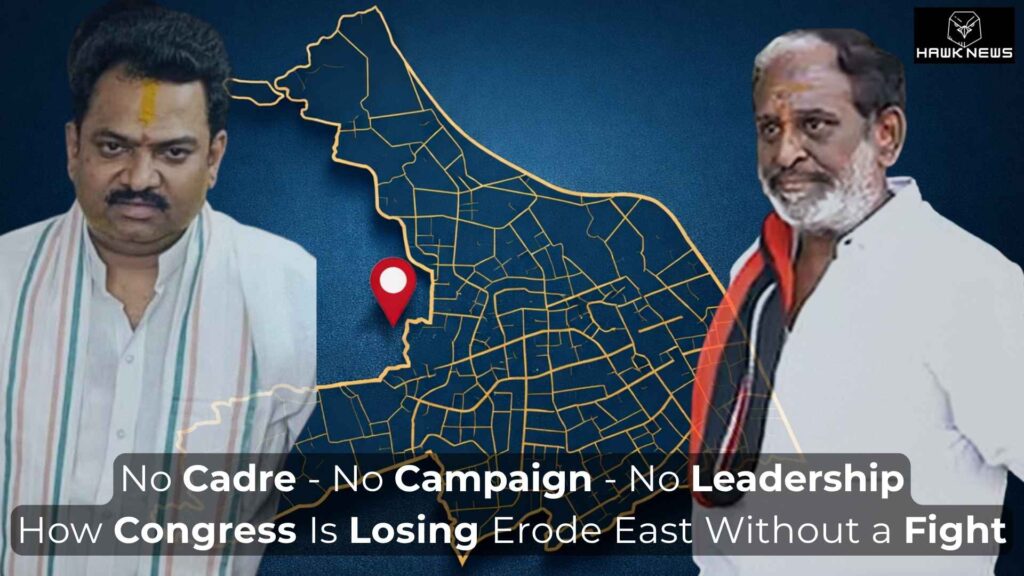
A Seat That Should Have Been Safe
Erode East is not a constituency where the DMK alliance struggles structurally. It has consistently shown alignment with the alliance when basic coordination exists on the ground.
The numbers have not turned hostile. What has changed is the presence, or rather the absence, of political work where it matters most.
Three Elections, Two Deaths, One Political Pattern
In 2021, Thirumagan Evera secured victory for Congress under the DMK alliance, benefiting from both alliance arithmetic and local familiarity. His win established a stable base in the constituency.
His sudden death in January 2023 triggered a by-election, where sympathy and structure combined to deliver a massive victory for his father, EVKS Elangovan.
Sympathy Sustained the Seat, Not Strategy
The second loss in December 2024, with the passing of EVKS Elangovan, again forced a by-election. This time, DMK fielded V C Chandhirakumar and retained the seat.
These consecutive wins did not happen by accident. They reflected a functioning alliance machinery that converted circumstances into electoral advantage.
Congress Fought for Control, But Lost Direction
During 2026 seat-sharing negotiations, Congress strongly pushed to reclaim Erode East. The party did not inherit the seat passively, it demanded and secured it.
However, securing the ticket was only the beginning. What followed has exposed a serious lack of preparedness and control.
Candidate Without Local Roots
The selection of Gopinath has created visible discomfort among local Congress workers. Being from Tiruppur, he lacks organic political roots within Erode East.
In constituencies driven by booth-level loyalty, this disconnect is not a minor issue. It directly affects mobilisation, trust, and worker participation.
Cadre Absence Is Now the Core Issue
Ground reports are not indicating mild dissatisfaction, but near-total inactivity. Local Congress cadre are either disengaged or operating without coordination.
Booth structures are weak, street-level presence is missing, and there is no visible campaign rhythm developing across the constituency.
Leadership Vacuum Deepens the Crisis
The absence of senior Congress leadership has amplified the problem. There is no consistent high-level push to energise or stabilise the campaign.
Even prominent leaders like P Chidambaram prioritised campaigning in Erode West, leaving Erode East without visible attention.
Two Neighbouring Seats, Two Contrasting Campaigns
Erode West presents a sharp contrast, where cadres are active and leadership presence is visible. Campaign energy exists, and coordination is evident.
Erode East, on the other hand, is experiencing a near-silent campaign. The difference is not in voters, but in political effort.
DMK Alliance Growing Increasingly Uneasy
Within the DMK alliance, frustration is becoming difficult to hide. This is not considered a difficult seat based on voter composition and past results.
The concern is not about losing a tough fight, but about losing a manageable contest due to internal lapses.
A Winnable Seat Being Neglected
From a strategic standpoint, Erode East should have remained comfortably within the alliance’s reach. The past three election outcomes support that assessment.
Yet, the current trajectory suggests that the seat is being weakened not by opposition strength, but by organisational failure.
Kongu Region Demands Ground Strength
Erode lies within the Kongu belt, where Congress traditionally lacks a deep independent structure. The party relies significantly on DMK’s organisational network here.
Without that coordination, Congress struggles to translate voter preference into actual votes, especially in tightly managed constituencies.
Alliance Exists, Coordination Does Not
An electoral alliance is only as strong as its ground execution. In Erode East, that execution is visibly fractured.
Congress is not mobilising effectively, and DMK’s support mechanisms are not fully activated to compensate for the gap.
Favourable Voter Base Still Exists
Despite the internal breakdown, the voter composition has not dramatically shifted. Minority voters, urban segments, and sections of traders still lean toward the alliance.
This means the seat is not lost at the voter level. It is being lost at the organisational level.
Votes Require Activation, Not Assumption
Elections are not won by historical preference alone. Voters need to be reached, convinced, and mobilised on polling day.
Without booth agents and local coordination, even a favourable electorate can remain passive or fragmented.
AIADMK Benefits Without Overexertion
In this environment, AIADMK does not need an aggressive surge. It only needs consistency while the ruling alliance underperforms.
The perception on the ground is shifting toward a simple conclusion, that the seat is becoming easier than expected.
From Contest to One-Sided Drift
A competitive election requires both sides to be present and active. In Erode East, one side is visibly missing from the ground.
This imbalance is slowly converting what should have been a contest into a one-sided drift.
Internal Friction Driving External Loss
Congress is facing internal friction at multiple levels, including candidate acceptance and local coordination. These issues are not being resolved quickly enough.
The longer this continues, the more it directly translates into electoral disadvantage in real time.
A Pattern of Missed Opportunities
This situation is not the result of a single failure. It reflects a pattern of missed campaign opportunities and delayed responses.
Each missed visit, each inactive booth, and each absent leader adds to the growing perception of neglect.
Misreading the Strength of Past Wins
There appears to be an assumption within Congress that past victories will carry forward automatically. That assumption is proving to be flawed.
Every election resets the ground reality, and without fresh effort, previous margins lose their relevance.
DMK’s Strategic Constraint
DMK faces a difficult position within the alliance. Intervening too strongly risks political friction, while inaction risks losing the seat.
So far, the approach appears cautious, but caution is not correcting the ongoing decline.
A Seat Slipping Without Resistance
There is no overwhelming anti-incumbency wave visible in the constituency. There is no dominant opposition surge reshaping voter sentiment.
What exists instead is a vacuum, and that vacuum is steadily altering the likely outcome.
A Loss That Will Be Self-Inflicted
If Erode East slips, it will not be attributed to voter rejection or ideological shift. It will be seen as a failure of coordination and execution.
The narrative will not question the electorate, but the leadership and organisational decisions behind the campaign.
Conclusion: Surrender Before the Fight
Erode East is not being forcefully taken away by a stronger opponent. It is being left exposed through inaction and internal disconnect.
No cadre, no campaign, no leadership. When all three collapse together, defeat is no longer a possibility, it becomes a predictable outcome.