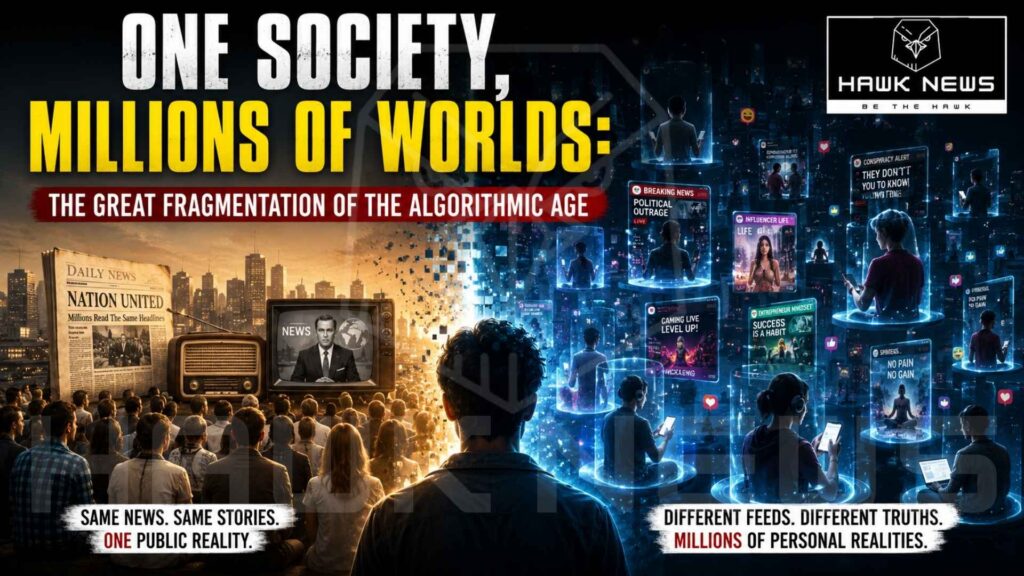
A century ago, societies consumed information together. Today, every citizen carries a personalized media universe shaped by algorithms. The result is a historic shift from a shared public reality to millions of separate informational worlds, a transformation that is reshaping politics, business, culture, and human relationships.
The Disappearance of the Common World
There was a time when societies lived inside a common informational universe.
People came from different economic backgrounds. They followed different religions, belonged to different communities, voted for different political parties, and held different opinions about the direction of their country. Yet despite these differences, they shared something that modern societies are rapidly losing: exposure to the same information.
A factory worker and a school teacher might read the same newspaper in the morning. A businessman and a farmer might listen to the same radio bulletin in the evening. Millions of families would sit in front of the same television news broadcast at night. The stories that entered public discussion were not individually selected for each person. They were broadly shared across society.
This did not create uniformity of opinion. People still argued fiercely. Political debates existed. Ideological battles existed. Cultural conflicts existed. However, those disagreements generally emerged from a common set of reference points. Citizens were often debating the meaning of the same events rather than operating from entirely different versions of reality.
For much of modern history, society functioned because people occupied the same informational landscape even when they stood on opposite sides of political or cultural questions. A nation was not simply a collection of individuals living within a geographical boundary. It was also a collection of people participating in many of the same conversations at the same time.
Today, that condition is rapidly disappearing.
The transformation has happened so gradually that many people have failed to notice its significance. Smartphones arrived. Social media platforms emerged. Streaming services replaced scheduled programming. Digital advertising became more sophisticated. Recommendation systems improved. Each innovation appeared to be a technological upgrade designed to make media consumption more convenient and more relevant.
Yet beneath these developments, something much larger was occurring. Society was quietly moving away from a shared public sphere and toward a system in which every individual increasingly experiences a customized version of reality.
The implications of this shift extend far beyond media. They affect politics, culture, business, relationships, education, social cohesion, and even the way citizens understand truth itself. The rise of algorithmic media is not simply changing what people watch. It is changing the conditions under which society forms collective understanding.
To appreciate the scale of this transformation, it is necessary to understand what media historically represented. Media was never merely a delivery mechanism for information. It was one of the primary tools through which societies created common awareness. Newspapers informed citizens about events beyond their immediate surroundings. Radio connected geographically dispersed populations through shared broadcasts. Television transformed national conversations by concentrating public attention on a limited number of stories and cultural experiences.
The power of these systems did not come solely from the information they carried. Their influence came from the fact that millions of people received that information simultaneously. Media institutions effectively acted as central gathering points for public attention. They helped create a common cultural vocabulary that allowed strangers to participate in the same conversations and understand the same references.
A citizen did not need to actively search for politics to encounter political news. A person who cared only about sports would still be exposed to major national developments. Someone interested primarily in entertainment would still encounter economic events, international conflicts, elections, scientific discoveries, and social debates. The structure of mass media ensured that individuals regularly crossed paths with information outside their immediate interests.
This accidental exposure played a crucial role in shaping modern societies. It broadened awareness, established common reference points, and prevented citizens from becoming entirely enclosed within their personal preferences. The newspaper reader did not receive a personalized front page. The television viewer did not receive a customized version of the evening bulletin. The same content reached large sections of society regardless of individual taste.
The result was the creation of what might be called a common world.
That common world was imperfect. Media institutions possessed biases. Governments exerted influence. Powerful interests often shaped narratives. Marginalized voices were frequently excluded. Yet despite its limitations, the mass media era maintained a shared informational environment that connected citizens across social and political divisions.
The twenty-first century has introduced a fundamentally different model.
For the first time in human history, information systems are no longer primarily organized around societies. They are organized around individuals.
The distinction may appear subtle, but its consequences are enormous. Traditional media asked a collective question: What should society know today? Modern algorithmic systems ask a personalized question: What is this specific individual most likely to engage with next?
Everything that follows emerges from that difference.
As algorithms increasingly determine what people see, hear, read, and discuss, the concept of a common informational world begins to weaken. The shared public square that once connected millions of citizens starts to fragment into countless personalized environments. Every click, every pause, every search, every interaction becomes a signal used to construct a unique media experience tailored to a single individual.
The consequence is not merely personalization.
The consequence is fragmentation.
And fragmentation may prove to be one of the defining social forces of the twenty-first century.
When Society Consumed Together
To understand the significance of today’s fragmented media landscape, it is necessary to revisit the structure of media before the arrival of digital platforms. The history of modern communication can be understood as a gradual expansion of reach combined with a relatively stable concentration of attention.
For centuries, information flowed through institutions that broadcast the same content to large groups of people. Whether the medium was print, radio, or television, the underlying principle remained remarkably consistent. Editors selected stories. Publishers determined priorities. Broadcasters created schedules. Audiences consumed what was made available.
The relationship between media institutions and citizens was therefore fundamentally collective. Media organizations did not attempt to create separate information environments for every individual. Their objective was to attract large audiences through common content. Success depended upon gathering attention, not dividing it.
This structure produced some of the most powerful cultural moments in modern history. National elections became shared experiences. Major sporting events became collective memories. Significant political speeches entered public consciousness simultaneously. Television series, newspaper investigations, and radio broadcasts frequently became topics of discussion across entire countries because vast numbers of people encountered them at roughly the same time.
Even individuals who were not particularly interested in current affairs often absorbed information simply because there were limited alternatives. A person opening a newspaper might begin with the sports section but still encounter headlines about foreign policy, economic developments, public health, or scientific discoveries. Exposure to information outside one’s interests was not unusual; it was built into the structure of the media system itself.
This created a society in which public attention moved somewhat together. Citizens did not necessarily agree with one another, but they were often responding to the same stimuli. A major event could dominate conversations across workplaces, schools, homes, and public spaces because media institutions concentrated collective attention on a relatively small number of stories.
The concept of a “national conversation” was possible because nations were, to a significant extent, consuming the same media.
The arrival of the internet began to weaken this model, but the initial stages of digital media did not immediately destroy it. Early websites largely mirrored traditional media structures. News portals, search engines, and online publications still distributed broadly similar content to large audiences. The true rupture would come later, when technological systems acquired the ability to personalize media experiences at an unprecedented scale.
That transformation would fundamentally alter the relationship between citizens, information, and society itself.
And unlike previous media revolutions, its consequences would extend far beyond journalism.
The Algorithm Replaces the Editor
For most of modern history, editors stood between information and society.
Newspaper editors decided which stories deserved front-page attention. Radio producers determined what would be discussed during a broadcast. Television executives chose which events warranted national coverage and which did not. These individuals possessed enormous influence because they acted as gatekeepers of public attention. Their decisions shaped what millions of people would encounter each day.
The rise of digital platforms did not eliminate this gatekeeping function. Instead, it transferred it from human beings to mathematical systems.
Many people assume that social media platforms merely host content created by others. In reality, their most important function is not publishing content but selecting content. Every second, recommendation systems evaluate countless pieces of information and determine what each user is most likely to engage with. The modern media experience is therefore not simply a collection of posts, videos, articles, and images. It is a continuous process of selection.
The crucial difference is that traditional editors produced one front page for society, whereas algorithms produce millions of front pages simultaneously. Every user receives a different sequence of information based on previous behaviour, interests, habits, interactions, and patterns of engagement. Two people opening the same application at the same moment may encounter entirely different versions of the world.
This shift represents one of the most consequential changes in the history of communication. The editor’s responsibility was once directed toward a public audience. The algorithm’s responsibility is directed toward an individual user. Traditional media attempted to answer the question, “What should the public know today?” Algorithmic media attempts to answer a very different question: “What will keep this specific person engaged for a little longer?”
That distinction may appear technical, but it fundamentally changes the purpose of media itself.
Under the old model, information moved from institutions to society. Under the new model, information is increasingly organized around individual behaviour. The system continuously studies users and adjusts itself accordingly. Every click becomes data. Every pause becomes data. Every share becomes data. Every like, comment, search, and watch time measurement becomes part of a growing profile used to predict future behaviour.
The result is a media environment that becomes increasingly personalized over time. The more an individual uses a platform, the more accurately the platform learns what captures that individual’s attention. Eventually, the feed begins to feel natural, relevant, and intuitive. Users often describe algorithmic recommendations as though platforms somehow understand them personally.
In many respects, that perception is accurate.
The algorithm does not know users as human beings, but it understands their behavioural patterns with remarkable precision. It identifies interests, emotional triggers, ideological preferences, entertainment habits, purchasing tendencies, and attention patterns. The objective is not necessarily to inform. The objective is to maximize engagement.
Once that objective becomes the organizing principle of media, profound social consequences begin to emerge.
How Personalization Became Reality Construction
Most discussions about algorithms focus on personalization as a convenience. People enjoy seeing content that aligns with their interests. A football fan prefers football content. A movie enthusiast prefers cinema discussions. A business owner prefers entrepreneurship-related information. Personalization appears harmless because it seems to improve relevance.
The deeper issue, however, is that personalization does not merely determine what people consume. It increasingly influences how they understand reality itself.
Human beings construct their understanding of the world through repeated exposure to information. Individuals cannot personally observe most political events, economic developments, international conflicts, scientific discoveries, or social changes. Instead, they rely on media systems to provide representations of those events. Media therefore acts as a bridge between personal experience and broader reality.
When media exposure becomes highly personalized, that bridge begins to change shape.
Consider two citizens living in the same city. One regularly engages with political content emphasizing corruption, government failures, crime, and institutional decline. Another primarily consumes content focused on economic growth, technological innovation, infrastructure development, and entrepreneurial success. Neither individual is necessarily receiving false information. Yet over time, each develops a fundamentally different perception of the society around them.
One sees decline.
The other sees progress.
One sees crisis.
The other sees opportunity.
Both perceptions emerge from selective exposure to reality.
Historically, citizens encountered a broader mix of information because media institutions distributed similar content to large audiences. Today, recommendation systems increasingly narrow exposure around demonstrated interests. Individuals receive more of what they engage with and less of what they ignore. As this process continues, informational environments become progressively specialized.
The consequence is that people are no longer merely consuming different content. They are constructing different realities from different streams of information.
This phenomenon helps explain many of the social tensions that characterize contemporary society. Increasingly, disagreements do not arise because individuals interpret the same facts differently. Disagreements arise because individuals encounter different facts in the first place. They are operating from different informational foundations.
A person immersed in political content may struggle to understand why others appear indifferent to major controversies. Someone deeply engaged with climate issues may be shocked by the lack of urgency displayed by others. Individuals immersed in cultural debates often assume those debates dominate public consciousness, only to discover that large portions of society are barely aware they exist.
The problem is not ignorance.
The problem is fragmentation.
Millions of people are paying attention, but they are paying attention to different things.
As a result, society increasingly resembles a collection of parallel realities rather than a single shared public sphere.
Why Human Psychology Encourages Fragmentation
Algorithms alone cannot explain this transformation.
If recommendation systems are successful, it is partly because they align with deeply rooted aspects of human psychology. The technology did not create these tendencies. It merely learned how to amplify them.
Human beings naturally gravitate toward information that confirms existing beliefs. Psychologists have long documented confirmation bias, the tendency to seek, interpret, and remember information in ways that reinforce prior assumptions. People generally prefer material that validates their worldview rather than challenges it.
This tendency becomes significantly more powerful within algorithmic environments.
When individuals engage with a particular type of content, platforms interpret that behaviour as a signal of preference. The system then responds by supplying similar material. The user engages further, generating additional signals that encourage even more recommendations. Over time, a feedback loop develops between human psychology and machine optimization.
The process often occurs without conscious awareness.
A person who watches a few videos on a political issue may eventually find their feed dominated by related content. Someone who develops an interest in a particular ideology may begin encountering an entire ecosystem of creators, commentators, communities, and narratives built around that ideology. A casual curiosity can gradually evolve into a comprehensive informational environment.
The psychological appeal of such environments is easy to understand. People enjoy familiarity. They enjoy certainty. They enjoy communities that affirm their identity and values. Information that confirms expectations often feels more trustworthy than information that challenges them.
As a result, algorithmic systems frequently guide users toward increasingly concentrated forms of content consumption. Individuals become surrounded by voices, arguments, and perspectives that resemble those they have previously engaged with.
The outcome is not necessarily radicalization in the traditional sense. More commonly, it is reinforcement. Existing beliefs become stronger. Existing interests become deeper. Existing identities become more central to the way people interpret events.
This process contributes to the formation of highly distinct informational worlds. Different groups develop different priorities, different concerns, different heroes, different villains, and different understandings of what matters most.
Over time, these differences accumulate. What begins as personalized content consumption gradually evolves into personalized social reality.
The Birth of Digital Tribes
Throughout history, human beings have organized themselves into communities. Families, villages, religious institutions, professional associations, and political organizations have all played important roles in shaping identity and belonging.
The digital age has not eliminated tribal behaviour. It has transformed it.
Algorithmic platforms possess an extraordinary ability to connect individuals who share similar interests, beliefs, frustrations, ambitions, and identities. Geography becomes less important. Physical proximity becomes less important. Shared informational environments become more important.
A person in Chennai may feel more connected to an online community in New York than to neighbours living on the same street. A teenager may spend more time interacting with people who share a specific interest than with individuals who share a physical environment. Political supporters increasingly gather inside digital ecosystems that reinforce collective narratives and strengthen group identity.
These communities provide belonging, validation, and meaning. Yet they also contribute to fragmentation.
As digital tribes become stronger, common cultural reference points become weaker. Different groups begin consuming different creators, following different news sources, using different language, and prioritizing different issues. They develop distinct interpretations of events and often struggle to understand why other groups see the world differently.
This dynamic creates a paradox.
Technology has connected humanity more extensively than ever before. Yet many societies appear increasingly divided. The reason is that connection and commonality are not the same thing. People may be connected through networks while simultaneously inhabiting entirely different informational realities.
The internet promised a global village. In many respects, it delivered millions of separate villages connected by the same infrastructure.
And those villages are becoming increasingly influential in shaping how citizens think, vote, purchase, organize, and understand the world around them.
Why Families Now Live in Different Worlds
One of the most overlooked consequences of algorithmic media is that fragmentation is no longer occurring only between political parties, social groups, or generations. It is increasingly occurring within families themselves.
For much of the twentieth century, households often consumed media collectively. Families gathered around the same radio broadcasts. They watched the same television programs. They discussed the same newspaper headlines. Even when disagreements emerged, those disagreements typically arose from a shared informational foundation. Members of the same household were exposed to many of the same events, stories, and cultural references.
Today’s media environment operates very differently.
The smartphone has transformed media consumption from a collective activity into an individual one. Every member of a household now carries a personalized media universe in their pocket. The father scrolling through political videos, the mother watching spiritual content, the son consuming gaming streams, and the daughter following lifestyle creators may all be spending hours online each day. Yet they are not necessarily participating in the same informational environment.
The result is a phenomenon that would have been difficult to imagine in earlier generations. Individuals living under the same roof can develop entirely different perceptions of society, politics, culture, and even reality itself.
This helps explain why conversations increasingly feel disconnected. Family members are often not merely disagreeing about issues. They are approaching those issues from fundamentally different informational starting points. One person may consider a particular political controversy to be the most important issue facing the nation, while another may barely know it exists. One individual may believe society is experiencing unprecedented decline, while another may believe society is progressing rapidly. Both conclusions may emerge from the information environments they inhabit.
The significance of this development extends beyond family relationships. Households have historically functioned as important mechanisms through which societies transmitted shared values, common knowledge, and cultural continuity. When members of the same family consume increasingly divergent streams of information, those traditional mechanisms begin to weaken.
A society does not become fragmented only when its political institutions divide. It also becomes fragmented when its households stop sharing the same informational experiences.
Culture After the Collapse of Shared Attention
The rise of algorithmic media has transformed not only how information is distributed but also how culture itself is created.
Mass media produced cultural moments that were experienced collectively. Television finales attracted enormous audiences. Sporting events became national conversations. Popular films, songs, and public figures often achieved widespread recognition because media exposure was relatively concentrated. Even people who did not actively seek out certain forms of entertainment were likely to encounter them through the broader media environment.
This concentration of attention helped create common cultural reference points. Citizens could discuss major events because large numbers of people had experienced them. Shared cultural experiences became part of social identity and national memory.
The algorithmic era operates according to a different logic.
Instead of concentrating attention, digital platforms distribute attention across countless niches. Content creators no longer need to appeal to entire societies. They can build large and influential audiences by serving highly specific communities. A creator can become enormously influential within a particular digital ecosystem while remaining completely unknown outside it.
This transformation has produced extraordinary opportunities for creativity and representation. Communities that were previously ignored by traditional media can now build their own audiences. Specialized interests can flourish. Diverse voices can reach millions without relying on conventional gatekeepers.
Yet these benefits come with a trade-off.
As cultural consumption becomes increasingly personalized, the number of shared experiences declines. Different groups consume different forms of entertainment, follow different public figures, and participate in different cultural conversations. The cultural centre becomes weaker while the cultural edges become stronger.
The result is not the disappearance of culture but its fragmentation into multiple parallel cultures operating simultaneously. Society still produces stars, movements, trends, and narratives. The difference is that those phenomena often remain confined within specific informational worlds rather than becoming truly universal experiences.
A generation ago, entire nations might have watched the same television program. Today, millions of people can spend hours consuming media without encountering any of the same content.
The age of mass culture is gradually giving way to the age of micro-cultures.
Politics After the Death of Mass Audiences
Few institutions have been transformed more dramatically by fragmentation than politics.
Political movements historically operated under the assumption that society could be reached through a relatively small number of communication channels. Newspapers, radio broadcasts, television interviews, campaign rallies, and public speeches allowed leaders to communicate with large sections of the population simultaneously.
Success often depended on winning the attention of the public sphere.
Today, the public sphere itself is increasingly fragmented.
Political leaders continue to hold rallies. They continue to appear on television. They continue to release advertisements and speeches. Yet the effectiveness of these strategies is no longer determined solely by the quality of the message. It is increasingly determined by whether that message successfully enters multiple algorithmic worlds.
This distinction is critical.
A political movement may dominate one digital ecosystem while remaining virtually invisible in another. Supporters often mistake visibility within their own informational environment for visibility across society. A leader who appears unavoidable within one feed may barely exist within another. A controversy that dominates one community may never reach another community at all.
This creates significant challenges for political strategy.
In the era of mass media, campaigns primarily competed for public attention. In the algorithmic era, campaigns compete for entry into countless separate informational environments. Reaching one audience does not guarantee access to another. Influencing one digital tribe does not necessarily influence others.
The implications extend beyond electoral politics.
Public consensus becomes more difficult to build when citizens encounter different information streams. National conversations become harder to sustain when attention is dispersed across thousands of competing realities. Political polarization becomes easier because groups increasingly consume information that reinforces existing perspectives while reducing exposure to alternative viewpoints.
The challenge facing modern political movements is therefore not merely persuasion. It is navigation.
They must learn how to operate across multiple informational worlds simultaneously without assuming that dominance in one world automatically translates into influence across society.
The political leaders who understand fragmentation will possess a significant advantage over those who continue to communicate as though mass audiences still exist.
Why Businesses Are Targeting Audiences That No Longer Exist
The consequences of fragmentation are not limited to politics. Businesses face a similar challenge, although many have yet to fully recognize it.
Traditional advertising emerged during the age of mass audiences. Companies purchased newspaper space, radio sponsorships, television commercials, and billboard placements because these channels offered access to large groups of people consuming similar media. Marketing strategy often revolved around maximizing reach within broadly defined demographic categories.
The underlying assumption was simple: reach enough people and a significant percentage will become customers.
That assumption becomes more complicated in a fragmented media environment.
The modern consumer does not inhabit a single media ecosystem. Instead, consumers move through highly personalized informational worlds shaped by interests, behaviours, identities, and algorithmic recommendations. Two individuals belonging to the same age group, income category, and geographic location may consume entirely different content and respond to entirely different forms of communication.
As a result, many businesses continue targeting audiences that effectively no longer exist.
A company may believe it is speaking to “young consumers,” “urban voters,” “middle-class families,” or “working professionals.” In reality, these categories often contain numerous distinct informational worlds with different cultural references, priorities, aspirations, and attention patterns.
A marketing campaign can therefore achieve enormous visibility within one segment while remaining invisible to others. A brand may dominate conversations on one platform yet struggle to gain recognition elsewhere. Businesses often interpret such outcomes as execution failures when they are actually distribution failures.
The issue is not necessarily the message.
The issue is whether the message entered enough worlds.
This shift requires a fundamental rethinking of communication strategy. Organizations can no longer assume that a successful campaign automatically reaches society at large. They must understand how different informational environments function and how messages travel within them.
The brands that succeed in the algorithmic age will not simply create compelling content. They will understand the architecture of fragmented attention.
The New Geography of Influence
For centuries, influence was largely shaped by physical geography.
Political leaders built support within territories. Businesses expanded into markets. Media organizations increased circulation within regions. Influence was measured according to location.
The digital age has introduced a new geography.
This geography is not organized around physical space but around attention.
People who share the same city may inhabit different informational worlds. Meanwhile, people separated by thousands of kilometres may occupy the same digital ecosystem. Communities increasingly form around interests, identities, and behavioural patterns rather than geographical proximity.
This shift has profound implications for anyone attempting to communicate with large audiences.
The question is no longer simply where people are located.
The more important question is where people are paying attention.
Understanding attention has become as important as understanding territory. A political movement seeking support, a business seeking customers, or a media organization seeking readers must identify not only demographic groups but also informational worlds. Each world possesses its own language, values, narratives, influencers, and patterns of engagement.
Influence in the algorithmic age therefore depends on the ability to travel between worlds.
Organizations that remain confined to a single informational ecosystem may appear dominant within that ecosystem while remaining largely irrelevant elsewhere. Those that successfully navigate multiple worlds gain access to a much broader range of citizens, consumers, and communities.
The future of communication belongs not to those who shout the loudest within one world, but to those who understand how to move between many worlds without losing the coherence of their message.
The New Media Map
The history of modern media can be understood as a story of attention.
For more than a century, communication systems were designed to gather attention into common spaces. Newspapers concentrated public discussion around a limited number of stories. Radio brought millions of listeners into the same broadcasts. Television further intensified this concentration by creating national audiences that often watched the same content at the same time.
The internet initially appeared to extend this model. Information became more accessible, distribution became cheaper, and audiences gained unprecedented freedom to choose what they consumed. Many observers believed digital technology would create a more informed and connected society because information would no longer be controlled by a small number of institutions.
What emerged instead was something far more complex.
The internet did not merely decentralize media. It personalized media. The rise of recommendation systems shifted the focus from distributing information to populations toward distributing information to individuals. Rather than asking how society consumes information, platforms increasingly asked how each person consumes information.
This distinction fundamentally altered the structure of public attention.
Under mass media, citizens often travelled through similar informational pathways. Under algorithmic media, every citizen travels through a different pathway. The destination is no longer a common public sphere but a personalized media environment shaped by behaviour, preferences, and engagement patterns.
The result is that modern society increasingly resembles a network of overlapping informational worlds rather than a single shared reality. These worlds interact with one another, compete with one another, and occasionally collide with one another, but they are not identical. They operate according to different priorities and expose their inhabitants to different interpretations of events.
To understand this transformation more clearly, it is useful to compare the logic of mass media with the logic of algorithmic media.
The Evolution of Public Attention
Mass Media Era
Algorithmic Media Era
One newspaper for millions
Millions of personalized feeds
Shared front page
Personalized front page
Collective consumption
Individual consumption
Common cultural moments
Fragmented cultural moments
Broad exposure to multiple topics
Deep exposure to selected topics
Editor decides priorities
Algorithm decides priorities
National conversations
Parallel conversations
Audience as a public
Audience as individuals
Reach determines influence
Distribution across worlds determines influence
Shared reality
Personalized reality
The table highlights a critical shift. The transformation is not simply technological. It is structural. The way society organizes attention has changed, and attention is one of the foundational resources through which culture, politics, and public understanding are formed.
From Information Economy to Attention Economy
Many discussions about modern media focus on information overload. While information abundance is certainly a defining feature of the digital age, the more important issue may be attention scarcity.
Citizens today have access to more information than any previous generation in history. News, entertainment, education, commentary, and analysis are available at virtually any moment. The challenge is no longer obtaining information. The challenge is deciding what deserves attention.
Algorithms emerged as a solution to this problem. Faced with overwhelming quantities of content, platforms developed systems capable of filtering, ranking, and recommending information. These systems became the primary navigational tools of the digital age.
However, once algorithms became responsible for directing attention, they acquired enormous cultural power.
The content that succeeds within an algorithmic environment is often the content that generates engagement. This does not necessarily mean the content is false, sensational, or harmful. It simply means that visibility increasingly depends upon a platform’s ability to predict what users are likely to interact with.
Consequently, attention becomes the most valuable currency in the modern media ecosystem.
Businesses compete for it.
Politicians compete for it.
Creators compete for it.
Activists compete for it.
Media organizations compete for it.
The competition for attention shapes not only what becomes visible but also what remains invisible. Entire issues, communities, and perspectives can disappear from a person’s informational world simply because they fail to trigger the signals that algorithms prioritize.
This creates a media environment in which visibility and reality become increasingly intertwined. People often assume that what appears repeatedly in their feed reflects what matters most in society. Yet in a fragmented system, visibility may reveal more about a user’s behavioural profile than about society itself.
The distinction is subtle but important.
A person may feel highly informed while possessing a remarkably narrow view of the broader informational landscape.
How Society Reorganized Itself Around Algorithms
When historians look back on the early twenty-first century, they may not describe the period primarily as the age of smartphones or social media. They may describe it as the period during which societies reorganized themselves around algorithmic systems.
Algorithms now influence what citizens read, watch, purchase, discuss, and share. They shape cultural trends, political narratives, consumer behaviour, and public attention. Their influence extends far beyond technology companies because they increasingly mediate the relationship between individuals and information.
Yet algorithms are not independent actors imposing reality upon society. They operate through interaction with human behaviour. Every recommendation emerges from a relationship between machine prediction and human preference.
This relationship creates a powerful cycle.
People engage with content that reflects their interests.
Algorithms learn from that engagement.
The systems recommend more of that content.
Users engage further.
The cycle repeats.
Over time, informational environments become increasingly specialized and increasingly personalized.
The significance of this process lies in its cumulative effect. Each individual decision appears insignificant. One click does not transform society. One video recommendation does not transform society. One personalized advertisement does not transform society.
However, billions of such interactions occurring every day gradually reshape the architecture of public attention.
The result is not a society that knows less.
In many respects, society knows more than ever before.
The result is a society that knows different things.
Different citizens develop expertise in different domains. Different groups prioritize different concerns. Different communities construct different narratives about the same events. The challenge is not the absence of information but the absence of common informational ground.
The more fragmented informational environments become, the more difficult it becomes for societies to maintain shared understanding.
The Strategic Challenge for the Next Generation
The implications of fragmentation extend beyond media studies. They will increasingly shape the future of politics, governance, business, education, and social cohesion.
Political leaders can no longer assume that visibility in one media ecosystem translates into visibility across society. Businesses can no longer assume that a successful campaign automatically reaches all potential consumers. Educational institutions can no longer assume that students arrive with similar informational backgrounds. Journalists can no longer assume that major stories enter public consciousness simply because they are important.
Every institution now faces the same challenge.
How do you communicate with a society that no longer consumes information collectively?
This question may become one of the defining strategic problems of the twenty-first century.
Organizations must learn to identify multiple informational worlds and understand how those worlds function. They must recognize that audiences are increasingly fragmented, not merely by demographics but by attention patterns. They must learn how to communicate across different realities without abandoning the coherence of their message.
The winners of the algorithmic age may not be those with the largest budgets, the most sophisticated technology, or even the strongest messages.
They may be those who best understand fragmentation itself.
Conclusion: One Society, Millions of Worlds
The defining media institutions of the twentieth century were built around a simple idea: gather people together.
Newspapers gathered readers around common headlines. Radio gathered listeners around common broadcasts. Television gathered viewers around common programs. These systems helped create shared experiences, shared conversations, and shared reference points. They contributed to the formation of what might be called a common world, an environment in which citizens encountered many of the same events and participated in many of the same discussions.
The twenty-first century has introduced a different model.
Instead of gathering attention, modern media increasingly distributes attention. Instead of exposing citizens to similar informational environments, it constructs personalized environments tailored to individual behaviour. Instead of producing one version of the public sphere, it produces millions of parallel informational worlds.
This transformation has generated extraordinary benefits. Individuals enjoy greater choice, greater access to information, and greater opportunities to find communities aligned with their interests and identities. Voices that once struggled to reach audiences can now build influence independently. Knowledge is more accessible than at any previous point in human history.
Yet these gains come alongside a profound social challenge.
As personalization expands, commonality contracts.
As informational worlds become more specialized, shared experiences become less frequent.
As citizens spend more time inside algorithmically curated environments, the foundations of collective understanding become more fragile.
The consequence is not necessarily division, polarization, or conflict, although all three can emerge from fragmentation. The deeper consequence is that society increasingly loses the common reference points that once allowed citizens to understand one another.
A neighbour may inhabit a different informational world.
A colleague may inhabit a different informational world.
A family member may inhabit a different informational world.
A voter may inhabit a different informational world.
A customer may inhabit a different informational world.
The physical distance between these individuals may be negligible. The informational distance between them may be enormous.
This reality presents a challenge for every institution that seeks to influence public life. Political movements must learn how to enter multiple worlds rather than dominate only one. Businesses must understand that audiences are no longer unified markets but collections of distinct informational ecosystems. Media organizations must recognize that publishing information is no longer enough; they must understand how information travels through fragmented networks of attention.
The central question of the algorithmic age is therefore not whether information is available. Information has never been more abundant.
The central question is whether societies can preserve enough common ground to remain societies at all.
For most of modern history, citizens lived within a shared informational universe. Today, they increasingly inhabit personalized realities constructed through countless interactions between human behaviour and machine prediction.
We still live in the same cities.
We still vote in the same elections.
We still share the same economies.
We still occupy the same nations.
Yet with every passing year, it becomes harder to claim that we inhabit the same informational world.
Perhaps that is the defining paradox of our age.
Never before have human beings been so connected.
And never before have so many people lived in such different worlds.