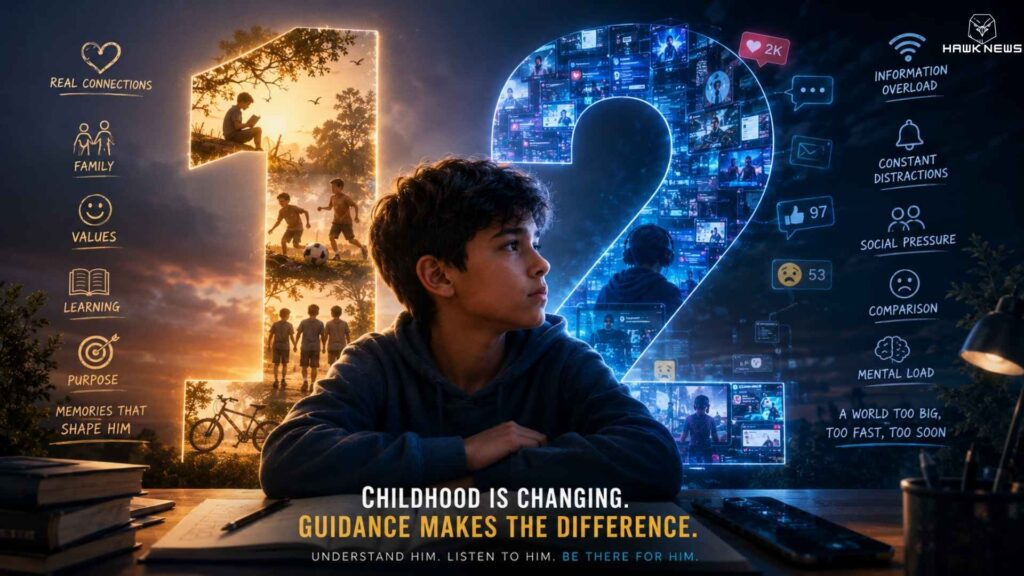
Understanding Gen Alpha, Digital Childhood, and the Quiet Shift Happening Inside Modern Boys
“Every generation grows up in a different world.
Gen Alpha is growing up in several worlds at once.”
There was a time when turning twelve meant standing at the edge of adolescence slowly and naturally. Childhood stretched longer then. The world arrived in pieces through school corridors, neighborhood friendships, family conversations, and lived experience.
Today, the world arrives all at once.
A boy turning twelve in the age of Generation Alpha is growing up in an environment that no previous generation has experienced before. Information no longer waits for maturity. Culture no longer arrives gradually.
The internet has compressed discovery, entertainment, trends, humor, influence, and social exposure into something immediate and constant.
And while many parents recognize that “times have changed,” few fully understand how deeply this new environment shapes the emotional and psychological development of modern children.
This does not mean childhood has disappeared.
But it does mean childhood has changed.
Childhood Is Becoming More Digitally Shaped
“Children once explored the world step by step.
Now the world enters their minds all at once.”
Modern children are not necessarily becoming adults faster emotionally. What is happening instead is that they are being exposed to the adult world earlier than previous generations were.
A twelve-year-old today may still enjoy games, cartoons, silly humor, and playful moments. At the same time, he may also understand internet slang, online trends, viral culture, influencer behavior, sarcasm layered with irony, and social dynamics that older generations typically encountered much later in life.
Psychologists often describe this as a developmental imbalance: exposure begins accelerating before emotional maturity fully catches up.
The internet does not separate the child’s world from the adult world very effectively. Social media feeds, gaming communities, short-form videos, and algorithm-driven platforms expose children to enormous amounts of information long before they possess the emotional tools to interpret everything wisely.
For many boys, this creates an unusual mixture of innocence and awareness existing at the same time.
The Digital Environment Is Reshaping Attention and Emotional Habits
“The modern child is not growing up in silence.
He is growing up in constant stimulation.”
One of the biggest differences between Gen Alpha and earlier generations is not intelligence — it is stimulation.
Modern children grow up surrounded by:
- rapid scrolling,
- short-form videos,
- instant entertainment,
- constant notifications,
- personalized algorithms,
- and endless streams of content competing for attention.
Researchers studying child development and screen exposure have increasingly observed links between heavy digital stimulation and difficulties involving concentration, emotional regulation, patience, and sustained attention in some young users.
This does not mean technology is inherently harmful. Digital platforms also provide creativity, learning opportunities, connection, and access to knowledge that earlier generations never had.
But the pace of stimulation matters.
Many modern children rarely experience long periods of silence, boredom, or uninterrupted thinking. Yet psychologists consistently note that boredom itself plays an important role in imagination, emotional processing, creativity, and independent thought.
A twelve-year-old today may appear restless, not because he lacks discipline, but because his brain has adapted to environments where stimulation rarely stops.
Why Many Modern Boys Seem Older Than They Actually Are
“Exposure can make a child sound older.
It does not automatically make him emotionally older.”
Parents often notice something unusual around this age.
Their son may suddenly:
- speak with surprising awareness,
- understand complex jokes,
- reference internet culture effortlessly,
- or discuss topics that seem older than his years.
At first glance, it can feel as though children are maturing faster than before.
But psychologists make an important distinction:
Awareness is not the same as emotional maturity.
A boy may understand trends, humor, online behavior, or social dynamics while still struggling with:
- emotional regulation,
- insecurity,
- identity,
- self-control,
- or confusion about himself.
This is one of the defining characteristics of modern adolescence.
Children today often gain social awareness earlier, while emotional development still unfolds at its natural human pace.
That gap can sometimes create misunderstandings between parents and children. Adults may assume:
“He already understands everything.”
But exposure alone does not automatically create wisdom, stability, or emotional readiness.
The Quiet Pressure Modern Boys Experience
“The internet rarely tells children who to become directly.
It quietly teaches them what gets rewarded.”
Unlike previous generations, Gen Alpha children are growing up inside highly visible social environments.
Even children who are not obsessed with popularity still absorb subtle social signals constantly:
- what is trending,
- what gets attention,
- what people laugh at,
- what earns approval,
- what becomes viral,
- and what gets ignored.
For many boys, the pressure is not necessarily about wanting fame or validation in obvious ways. Often it is more subtle than that.
They begin learning, very early, that online spaces reward performance:
being funny,
being confident,
being entertaining,
being emotionally unaffected,
or appearing socially aware.
This is one reason many modern boys communicate through humor, memes, sarcasm, or irony. Internet culture often teaches children to soften vulnerability with comedy.
As a result, parents may sometimes mistake emotional masking for emotional maturity.
But underneath the humor, many children are still trying to understand themselves.
The Emotional World of a 12-Year-Old Boy Has Become More Complicated
“A modern child carries more voices in his head than any generation before him.”
Adolescence has always involved confusion, insecurity, and identity formation. That part is not new.
What is new is the sheer amount of psychological input children now absorb while going through it.
A twelve-year-old today is navigating:
- school expectations,
- friendship dynamics,
- online culture,
- rapidly changing trends,
- digital entertainment,
- and constant comparison environments
all at the same time.
And because much of this happens privately through screens, many parents never fully see the emotional weight children carry internally.
Some boys become quieter.
Some become more distracted.
Some retreat into gaming or online humor.
Others appear emotionally detached while still deeply affected underneath.
This does not mean something is “wrong” with this generation.
It means the environment surrounding childhood has become more mentally crowded than ever before.
What Gen Alpha Boys Need Most Is Not Panic, but Grounding
“Children do not need perfect parents for the digital age.
They need emotionally present ones.”
Modern parenting discussions often swing between two extremes:
complete fear of technology or complete surrender to it.
Neither approach fully helps children.
Research consistently suggests that children benefit most from balance:
- healthy structure,
- emotional safety,
- real-world interaction,
- physical activity,
- meaningful conversation,
- boundaries around digital consumption,
- and adults who remain emotionally approachable.
One of the greatest protective factors for children is a strong human connection.
Not surveillance.
Not constant lectures.
Not humiliation.
But presence.
Children are far more likely to navigate the digital world safely when they feel they can speak honestly without fear of immediate judgment.
The Real Challenge for Parents Today
“The greatest distance between parent and child today is not physical.
It is digital and psychological.”
Perhaps the greatest challenge is not simply protecting children from the internet.
It is staying connected to children while they grow in a world that parents themselves did not experience at that age.
Many boys stop communicating openly, not because they dislike their parents, but because they assume adults will not understand the world they inhabit online.
That emotional gap matters.
The most effective modern parents are rarely the ones who know every trend or control every screen perfectly. They are often the ones who remain emotionally reachable while still providing stability and guidance.
Because even in the digital age, children still look for something timeless:
a safe place to grow without feeling lost.
Final Thought
“Previous generations worried children would grow up too slowly.
Modern parents quietly wonder if childhood itself is moving too fast.”
Turning twelve has always marked the beginning of change.
But for Generation Alpha, that transition now unfolds inside a world of algorithms, constant stimulation, rapid exposure, and endless information.
The modern twelve-year-old boy is no less human than previous generations.
He is simply growing up under conditions humanity has never experienced before.
And perhaps that is why understanding him matters more now than ever.