Introduction
Few issues have shaped Tamil Nadu’s political history as repeatedly as liquor policy.
For nearly a century, successive governments have promised prohibition, lifted prohibition, reintroduced restrictions, expanded liquor sales, tightened controls and reinvented the system again and again. Every major political era in Tamil Nadu has left its mark on alcohol policy.
The result is a fascinating political story stretching from the pre-Independence period to the present day. It is a story where morality, public health, revenue generation, elections and political power have continuously collided.
1937: The Beginning of Prohibition
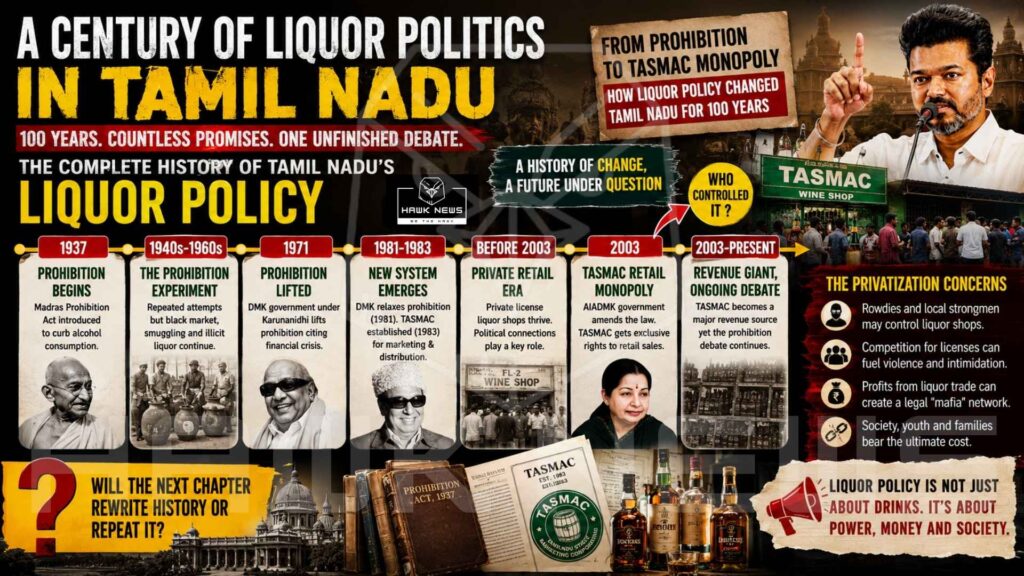
Tamil Nadu’s liquor policy traces its roots to the Madras Prohibition Act of 1937, later renamed the Tamil Nadu Prohibition Act.
The legislation emerged from the prohibition movement supported by leaders influenced by Mahatma Gandhi’s belief that alcohol was harmful to families and society. The law aimed to restrict the manufacture, sale and consumption of liquor across the province. The legal foundation created in 1937 continues to influence Tamil Nadu’s liquor administration even today.
At that stage, the political objective was clear. The state wanted to reduce alcohol consumption rather than generate revenue from it.
Independence and the Prohibition Experiment
After Independence, Tamil Nadu continued to experiment with prohibition.
However, governments quickly encountered a recurring problem that would reappear throughout the next century. While prohibition reduced legal sales, it frequently encouraged illegal production and black-market distribution.
Several periods of strict prohibition were accompanied by reports of illicit liquor production, smuggling and tragic incidents involving toxic alcohol consumption. These unintended consequences repeatedly forced governments to reconsider their approach.
The conflict between public health goals and practical enforcement became a defining feature of Tamil Nadu’s liquor politics.
1971: Karunanidhi Lifts Prohibition
One of the most significant turning points came in 1971.
The DMK government under M. Karunanidhi lifted prohibition, arguing that the state faced serious financial pressures and required additional sources of revenue. Karunanidhi himself later defended the decision by stating that financial realities forced the government to act.
This decision transformed liquor from a moral debate into a major fiscal issue.
From this point onward, every government had to balance revenue needs against demands for prohibition.
The Return of Restrictions
Tamil Nadu’s liquor policy did not follow a straight line.
After prohibition was lifted, various governments alternated between restrictions and relaxations. Different administrations attempted different formulas, often influenced by changing political circumstances and public pressure.
The state repeatedly moved between competing goals: reducing alcohol consumption and protecting government revenue.
MGR Changes the System
When M.G. Ramachandran came to power, Tamil Nadu entered another important phase.
In 1981, prohibition was relaxed. In 1983, the government created two state corporations. One handled manufacturing-related functions, while the other became responsible for liquor marketing and distribution.
The marketing corporation became known as TASMAC, the Tamil Nadu State Marketing Corporation.
This marked the beginning of the state’s direct involvement in the liquor trade on a large scale.
The Era of Private Retail Liquor Shops
Although TASMAC controlled wholesale operations, retail liquor sales were still largely handled through private operators.
This period is often remembered as the era when private licenses carried enormous value. Retail liquor shops operated under government-issued licenses and became significant commercial assets.
Political observers from that era frequently point out that access to licenses, permissions and renewals often depended on influence, relationships and local power structures.
Whether every such allegation was true or not, the perception became widespread that liquor retailing had become closely linked with political influence.
Jayalalithaa and the TASMAC Monopoly
The biggest transformation occurred in 2003.
The Tamil Nadu government amended the Prohibition Act and granted TASMAC exclusive rights over retail liquor sales. Private retail vending effectively ended and the government assumed direct control over the sale of Indian Made Foreign Liquor throughout the state.
This decision fundamentally changed the liquor economy.
For the first time, the government became the dominant retailer rather than merely the regulator.
The old private-license system largely disappeared and a state monopoly emerged.
TASMAC Becomes a Revenue Giant
Following the retail takeover, TASMAC grew into one of Tamil Nadu’s largest revenue-generating institutions.
Annual turnover increased dramatically over the following years. What began as a regulatory mechanism gradually evolved into one of the state’s most important sources of income.
This created a new political dilemma.
The same governments that spoke about prohibition and reducing alcohol consumption were also becoming increasingly dependent on revenue generated through liquor sales.
The Politics of Prohibition Returns
Despite the growth of TASMAC, demands for prohibition never disappeared.
Every major political party has, at different times, promised liquor restrictions, shop closures or phased prohibition. Public protests, anti-liquor campaigns and social movements have repeatedly challenged the expansion of alcohol sales.
The issue remains emotionally powerful because it affects families, health, law and order and local communities.
The Privatization Debate
Today, discussions occasionally emerge regarding the future structure of Tamil Nadu’s liquor market.
Supporters of privatization generally argue that government should regulate liquor rather than directly sell it. They claim competition can improve efficiency and reduce bureaucratic control.
Critics raise a different set of concerns.
According to opponents of privatization, returning to a private-license model could recreate many of the problems associated with politically connected liquor networks. They argue that powerful local operators may attempt to dominate licenses, influence enforcement mechanisms and build economic influence around liquor retailing.
Some critics also fear that aggressive competition for licenses could encourage the growth of local strongmen and criminal networks seeking control over profitable liquor markets. These concerns are widely debated in political discussions, although they remain arguments rather than established outcomes. Historical evidence shows that outcomes depend heavily on how regulation is designed and enforced.
The Larger Question
A century after the first prohibition law, Tamil Nadu still finds itself debating the same fundamental question.
Should alcohol be banned, privately sold or controlled by the government?
Successive governments have offered different answers, yet none has completely resolved the conflict between public health, social welfare, personal freedom and state revenue.
The story of Tamil Nadu’s liquor policy is therefore much larger than TASMAC. It is a story about how governments struggle to balance morality, economics and political reality.
Nearly one hundred years after the Prohibition Act of 1937, that debate remains as alive as ever.