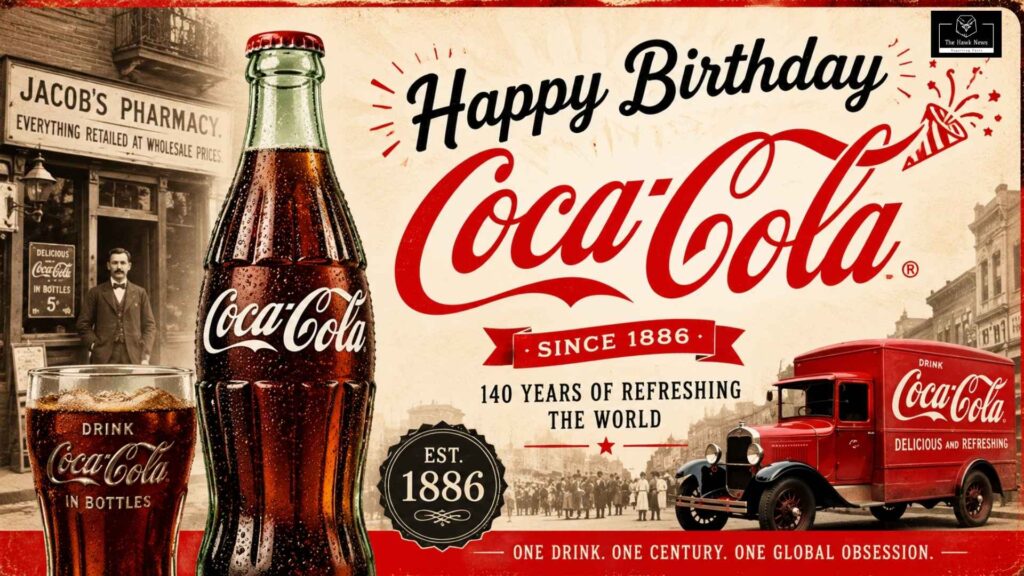
On May 8, 1886, inside a small pharmacy in Atlanta, a drink was poured into a glass for the very first time. No one in that room could have imagined that the dark, fizzy liquid would one day travel farther than kings, flags, and empires.
Yet that is exactly what happened…
That drink was Coca-Cola!!!
Created by pharmacist John Stith Pemberton and first sold at Jacob’s Pharmacy, Coca-Cola began not as a symbol of pop culture, but as a medicinal tonic.
It was marketed as a remedy for headaches, fatigue, and nervous exhaustion, ailments common in an America still recovering from war and industrial strain.
In its earliest days, Coca-Cola reportedly sold only about nine glasses a day.
Nine!
Today, that number feels almost poetic considering the scale the brand would eventually reach. What began as a pharmacy experiment became one of the most recognized products in human history.
In some corners of the world, the red-and-white Coca-Cola logo is said to be more familiar than certain national symbols.
But Coca-Cola’s story is not merely about soda. It is about advertising, memory, globalization, identity, and the extraordinary power of branding.
The rise of Coca-Cola mirrors the rise of modern consumer culture itself.
In the late nineteenth century, America was changing rapidly. Cities were growing. Factories were expanding. Railroads were connecting regions. Mass production was transforming everyday life.
Coca-Cola entered the world at exactly the right moment, when products were no longer just products, but experiences waiting to be sold emotionally.
That became the genius of Coca-Cola.
It did not simply sell taste.
It sold feeling.
Over the decades, Coca-Cola advertisements rarely focused only on ingredients or flavor. Instead, they sold happiness, togetherness, youth, celebration, family, friendship, summer afternoons, Christmas nostalgia, and the idea of belonging itself.
The drink became deeply woven into emotional memory.
A chilled glass bottle after a long day.
Cinema halls glowing with red signage.
Roadside diners.
Festival celebrations.
Cricket matches.
Family gatherings.
Songs, posters, and jingles that lingered across generations.
Few brands have embedded themselves into daily life with such persistence.
Even globally, Coca-Cola adapted itself with remarkable intelligence. While remaining unmistakably American in origin, it learned how to enter local cultures without completely erasing them.
In countries across Asia, Africa, Latin America, and Europe, Coca-Cola often positioned itself not as foreign, but familiar.
That balance helped build one of the most powerful commercial identities the world has ever seen.
Advertising experts still study Coca-Cola campaigns as masterclasses in emotional marketing.
Its slogans became part of the cultural vocabulary.
“Open Happiness.”
“Taste the Feeling.”
“It’s the Real Thing.”
Simple phrases. Yet enormously effective.
Perhaps one of Coca-Cola’s most culturally influential contributions was its relationship with modern Christmas imagery. While Santa Claus existed long before the company, Coca-Cola’s advertisements in the twentieth century helped popularize the warm, cheerful, red-suited version of Santa recognized today across much of the world.
The company did not invent Santa. But it undeniably helped shape the global image of him.
That is the scale of Coca-Cola’s cultural influence.
Few corporations have affected visual culture, advertising psychology, and public memory in the same way.
Even artist Andy Warhol once reflected on Coca-Cola’s strange universality. He famously remarked:
“A Coke is a Coke and no amount of money can get you a better Coke.”
The quote captured something deeper than consumerism. Coca-Cola represented one of the rare products consumed by presidents, celebrities, workers, students, and ordinary families alike.
For decades, the brand has also become intertwined with American soft power. During the twentieth century, Coca-Cola expanded alongside the global influence of the United States itself.
Soldiers carried it overseas during wars. American films displayed it. Music culture embraced it. Sporting events promoted it.
In many ways, Coca-Cola became one of America’s unofficial ambassadors.
Yet its journey has not been without criticism.
In recent years, the brand has faced growing scrutiny over sugar consumption, obesity concerns, plastic waste, environmental impact, and aggressive corporate globalization.
Health experts increasingly warn against excessive sugary beverage intake, especially among children and young adults.
The modern consumer is far more skeptical than the consumer of 1886.
People today ask harder questions:
What is inside the bottle?
How sustainable is the company?
What are the long-term health effects?
What responsibility do global brands carry?
Coca-Cola has responded by diversifying products, expanding into zero-sugar alternatives, bottled water, juices, and energy drinks. The company understands that survival in modern culture requires reinvention.
And reinvention has always been part of Coca-Cola’s story.
It survived economic depressions, world wars, changing tastes, fierce competition, and dramatic cultural shifts. Few brands maintain relevance across generations. Fewer remain emotionally recognizable to both grandparents and teenagers.
That may be Coca-Cola’s greatest achievement.
Not merely longevity, but continuity.
The drink evolved from a pharmacy counter curiosity into a global ritual shared across languages and borders. Somewhere in the world, at almost every moment, someone is opening a bottle of Coca-Cola.
That reality feels less like commerce and more like anthropology.
Because Coca-Cola is no longer just a beverage. It is a cultural artifact.
A symbol of twentieth-century globalization.
A lesson in branding.
A reflection of consumer desire.
A memory machine wrapped in red and white.
And it all began with nine glasses a day.
On May 8, as Coca-Cola marks another birthday, the story remains astonishing not because the drink became famous but because it became timeless.
One drink!
One century!!
One global obsession!!!