Every year, the world waits for the first Monday of May.
Every year, the steps of the Metropolitan Museum of Art become the center of fashion’s universe.
But the Met Gala 2026 was not merely another celebrity red carpet.
This year, fashion stopped trying to look beautiful.
It tried to become immortal.
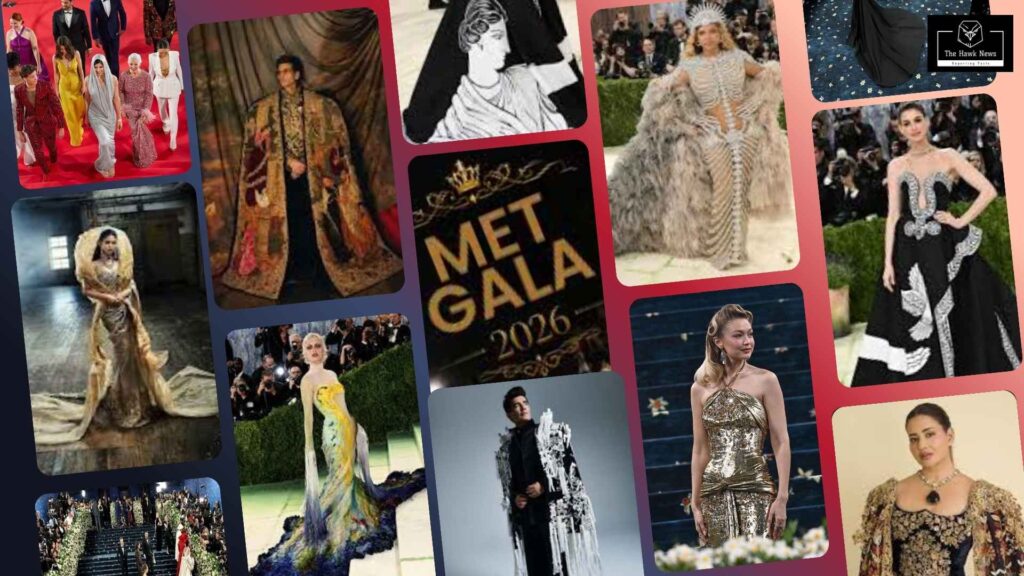
Under the theme “Costume Art” and the dress code “Fashion Is Art,” the gala transformed into a surreal collision of couture, sculpture, anatomy, fantasy, and performance. Celebrities arrived not as stars alone, but as living installations.
As legendary designer Yves Saint Laurent once said:
“Fashion fades, style is eternal.”
At the Met Gala 2026, the industry appeared determined to make fashion eternal, too.
A Red Carpet That Looked Like a Museum Exhibition
The famous Met steps resembled less of a social gathering and more of a moving art gallery.
There were gowns inspired by Renaissance paintings.
Metallic corsets shaped like sculptures.
Prosthetic body pieces.
Crystal skeletons.
Faceless masks.
Mechanical couture.
One attendee arrived wearing animatronic hands stitched into the garment itself. Another wore a fiberglass chest plate resembling modern art more than clothing. Critics called it “the most theatrical Met Gala in years.”
The evening blurred the boundary between the body and the artwork.
Fashion critic Diana Vreeland once famously described style as:
“A way of life.”
The 2026 Met Gala took that philosophy further.
Fashion was no longer worn. It performed.
Beyoncé’s Return Became One of the Night’s Biggest Moments
Few arrivals generated as much anticipation as Beyoncé.
Returning to the Met Gala after years away, she appeared in a crystal-embellished skeletal gown designed by Olivier Rousteing, a haunting blend of glamour and mortality. Social media instantly crowned it one of the defining looks of the night.
Meanwhile, Naomi Osaka stunned audiences with an anatomical couture piece inspired by exposed musculature and blood vessels, a visual metaphor for vulnerability beneath celebrity culture.
And as expected, Kim Kardashian once again dominated online conversation with a sculptural metallic ensemble that divided viewers between admiration and disbelief.
The internet reacted in its usual fashion: awe, confusion, memes, criticism, and obsession within minutes.
India Quietly Became One of the Evening’s Biggest Winners
Amid Hollywood’s spectacle, India emerged as one of the strongest artistic voices of the evening.
What stood out was not simply celebrity presence, but craftsmanship.
Indian attendees leaned heavily into heritage, embroidery, textile storytelling, sculpture, and symbolism, a direction many critics felt aligned perfectly with the gala’s artistic theme.
Karan Johar’s Grand Debut
Karan Johar made one of the night’s most acclaimed debuts in an elaborate ensemble by Manish Malhotra, inspired by the paintings of Raja Ravi Varma.
The outfit fused:
- zardozi embroidery,
- hand-painted motifs,
- sculptural tailoring,
- and royal Indian aesthetics.
Reports claimed the creation required over 5,000 hours of craftsmanship.
The look was not merely fashion.
It was cultural storytelling.
Isha Ambani and the Language of Indian Textiles
Isha Ambani arrived in a gold-threaded sari-inspired couture gown that celebrated Indian weaving traditions and artisanal luxury.
Fashion commentators noted how Indian couture has evolved from “ethnic representation” into a dominant global luxury language.
As designer Coco Chanel once observed:
“Fashion is architecture. It is a matter of proportions.”
Indian designers this year proved that heritage itself can be architecture.
Ananya Birla’s Experimental Statement
Ananya Birla perhaps interpreted the theme most radically.
Her metallic face mask and sculptural couture transformed her appearance into something between performance art and futuristic installation. The look sparked heavy debate online, but it succeeded in exactly what the Met Gala demands: conversation.
Because at the Met Gala, silence is failure.
The Met Gala’s Greatest Power Is Not Fashion. It Is Conversation
For admirers, the 2026 Met Gala represented fearless artistic experimentation.
For critics, it represented extravagance disguised as intellectualism.
But perhaps the gala has always existed between those two extremes.
The event is simultaneously:
- a fundraiser,
- a cultural spectacle,
- a branding machine,
- a social hierarchy,
- and a living commentary on modern celebrity culture.
Within minutes, the internet transformed couture into memes. Dresses became jokes, debates, think-pieces, and viral posts.
And yet, despite the criticism, the Met Gala continues to dominate global attention every year.
Why?
Because it understands something modern culture rarely admits:
Attention itself is power.
More Than a Fashion Event
The Met Gala has evolved beyond celebrity dressing.
It now functions as:
- a mirror of cultural influence,
- a showcase of artistic ambition,
- and a reflection of how modern fame operates.
This year, especially, the event asked a larger question:
Can the human body itself become art?
The answer, according to the Met Gala 2026, was yes.
Sometimes beautifully.
Sometimes absurdly.
Sometimes controversially.
But never quietly.
As cameras faded and celebrities disappeared behind the museum doors, one truth remained clear:
The Met Gala is no longer just fashion’s biggest night.
It is fashion attempting to explain civilization to itself.
One thought on “Met Gala 2026: When Fashion Became Performance, Sculpture, and Spectacle”
Comments are closed.