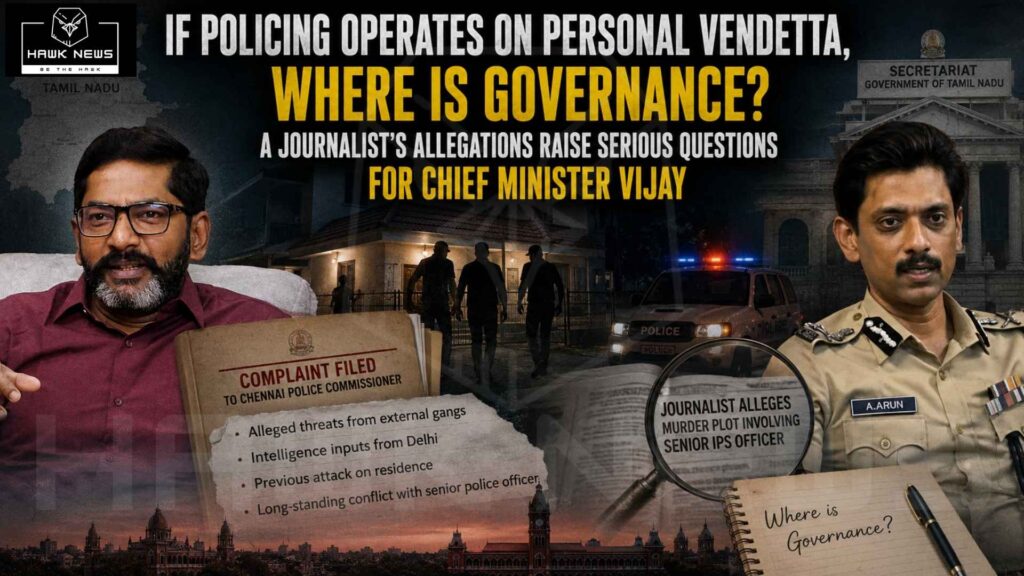
For years, Tamil Nadu has projected itself as a state governed by institutions, procedures, and the rule of law. Citizens are repeatedly told that if they face a threat, they can approach the police. If they face injustice, they can seek protection from the state. But what happens when allegations emerge suggesting that the threat itself may be linked to individuals within the policing system?
That is the uncomfortable question now being raised after journalist and political commentator Savukku Shankar publicly alleged that senior IPS officer Arun IPS was behind attempts to eliminate him through hired gangs. These are serious allegations and remain allegations unless proven through an investigation. Yet the gravity of the claims raises questions that cannot simply be brushed aside as another political controversy.
The issue is no longer about whether one agrees with Savukku Shankar’s politics, opinions, or style of journalism. The larger question is what these allegations reveal about the state of governance if such claims are even being made in the first place.
A Conflict That Did Not Begin Yesterday
The dispute between Savukku Shankar and Arun IPS is not a recent development. It has been a long-running public confrontation marked by accusations, counter-accusations, legal battles, and repeated criticism.
During Arun’s tenure in senior law-and-order positions, Savukku Shankar frequently accused sections of the police establishment of misusing power, targeting critics, and suppressing dissenting voices. Shankar’s public campaigns often placed him in direct conflict with powerful individuals within the system.
The latest allegation is therefore not emerging in a vacuum. It is part of a prolonged feud that has steadily intensified over the years. What makes the present controversy different is the nature of the accusation itself. This is not merely a claim of harassment or intimidation. It is an allegation that a senior police officer was linked to plans involving hired gangs.
Such claims demand scrutiny not because they have been proven, but because the consequences would be enormous if they were ever proven.
The Disturbing Questions Raised by the Latest Complaint
According to Savukku Shankar, intelligence sources warned him that individuals from Mumbai had allegedly been arranged to target him. He claims that similar information was conveyed to him previously regarding an alleged plot involving individuals from southern Tamil Nadu.
Acting on these claims, he says he approached the Chennai Police Commissioner and submitted a formal complaint seeking an investigation.
The immediate question is straightforward. If the allegations are baseless, they must be disproven through a transparent inquiry. If there is substance to them, then the implications are far more serious than a dispute between two individuals.
The public deserves clarity because allegations involving contract killers, intelligence warnings, and senior police officials cannot remain trapped in the realm of rumours and social media speculation.
When a Journalist Says He Fears the Police More Than Criminals
One of the most troubling aspects of this controversy is the message it sends to the public.
In any democratic society, journalists often face criticism, political pressure, legal challenges, and even threats from criminal elements. However, a democracy enters dangerous territory when a journalist publicly claims that his threat originates from individuals associated with state power.
The concern here extends beyond Savukku Shankar. If a journalist believes that he requires protection from those entrusted with enforcing the law, what confidence can ordinary citizens have in the system?
Even if the allegations ultimately prove false, the fact that such accusations have gained public attention reveals a growing trust deficit between sections of society and institutions that are expected to command public confidence.
The Shadow of Earlier Controversies
The latest claims have also revived discussions surrounding previous incidents involving Savukku Shankar.
One of the most widely discussed episodes was the attack on his residence, where sewage and waste were allegedly dumped inside the house while family members were present. At the time, questions were raised regarding the speed and effectiveness of the police response.
In his recent statement, Shankar revisited that episode and suggested that the response from certain officials reflected hostility rather than concern.
Whether those claims are accurate remains a matter requiring evidence and verification. Yet they continue to fuel a narrative that personal animosity may have influenced institutional conduct.
That perception alone is damaging because policing depends not only on authority but also on public trust.
Where Is Governance in All This?
Tamil Nadu now has a new political administration under Chief Minister Vijay. The government came to power promising change, accountability, and a different style of governance.
If that promise is to carry weight, then controversies of this nature cannot be ignored.
When allegations of this magnitude emerge, citizens naturally look towards the government for answers. They expect transparency. They expect impartial investigations. They expect institutions to function independently.
The role of the government is not to protect individuals from scrutiny. Nor is it to endorse allegations without evidence. Its responsibility is to ensure that allegations involving powerful public officials are investigated fairly and credibly.
If governance means anything, it means ensuring that nobody is above accountability.
The Questions Chief Minister Vijay Cannot Ignore
The most important questions today are not directed at Savukku Shankar or Arun IPS alone.
Has the complaint been formally examined?
Will an independent inquiry be conducted?
Will the findings be made public?
Will the government ensure that political considerations do not influence the process?
Most importantly, what message does the administration intend to send regarding allegations that involve the state’s policing apparatus?
These are not opposition questions. They are governance questions.
A Test Bigger Than One Man
This controversy is ultimately larger than the rivalry between a journalist and a police officer.
It is a test of whether institutions can command public confidence during moments of controversy. It is a test of whether allegations involving powerful individuals will be examined with transparency. It is a test of whether citizens can believe that the law applies equally to everyone.
If the allegations are false, a proper investigation will expose them. If they contain truth, accountability must follow wherever it leads.
Until then, one question will continue to linger over Tamil Nadu’s political and administrative landscape.
If policing begins to look personal, where exactly does governance stand?