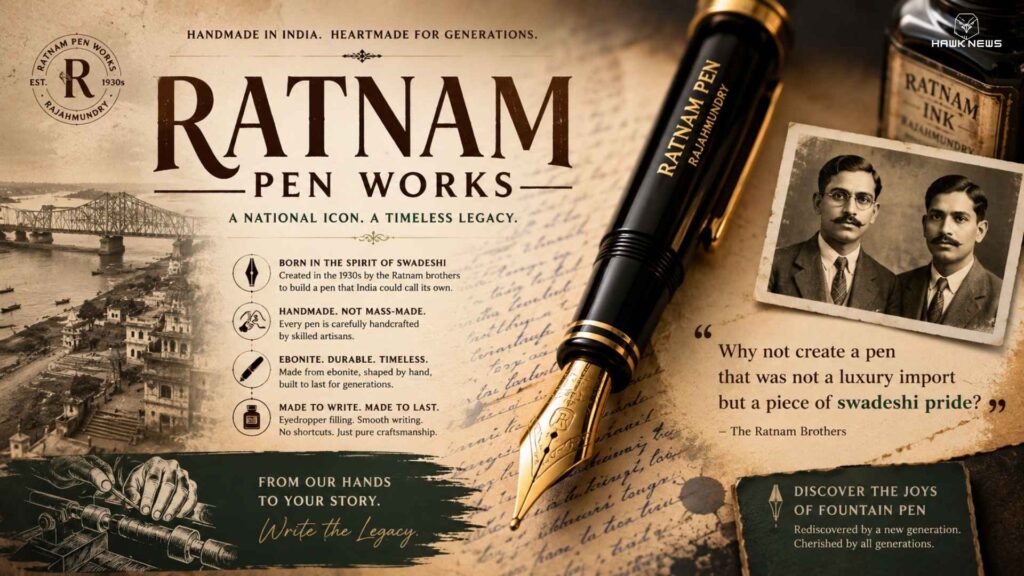
There is something almost sacred about a handmade fountain pen.
The slow twist of the cap.
The smell of ebonite.
The scratch-soft glide of ink across paper.
The feeling that words suddenly matter again.
And in India, few names carry that emotional weight like Ratnam Pen Works.
Founded in the early 1930s in Rajahmundry by K.V. Ratnam and his brother, Ratnam Pen Works is often regarded as one of India’s earliest indigenous fountain pen makers, born not from corporate ambition, but from the spirit of the Swadeshi movement.
At a time when imported pens from Britain dominated the market and writing instruments were symbols of colonial privilege, the Ratnam brothers asked a simple but revolutionary question:
“Why should Indians depend on foreign pens to write their own future?”
That question became history.
A Pen Born from Freedom
The origin story feels almost cinematic.
The brothers reportedly repaired a broken fountain pen fitted with a gold nib. While examining its mechanism, they wondered whether Indians could manufacture such pens themselves.
This was not merely about stationery.
This was pre-independence India.
The air carried the ideals of self-reliance, nationalism, and Swadeshi pride.
Inspired by Mahatma Gandhi’s call for indigenous industry, they began experimenting with handcrafted fountain pens made from ebonite, a hard rubber material prized for durability and warmth in the hand.
Unlike factory-produced imports, every Ratnam pen carried the imprint of human craftsmanship.
And thus, Ratnam Pen Works was born.
Why Ratnam Pens Became Legendary
Ratnam pens were never flashy luxury objects.
They became beloved because they felt personal.
1. Handmade Craftsmanship
Each pen was individually shaped, polished, threaded, and assembled by hand — often using traditional lathe techniques passed across generations.
No two pens were perfectly identical.
That tiny imperfection became the soul of the pen.
2. Ebonite: The Forgotten Material
Modern pens often use acrylic or injection-molded plastic.
Ratnam stayed loyal to ebonite.
Ebonite ages beautifully. It becomes warmer with use, develops character over time, and offers a tactile experience impossible to replicate digitally.
Collectors often describe old ebonite pens as feeling “alive.”
3. The Eyedropper Tradition
Many Ratnam pens use the traditional eyedropper filling system, where ink is directly filled into the barrel.
Simple. Mechanical. No cartridges. No planned obsolescence.
A philosophy almost opposite to today’s disposable culture.
4. A Writer’s Pen
These were not boardroom status symbols.
Teachers, lawyers, students, poets, clerks, and civil servants used Ratnam pens.
For decades, handwritten India flowed through these nibs.
The Emotional Revival in the Digital Era
Ironically, the internet helped revive fountain pens.
Instagram reels showing ink swirls.
YouTube reviewers discussing nib flex.
Young creators rediscovering journaling, handwriting, and “slow living.”
Suddenly, fountain pens were no longer “old-fashioned.”
They became resistance against speed.
And among Indian enthusiasts, Ratnam emerged again as a hidden treasure rediscovered.
That quote you shared reflects something profound:
In a world of disposable convenience, handmade objects still carry emotional gravity.
When younger people hold a Ratnam pen today, they are not merely holding stationery.
They are holding continuity.
Ratnam and the Culture of Slow Writing
A fountain pen changes how people think.
You cannot rush it.
You refill it carefully.
You clean it patiently.
You write more slowly.
You become conscious of words.
In many ways, fountain pen culture today mirrors the revival of:
- vinyl records,
- film photography,
- mechanical watches,
- crochet,
- handcrafted leather,
- and analog journaling.
People are craving texture again.
Not everything meaningful can be touchscreen smooth.
The Cultural Importance of Ratnam Pen Works
Ratnam is not merely a pen company.
It represents:
- India’s Swadeshi industrial spirit,
- small-scale craftsmanship,
- generational artisan knowledge,
- and the emotional relationship between writing and identity.
Before keyboards became extensions of thought, handwriting carried personality.
A fountain pen made writing feel ceremonial.
And Ratnam preserved that ritual.
A Quiet National Icon
Unlike multinational luxury brands, Ratnam never became globally commercialized on a massive scale.
Perhaps that is exactly why people love it.
It remained intimate.
Rooted.
Human.
Even today, many Ratnam pens are still handcrafted in small batches in Andhra Pradesh.
Not mass-manufactured.
Not algorithmically optimized.
Made slowly by people who still believe a pen should outlive trends.
Why This Story Feels Nostalgic Today
Because it reminds us of an India that was built with patience.
An India where craftsmanship mattered.
Where repairing was normal.
Where objects were meant to age alongside us.
The Ratnam brothers did not just create pens.
They created an idea:
That even an ordinary object can become an expression of national dignity, artistry, and memory.
And perhaps that is why seeing a young person use a Ratnam pen feels so moving today.
It means some traditions are not disappearing.
They are quietly waiting to be rediscovered.