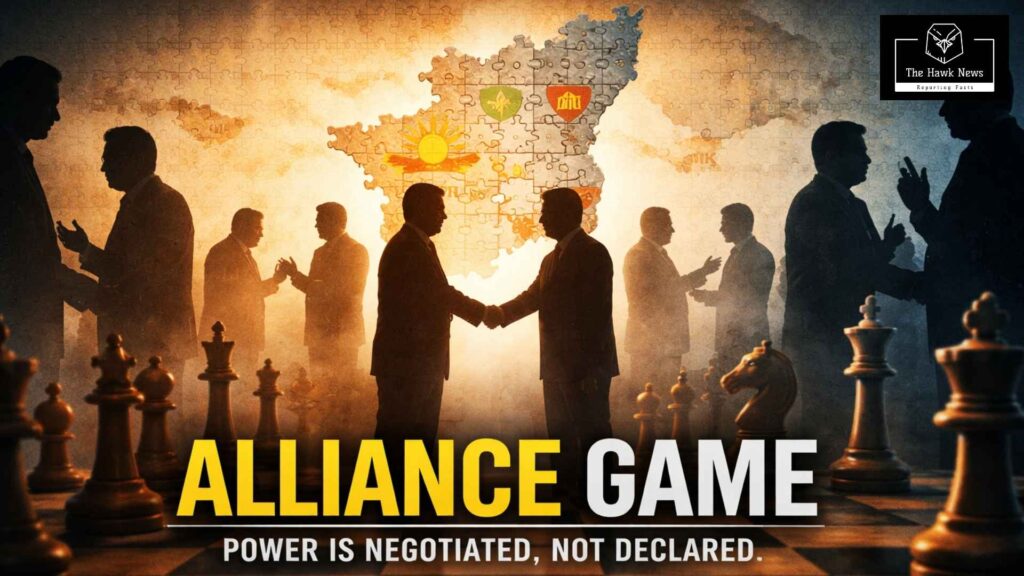
The Politics You Don’t See
As Tamil Nadu inches closer to another high-stakes electoral battle, what is visible on the surface — rallies, speeches, and public posturing — may only tell half the story.
Behind closed doors, a quieter process is unfolding.
Across party lines, strategic conversations, indirect signals, and calculated silences suggest that alliance equations are far from settled.
For major players like DMK, AIADMK, and BJP, the real contest may not just be against each other — but in how effectively they build or break alliances.
Reading the Signals
Unlike formal announcements, alliance-building often reveals itself through:
- Leaders avoiding direct criticism of certain rivals
- Sudden shifts in political tone
- Strategic public appearances or notable absences
- Backchannel meetings that never make headlines
These are not coincidences — they are calculated political signals.
Recent developments indicate that parties are keeping their options open, testing multiple combinations before locking in pre-election coalitions.
Why Alliances Matter More Than Ever
Tamil Nadu’s electoral history shows a consistent pattern:
Elections are rarely won alone — they are negotiated.
Alliances determine:
- Vote bank consolidation across caste and regional lines
- Seat-sharing agreements, which directly influence winnability
- Campaign momentum, especially in multi-cornered contests
Even a small shift in alliance structure can tilt outcomes across dozens of constituencies.
The Strategic Dilemma
For every party, alliance-building comes with a trade-off.
✔ Pros:
- Broader voter base through combined support
- Reduced vote splitting in key constituencies
- Stronger perception of electoral viability
✖ Cons:
- Ideological dilution, especially when partners have conflicting narratives
- Internal dissent over seat allocation
- Risk of alienating core supporters
This creates a delicate balancing act:
Win more seats — without losing identity.
Power Plays Beneath the Surface
Each major party is navigating its own strategic puzzle:
- DMK may aim to retain and stabilize its existing alliance network, ensuring minimal disruption
- AIADMK faces pressure to rebuild a cohesive front while managing internal and external expectations
- BJP is likely exploring new partnerships to expand its footprint, especially in regions where it lacks grassroots depth
In this environment, even smaller regional players could become kingmakers in closely contested seats.
Ground Reality Check
While alliance talks may dominate strategy rooms, their success depends on how well they translate on the ground.
Voters are not always passive recipients of political arithmetic. They often:
- Reject alliances that appear opportunistic
- Resist combinations that lack ideological coherence
- Respond strongly to local candidate credibility
This means that mathematical advantage does not always guarantee emotional acceptance.
The Unpredictable Factor
Tamil Nadu’s electorate has shown a pattern of:
- Rewarding stability
- Punishing confusion
- Valuing clarity in leadership and alliances
In such a landscape, delayed or unclear alliance decisions could create:
- Voter uncertainty
- Cadre confusion
- Campaign inefficiencies
Timing, therefore, becomes as crucial as the alliance itself.
The Bigger Picture
The emerging alliance dynamics point to a deeper truth:
This election may not just be about who is stronger — but who aligns smarter.
As negotiations continue behind the scenes, Tamil Nadu’s electoral map remains fluid, shaped not just by public campaigns, but by private calculations of power, survival, and expansion.