A Political Allegation That Refuses to Die
For years, allegations have periodically surfaced online claiming that Congress leader Praveen Chakravarty was involved in a “data theft case” in the United States.
The allegation has often been repeated in political circles without supporting court documents. In recent months, the claim has resurfaced following Chakravarty’s growing prominence within the Indian National Congress and his role in the party’s data analytics and electoral strategy operations.
But what do the publicly available court records actually show?
A review of accessible U.S. federal court documents, legal databases, and contemporaneous reporting reveals a more complicated story than the simplified political slogan of “data theft.”
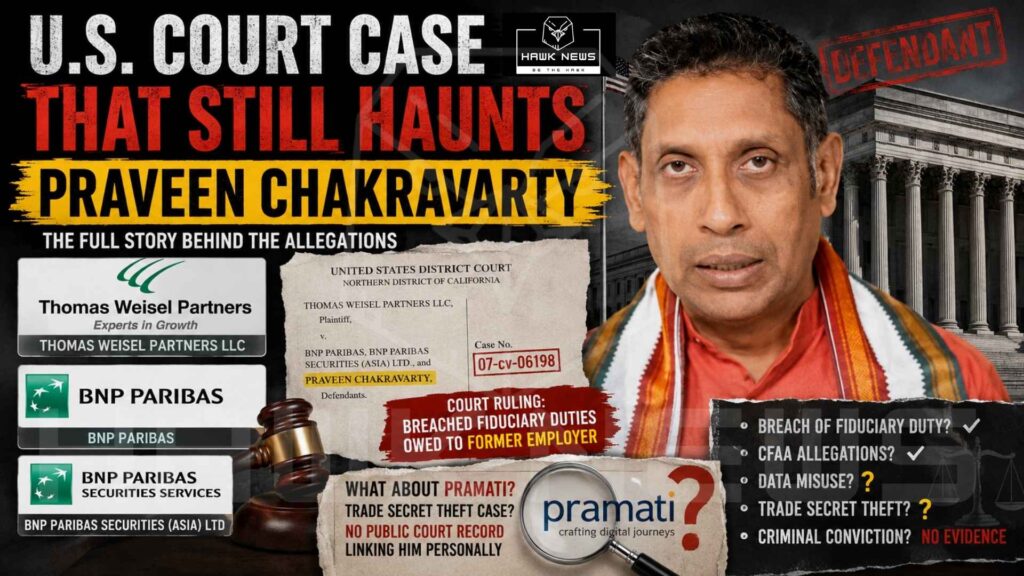
The available evidence confirms that Praveen Chakravarty was personally named as a defendant in a U.S. federal civil lawsuit. It also confirms that a federal judge ruled against him on a breach-of-fiduciary-duty claim.
However, the same publicly available record does not establish that he was criminally convicted of data theft.
Understanding that distinction requires revisiting a corporate dispute that unfolded nearly two decades ago.
Who Is Praveen Chakravarty?
Before entering politics, Praveen Chakravarty built a career in finance, investment banking, technology, and venture-related activities.
Over the years, he became associated with financial institutions, technology ventures, policy initiatives, and eventually political strategy.
Today he is best known as a senior Congress functionary and election strategist, playing a significant role in the party’s data analytics operations and campaign planning.
His professional background made him a relatively unusual entrant into Indian politics: a technocrat with experience in finance and analytics rather than a traditional political organizer.
The Lawsuit That Continues To Follow Him
The central case identified through U.S. court records is:
Thomas Weisel Partners LLC et al. v. BNP Paribas et al.
Key Parties
| Entity | Role |
|---|---|
| Thomas Weisel Partners (TWP) | Plaintiff |
| BNP Paribas | Defendant |
| BNP Paribas Securities (Asia) Ltd. | Defendant |
| Praveen Chakravarty | Defendant |
The case was filed in the United States District Court for the Northern District of California.
The dispute emerged after Chakravarty left Thomas Weisel Partners and joined BNP Paribas.
According to court filings, Thomas Weisel Partners alleged that personnel from its Mumbai operations were recruited away following Chakravarty’s move.
The dispute escalated into a major civil lawsuit involving claims relating to employee departures, business competition, fiduciary obligations, and computer-related allegations.
Timeline Of Events
| Year | Development |
| 2007 | Thomas Weisel Partners files suit in U.S. federal court |
| 2007–2009 | Litigation proceeds through multiple claims and motions |
| 2010 | Court rulings and reporting highlight findings against Chakravarty on fiduciary-duty issues |
| Subsequent Years | Political opponents increasingly characterize the dispute as a “data theft case” |
What Exactly Did Thomas Weisel Partners Allege?
The lawsuit involved multiple allegations.
Among the claims referenced in court materials were:
- Employee solicitation issues.
- Competitive business conduct.
- Fiduciary-duty violations.
- Computer-related claims brought under the Computer Fraud and Abuse Act (CFAA).
The inclusion of CFAA allegations is particularly significant.
The CFAA is a U.S. federal statute often associated with unauthorized computer access, misuse of computer systems, and related conduct.
Because of the CFAA’s connection to computer systems, later political narratives appear to have transformed the litigation into a shorthand allegation of “data theft.”
However, a lawsuit containing a CFAA claim is not automatically equivalent to a finding of criminal data theft.
The Most Important Court Finding
The most consequential publicly identified court ruling concerns fiduciary duty.
A federal judge granted partial summary judgment against Praveen Chakravarty on a breach-of-fiduciary-duty claim.
In practical terms, this means the court concluded that the evidence was sufficient to rule against him on that claim without requiring a full trial on that particular issue.
This was not merely an allegation.
It was a judicial finding.
The court concluded that Chakravarty breached fiduciary obligations owed to his former employer and that the breach caused injury to the plaintiffs.
For journalists, this is arguably the most important verified fact emerging from the litigation.
What Is A Fiduciary Duty?
A fiduciary duty is among the highest legal obligations recognized in business relationships.
Employees and executives entrusted with sensitive information, strategic planning, client relationships, or management responsibilities may owe fiduciary obligations to their employer.
A breach of fiduciary duty generally means a person acted contrary to those obligations.
The exact legal implications depend on the facts of a case, but courts treat such findings seriously because they involve questions of trust, loyalty, and responsibility.
What The Court Record Does Not Show
Despite repeated political claims, several commonly circulated allegations could not be verified through publicly available records reviewed for this analysis.
The available material does not establish:
No Verified Criminal Conviction
No publicly identified criminal conviction in the United States for data theft has been located.
No Verified Criminal Indictment
No publicly identified federal criminal indictment for data theft has been located.
No Verified Court Finding Of “Data Theft”
The reviewed material does not contain a court finding stating that Chakravarty was guilty of stealing data.
No Verified Criminal Computer Crime Conviction
No publicly identified record demonstrates that a U.S. court convicted him of a computer crime.
These distinctions are crucial because civil liability and criminal guilt are fundamentally different legal concepts.
Why The “Data Theft” Narrative Persisted
Several factors may explain why the allegation continued to circulate.
Factor 1: CFAA Claims
The lawsuit reportedly included claims under the Computer Fraud and Abuse Act.
For many observers, any case involving computer-related allegations can easily become simplified into a “data theft” narrative.
Factor 2: Technology And Analytics Background
Chakravarty’s later role in data analytics and election strategy may have reinforced public assumptions that the historical dispute involved data misuse.
Factor 3: Political Incentives
Once a legal dispute becomes politically useful, nuanced legal distinctions often disappear.
Terms such as “fiduciary breach,” “civil liability,” and “summary judgment” are frequently replaced by simpler but more dramatic phrases.
The Pramati Question
Another recurring allegation links Chakravarty to supposed trade-secret or technology-theft litigation involving Pramati.
A targeted review was conducted for:
- Pramati trade-secret lawsuits.
- Federal court filings involving Pramati.
- Technology-theft allegations involving Pramati.
- Cases personally naming Praveen Chakravarty.
The result was notable.
No publicly identified federal court record was located showing that Praveen Chakravarty was personally named in a Pramati trade-secret theft lawsuit.
This does not prove such litigation never existed.
However, based on publicly accessible material reviewed during this investigation, no verified court record establishing such a case was located.
What Journalists Should Verify Next
The publicly accessible record answers some questions but leaves others unresolved.
A deeper investigation would require obtaining:
Federal PACER Records
The complete docket for the Thomas Weisel Partners litigation.
Summary Judgment Materials
The full judicial reasoning behind the fiduciary-duty ruling.
Final Judgment Records
To determine all outcomes and liabilities.
Damages Documentation
To establish whether damages were awarded and in what amount.
Settlement Materials
To determine whether additional claims were settled, dismissed, or resolved through agreement.
CFAA Claim Outcomes
To determine whether those claims survived, were dismissed, or resulted in additional findings.
Only after reviewing those records can journalists definitively establish the complete legal history of the dispute.
The Central Question For Public Life
The publicly available record does not support the broad political claim that Praveen Chakravarty was criminally convicted of data theft in the United States.
However, the same record does establish something that is independently significant.
A U.S. federal court ruled against him on a breach-of-fiduciary-duty claim brought by his former employer.
That finding remains part of the documented history surrounding a man who today occupies an influential position within India’s political and electoral ecosystem.
Whether voters view that episode as an old corporate dispute, a serious question of professional conduct, or a politically exaggerated controversy is ultimately a matter of public judgment.
But the distinction between verified court findings and political rhetoric remains essential.
The court record shows more than social-media defenders admit.
It also shows less than many political critics claim.