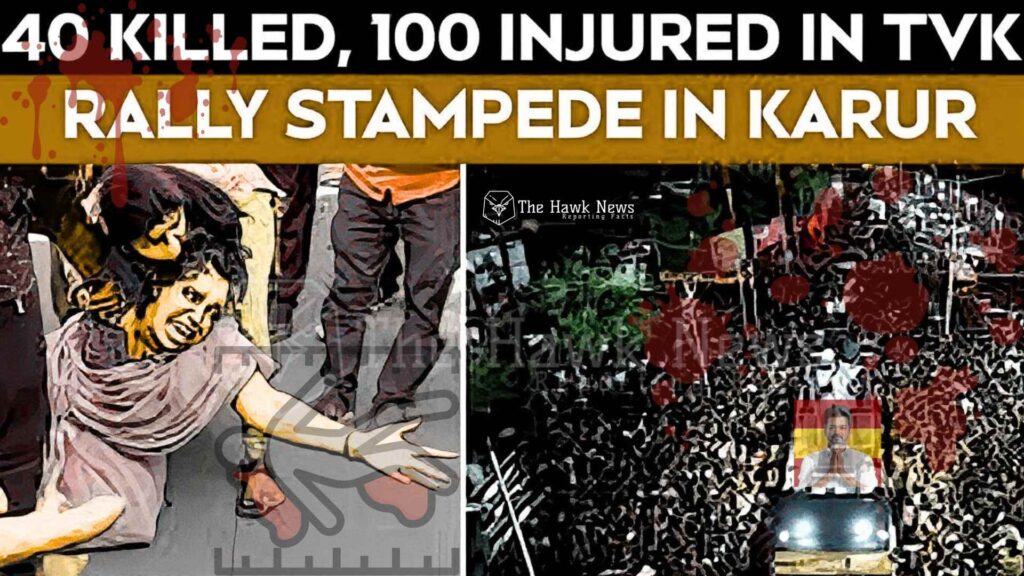
On September 27, 2025, Karur, a quiet town in Tamil Nadu, became the stage for a tragedy that shook an entire state. What was planned as a political rally by Tamilaga Vettri Kazhagam (TVK) ended in chaos, despair, and death.
More than 40 lives were lost, scores were injured, and thousands returned home scarred by an experience they never imagined.
From afar, one could almost mistake the event for a festival—a sea of people, banners of hope, the expectation of hearing from their leader, actor-turned-politician Vijay.
But for those on the ground, it became clear that this was not celebration but calamity in the making. The scorching sun bore down on a restless crowd that had waited, and waited, and waited—five hours beyond schedule—for a man they revered.
When he finally arrived, the pent-up energy burst into panic. Barricades collapsed, bodies fell, and lives were crushed under the weight of poor planning and unbridled arrogance.
This wasn’t just a rally gone wrong. This was a death rally.
The Questions No One Can Ignore
As an onlooker, one cannot help but ask:
- Why did Vijay and his team organize a rally so far beyond their capacity to manage?
- Why were basic police instructions ignored?
- Why was the leader himself delayed for hours, as tens of thousands suffered without food, water, or shelter?
The official permit allowed for 10,000 people. Reports estimate that anywhere between 27,000 and 60,000 gathered in Karur that day. What was already an overcrowded ground turned into a powder keg of risk. It was a human disaster waiting for a spark.
The spark came when Vijay’s convoy finally appeared. Fans surged forward, eager for a glimpse of their hero. In seconds, excitement turned to chaos. Within minutes, chaos turned to carnage.
When Admiration Becomes Exploitation
It’s important to understand who made up that massive crowd. These weren’t seasoned political cadres trained in discipline and safety. These were mostly fans—ordinary people, many from rural areas—drawn not by a manifesto, but by the magnetic pull of a movie star.
Vijay knew this. He knew that their loyalty came not from political conviction but from admiration. And yet, he chose to treat them as political capital, not as human beings. He admired the crowd, but for his own showcasing of strength, he made them wait in punishing conditions.
What does that say about a leader? If a man cannot respect the time, health, and safety of those who believe in him, what respect will he show to citizens when in power?
The Anatomy of Negligence
Walking away from the Karur rally, one thing is clear: this tragedy wasn’t an accident. It was negligence layered upon negligence.
- Overcrowding – A rally permitted for 10,000 spiraled into an uncontrolled crowd multiple times that size.
- Deliberate Delay – Vijay’s late arrival, stretching over five hours, left people under unbearable heat with no relief.
- Lack of Basic Amenities – Water, food, medical tents, shaded areas—none of it was arranged in proportion to the massive turnout.
- Absence of Safety Protocols – No proper barricades, no trained marshals, no clear exit routes. In case of emergency, the crowd had no escape.
These are not small oversights. They are life-and-death errors. Errors that killed mothers, fathers, and children alike.
Politics in the Shadow of Blood
In the aftermath, blame has been quick to shift. Police point to TVK organizers for violating permissions. TVK leaders deflect, calling it a conspiracy. Vijay himself has expressed sorrow, but sorrow without responsibility rings hollow.
The public, however, deserves answers. Was the delay intentional, designed to amplify crowd size for media optics? Were rules deliberately broken to project TVK as a rising force? Was this tragedy the result of arrogance—the belief that star power alone could substitute for management and safety?
If so, then this was not just negligence. It was exploitation: of faith, of admiration, and of human lives.
The Onlooker’s Anger
Standing outside the Karur grounds, the sight was haunting. Ambulances rushing. Families screaming. Sandals and bags scattered where people fell. The air heavy not with slogans, but with grief.
And the most painful thought: these deaths were avoidable.
No bomb blast. No natural disaster. No enemy attack. Just mismanagement, delay, and carelessness. The arrogance of a leader who wanted to make a show of strength but failed to protect the very people he claimed to lead.
This is not politics—it is criminal negligence. And when negligence kills, accountability cannot be avoided.
The Road Ahead
Tamil Nadu has seen political passion, but rarely has it seen passion turned so tragically into death. The Karur rally is a reminder that politics without responsibility is nothing more than theatre played with human lives.
For Vijay, the actor who aspires to be a leader, this is the first true test. Will he accept responsibility? Will he answer why he was delayed? Will he confront why his team ignored instructions? Or will he hide behind sympathy statements and deflections?
For the state, the question is larger. Will the law hold leaders accountable, or will charisma again override justice?
Because if lives lost in Karur are forgotten, then what message do we send? That political shows are worth more than human lives? That negligence in pursuit of power is forgivable? That an actor’s fan base is expendable for his ambitions?
Conclusion: A Call for Accountability
The Karur tragedy will be remembered not as a rally, but as a death rally. A day when more than 40 people went to see their leader and never returned home.
No apology can bring back those lives. No compensation can erase the trauma. What can matter is truth, accountability, and justice.
Actor Vijay must answer for this tragedy. His party must be held to account for their negligence. And the political system must recognize that people’s lives are not props for showcasing power.
As an onlooker, as a citizen, as a human being—one cannot simply walk away. The cries of Karur demand that those responsible are named, questioned, and punished.
Because no leader, no actor, no political party has the right to gamble with human lives for the sake of ambition.
And in Karur, ambition killed.