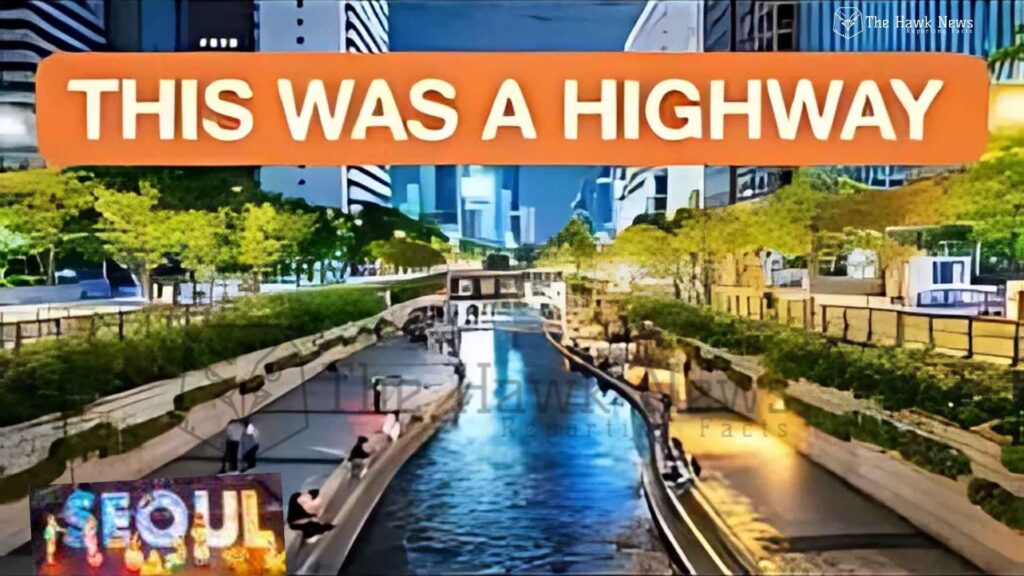
A Lesson from Seoul
Between 2003 and 2005, the city of Seoul did something radical. It tore down a congested highway that once cut through its heart and restored a long-buried stream—Cheonggyecheon.
What seemed like an impossible gamble became a triumph:
- Traffic didn’t collapse—it redistributed. Many commuters chose public transport.
- The city cooled by up to 3–5°C in the area.
- The stream became a cultural hub, attracting millions of visitors annually.
- Most importantly, Seoul rediscovered its ecological and social core.
This was not just an infrastructure project—it was a paradigm shift in urban philosophy.
Bengaluru’s Parallel Struggle
Bengaluru, India’s Silicon Valley, is choking.
- Endless flyovers and widened roads still leave commuters trapped in traffic snarls stretching hours.
- Lakes and rajakaluves (canals) that once formed a natural network of blue corridors are either encroached, polluted, or hidden under concrete.
- Public spaces are shrinking, and heat-island effects worsen each summer.
The current approach—building more roads—has only confirmed the principle of induced demand: the more space we give cars, the more cars fill it.
Seoul’s lesson offers Bengaluru a way out.
A Vision for Bengaluru: Tear Down to Build Up
Imagine this:
- A busy flyover or congested stretch reimagined as a linear park and stream corridor.
- Traffic redirected, not worsened, because better public transport becomes the attractive alternative.
- Commuters swapping honking horns for shaded walkways, cycling lanes, and cultural plazas.
- Reclaimed rajakaluves channeling monsoon waters into restored lakes instead of flooded streets.
Bengaluru could become India’s first megacity to flip the script—from car-dominated chaos to people-centric, eco-sensitive design.
Steps to Sow the Idea
- Pilot Project First
– Start small. Pick a canal that’s currently hidden or polluted and reintroduce it as a green corridor. - Stakeholder Engagement
– Involve BBMP, BDA, BMRCL, and citizen-led lake revival groups.
– Frame it not as a traffic project, but as ecological urban renewal. - Evidence from Seoul
– Use Cheonggyecheon’s data: cooler climate, better air, higher land values, reduced car use.
– Translate that into Bengaluru’s context: IT corridors, startup hubs, residential clusters. - Public Movement
– Launch a campaign: “Reclaim Bengaluru’s Blue and Green Heart.”
– Public demand + media coverage = political will.
The Payoff
- Mobility Shift: Reduced dependence on private vehicles.
- Ecological Healing: Revival of lakes, cleaner air, reduced heat.
- Cultural Identity: Public spaces that reconnect people with the city’s heritage.
- Economic Boost: Green, livable spaces attract talent and investments far more than gridlocks do.
Closing Thought
Seoul dared to dream, and in doing so, it set a new benchmark for the world. Bengaluru—India’s tech capital, a city of innovators—deserves no less.
The question is not whether it can be done. The question is:
Will Bengaluru’s leaders and citizens be bold enough to imagine their own Cheonggyecheon moment?