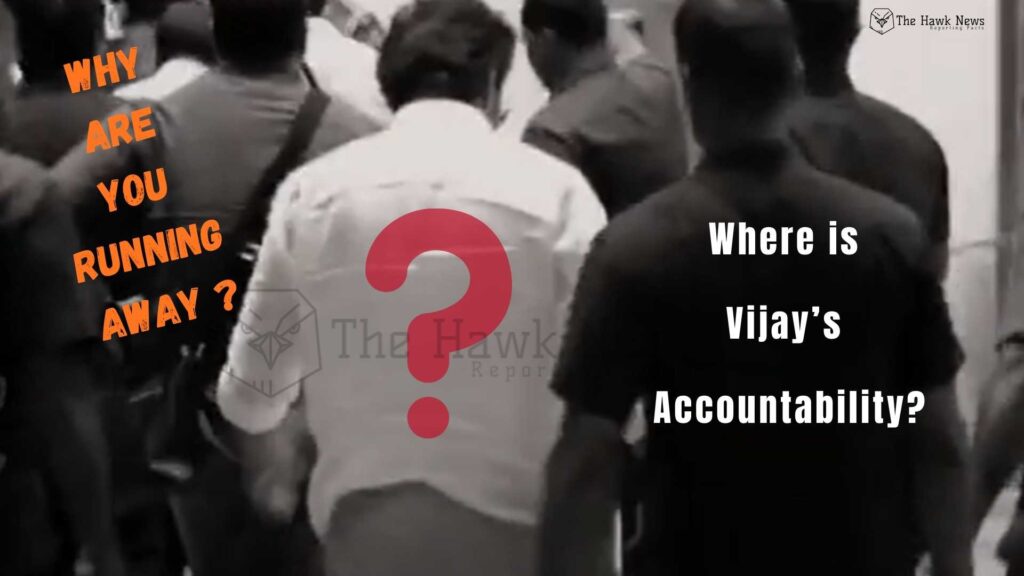
On September 27, 2025, Karur became the site of one of Tamil Nadu’s darkest political tragedies. What was meant to be a show of strength for actor-turned-politician Vijay and his party, the Tamilaga Vettri Kazhagam (TVK), ended as a death rally—claiming more than 40 innocent lives and injuring over 100.
Families who sent loved ones to see their favorite star never saw them return. Dreams were crushed, lives extinguished, and a district left scarred.
Yet amid the grief, shock, and outrage, one question remains unanswered: Where is Vijay’s accountability?
The pivot point of this tragedy is not only the mismanagement, the stampede, or the chaos. It is the silence, the evasions, and the refusal of a leader to accept responsibility. Because in Karur, ambition killed—and the man at the center of that ambition is shrinking away from the truth.
The Anatomy of Negligence
Reports reveal that the rally permit allowed for about 10,000 attendees. But the crowd swelled to over 30,000, some say even 50,000. Vijay was scheduled to arrive in the afternoon, but he turned up more than five hours late.
By then, the sun had scorched the restless crowd. People waited without water, without food, without even shade.
When the actor finally arrived, the crowd surged forward, breaking barricades, overwhelming police, and suffocating those trapped in the middle. People fainted, collapsed, and in the ensuing chaos, were trampled to death.
This was not a natural disaster. It was not fate. It was a man-made catastrophe born of arrogance, poor planning, and indifference to human life.
The Vanishing Leader
In the aftermath, what Karur needed was leadership. A leader who would stand before the grieving families, acknowledge the failures, and offer accountability. But instead, Vijay vanished into vague statements and token condolences.
Why is he shrinking from accountability? Perhaps because accepting responsibility would puncture the carefully constructed image he has built—a leader of the masses, a “people’s hero” stepping from silver screen to political stage.
To admit fault is to admit weakness, and in the ruthless world of Tamil Nadu politics, weakness is unforgivable.
Yet this shrinking posture only makes the tragedy worse. It tells the people that their pain is secondary to his ambition. That their lives were expendable props in a stage-managed show of strength.
The Politics of Silence
What has been most chilling is not just the deaths, but the political handling of them. TVK leaders have scrambled to redirect blame, accusing local authorities, rival parties, even the weather—anything but their own negligence. Instead of soul-searching, they are spinning. Instead of truth, they are dodging.
But silence is also a form of speech. And Vijay’s silence screams louder than words. It signals that accountability is negotiable, that lives lost can be brushed aside, that apologies can be packaged in press releases and forgotten in the next news cycle.
The people of Tamil Nadu deserve better. Leaders cannot vanish when their own rallies turn into graveyards.
Accountability Is Not Optional
Let us be clear: accountability is not a gesture. It is a duty. When lives are lost due to negligence, the leader at the center cannot distance himself as if he were a bystander. He was not a bystander. He was the reason tens of thousands gathered. He was the magnet that pulled them into a dangerous situation.
If Vijay could command their devotion, he must also shoulder the responsibility of their deaths. Leadership is not just about applause and slogans—it is about accepting blame when things fall apart.
By shrinking from accountability, Vijay diminishes himself. He turns from “people’s leader” to an actor who cannot step beyond the safety of scripted roles. In real life, the stage is harsher, the stakes higher, and the blood real.
What Does This Say About His Future?
The Karur tragedy casts a long shadow over Vijay’s political ambitions. If he cannot manage a rally, how can he manage a state? If he cannot protect his own supporters, how can he promise safety to a population of millions?
Accountability is the currency of democracy. Without it, leadership becomes dictatorship wrapped in glamour. Karur was a warning: when power is sought without responsibility, the people pay the price.
If Vijay continues to shrink from accountability, the tragedy will not end with Karur. It will repeat, in other towns, in other forms, until ambition devours more innocent lives.
The Cries of Karur
The streets of Karur have not fallen silent. The cries of grieving mothers, the shock of orphaned children, the trauma of the injured—they linger like an unhealed wound. They demand answers.
No apology can bring back the dead. No compensation can heal the scars. But justice can offer dignity. Truth can offer closure. Accountability can restore trust.
The tragedy in Karur is not just about the deaths. It is about the dangerous idea that leaders can gamble with human lives without consequences. It is about the illusion that charisma can cover for responsibility. It is about the falsehood that ambition is more important than accountability.
But people are not props. Crowds are not backdrops. And leadership without accountability is nothing but theatre.
Conclusion: The Duty of Truth
As an onlooker, a citizen, a human being—it is impossible to walk away from Karur without asking: who is responsible?
The answer is simple. Vijay must answer. His party must answer. And the political system must ensure that accountability is not lost in excuses.
Because no leader, no actor, no party has the right to gamble with human lives. The people of Tamil Nadu are not extras in a film. They are citizens who deserve dignity, safety, and truth.
The Karur tragedy will forever be remembered not as a rally, but as a death rally. And unless accountability is accepted, it will also be remembered as the moment when a leader shrank from responsibility and let ambition kill.