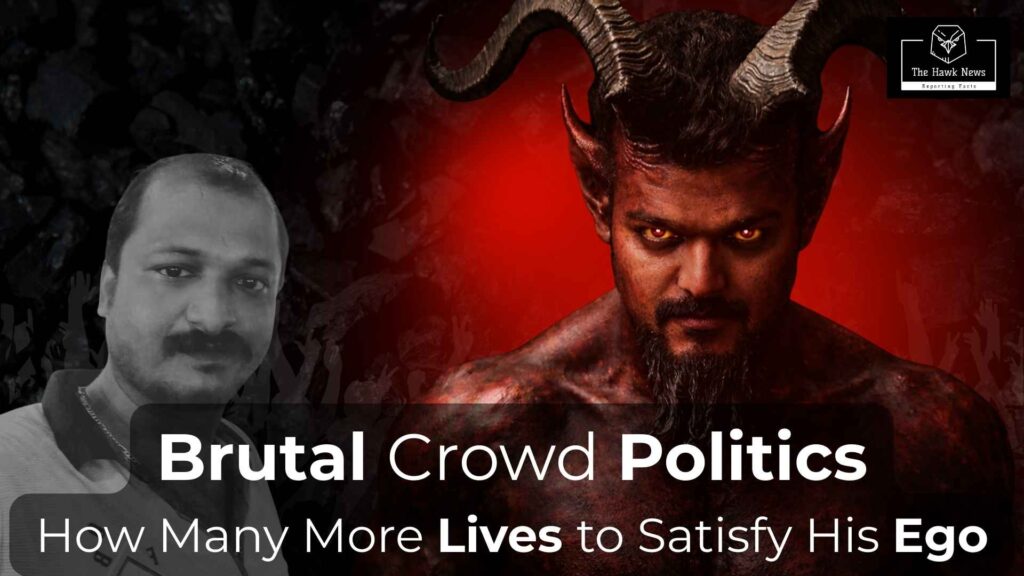
A 37-year-old man travelled to a political rally in Salem expecting nothing more than to listen to a speech and return home. He never made that journey back.
The meeting was organised by Tamilaga Vettri Kazhagam and addressed by Vijay. During the gathering, the man reportedly collapsed. He was rushed to hospital and declared dead. Early reports pointed to cardiac arrest, while others suggested dehydration and heat stress may have played a role.
Medical explanations will be debated. Official statements will follow. But no clarification can undo what has already happened. A family has lost one of its own. And politics, predictably, has moved on.
This is not merely about one tragic incident in Salem. It is about a deeper and more uncomfortable truth: India’s political culture increasingly treats human beings as background elements in mass spectacles, where optics matter more than safety and ambition routinely overrides responsibility.
A Planned Political Event That Ended in Death
This was not an accidental gathering. It was a carefully planned rally. Permissions were granted, stages were constructed, sound systems were installed, and supporters were mobilised in large numbers.
Everyone involved understood the environmental conditions. Tamil Nadu’s heat is not unpredictable. Even before peak summer, outdoor temperatures become oppressive. Open grounds amplify heat. Dense crowds trap humidity. Barricades restrict movement. Standing for hours without adequate hydration places severe strain on the human body.
These are not abstract concerns. They are established physiological realities.
When a man collapses under such circumstances, describing it as fate is intellectually dishonest. It raises unavoidable questions about planning, preparedness, and the seriousness with which organisers treat public safety.
Crowd management is not a cosmetic exercise. It is a critical operational responsibility. If a political organisation cannot ensure safe conditions for its own supporters, it exposes a troubling lack of administrative maturity.
When Crowd Optics Replace Governance Thinking
Modern politics increasingly measures success through surface optics. Attendance figures, the apparent size of gatherings, and carefully framed drone visuals now dominate political narratives. Discussions about medical preparedness, hydration access, or crowd density management rarely receive the same attention.
Crowds have become political currency. Bigger gatherings are marketed as proof of legitimacy and strength. Leaders are evaluated less on policy coherence and more on how many people can be assembled in one place.
But behind every impressive visual is a person with physical limits.
Many attendees travel long distances. Some skip meals. Others delay medication. Most stand for extended periods because movement is restricted. Water distribution is often uneven. Medical teams, when present, are typically stationed near VIP areas rather than embedded throughout the crowd.
Organisers chase numbers because numbers look powerful. They rarely chase safety metrics such as medical staff ratios, hydration point density, or shaded rest capacity.
That imbalance is not accidental. It reflects priorities.
Leadership Comes With Duty of Care
Vijay is no longer merely an actor drawing fan crowds. He is positioning himself as a political alternative and aspiring administrator. With that transition comes responsibility.
When a leader invites people to gather under his banner, he inherits a duty of care toward those who respond. That duty does not end with speeches or symbolism.
It includes ensuring sufficient drinking water across the venue. It includes deploying trained medical personnel throughout the crowd, not just near the stage. It includes monitoring heat stress and crowd density in real time. It includes maintaining clear emergency evacuation pathways.
If any of these systems were inadequate, then this death cannot be dismissed as unavoidable.
Political leadership is not measured only by charisma or turnout. It is measured by how seriously human safety is treated.
A party that seeks to govern millions must first demonstrate that it can responsibly manage thousands.
Government Approval Does Not Mean Government Is Blameless
Political rallies do not occur in isolation. They require police clearance, district administration coordination, traffic management, and public safety planning.
Which means responsibility does not stop with the organisers.
Why was such a large gathering approved under harsh weather conditions? Were organisers mandated to provide medical infrastructure proportional to crowd size? Were heat advisories considered before granting clearance? Was crowd density actively monitored by authorities? Or was permission treated as routine paperwork rather than a serious public safety decision?
When a citizen dies at a permitted political event, accountability travels upward through the administrative chain. Party organisers, district officials, and police authorities all share responsibility.
Public safety is not a courtesy extended by the state. It is a constitutional obligation. If that obligation was reduced to procedural approval without enforcement, then the system itself stands exposed.
The Family That Paid the Ultimate Price
Somewhere tonight, a family is sitting in shock.
A son who left home for a rally will never return. A wife may now face life alone. Children may grow up without a father.
This is not political rhetoric. This is lived reality.
No compensation can replace presence. No condolence message can undo absence. While leaders and spokespersons discuss narratives, ordinary people absorb irreversible loss inside their homes.
That is the real cost of careless crowd politics.
Why These Deaths Are Never Treated as Systemic Failures
Every rally death is presented as a standalone tragedy. Sudden health issue. Natural causes. Unfortunate incident. Then silence.
But deaths at mass gatherings follow familiar patterns: heat exposure, dehydration, crowd pressure, delayed medical response.
These risks are predictable. They are measurable. They are preventable.
Yet India still lacks strict national standards for political rallies. There are no universally enforced medical staffing ratios, no transparent post-event safety audits, and no meaningful penalties for organisers who compromise safety.
As a result, the cycle repeats. Large crowds are assembled. Safety weakens under pressure. Someone collapses. Statements are issued. The next rally is announced.
Without systemic reform, every gathering carries silent risk.
Ego Politics Versus Public Life
There is an uncomfortable truth beneath all this.
Contemporary politics is driven by display. Leaders seek visual dominance through bigger stages, larger crowds, and louder applause. Human safety does not generate viral content.
Every additional attendee increases pressure on water supply, shade availability, oxygen circulation, and emergency response capacity. If the priority is to showcase strength rather than protect attendees, ego becomes central to logistics.
And when ego dictates planning, people die.
This is not accidental. It is structural.
Transparency Is the Minimum Requirement
The Salem incident demands clear answers.
What exactly was the medical cause of death? How long did it take for first responders to reach the victim? Was on-site treatment attempted? What safety protocols were submitted by organisers? What conditions were imposed by authorities?
These details must be publicly disclosed.
Not vague condolences. Not generic explanations.
Facts.
If procedures were followed, they should be documented. If lapses occurred, they must be acknowledged and corrected, with accountability clearly assigned.
Anything less disrespects the dead.
Democracy Requires Responsibility, Not Recklessness
Political gatherings are part of democratic expression. Leaders must connect with people.
But democracy does not demand dangerous crowding.
Responsible politics means adjusting event timings during heat seasons, limiting density, ensuring hydration, deploying visible medical teams, creating shaded rest zones, and enforcing safety compliance.
These are basic governance practices.
If a party claims it can run a state, it must first prove it can run a rally safely.
The Question That Refuses to Go Away
Today it is Salem.
Tomorrow it could be any district in Tamil Nadu.
If deaths at rallies are normalised, public life becomes cheaper. If organisers face no consequences, safety will never improve. If leaders do not feel accountable, families will continue to pay the price.
The man who died will not hear future speeches. His family will not care about political slogans. They will only remember that he went to a meeting and never came back.
Until parties and governments place human life above spectacle, this question will hang over every stage and every microphone:
How many more lives must be lost to satisfy his ego.