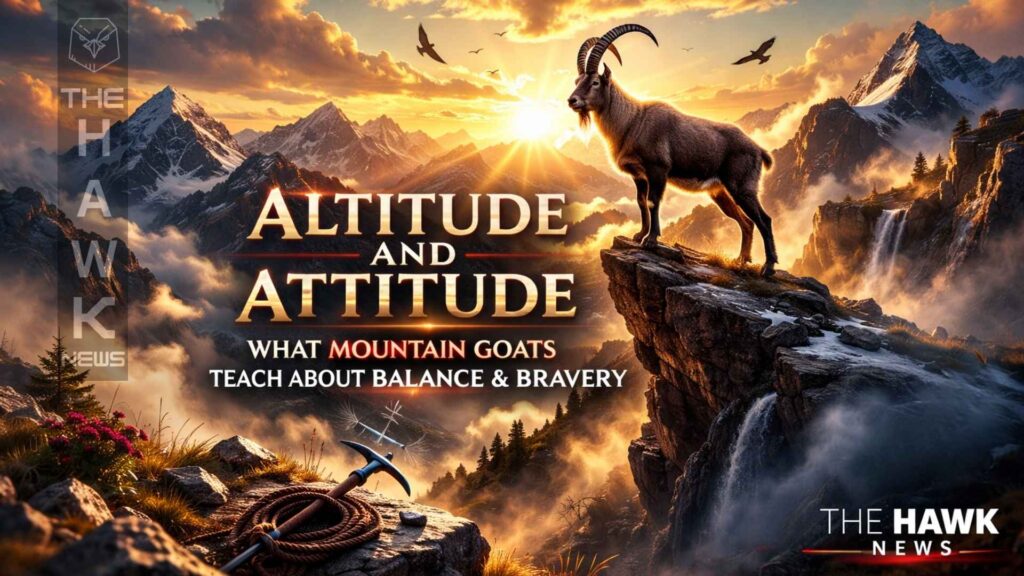
High above the tree line, where air thins and silence reigns, mountain goats move as if gravity were only a rumor.
Their poise on perilous cliffs isn’t just biology — it’s philosophy in motion.
The World Above the World
The wind grows sharper with every step.
The rocks shift, the ground narrows, the clouds drift below your feet.
And there — impossibly balanced on the sheer face of a mountain — stands the mountain goat. Calm. Unshaken. Completely at home where few would dare to stand.
Mountain goats live in places that almost reject life — cliffs rising over 13,000 feet (4,000 meters), where temperatures drop below freezing, oxygen thins, and predators rarely follow.
Yet these creatures not only survive there — they thrive.
They are nature’s quiet masters of impossible balance, the mountaineers of instinct, their lives written in hoofprints across the edges of creation.
“On the edge of danger, they find their peace.”
— Editorial reflection, The Hawk News
The Science of Staying Upright
Their secret lies not in magic, but in evolution’s precision engineering.
A mountain goat’s hooves are divided into two tough outer toes, each with a concave pad of rough, rubbery skin that grips rock like soft suction cups.
Their hind legs carry most of the power, allowing them to spring up to 12 feet in a single leap, scaling cliffs that appear vertical to the human eye.
Even their posture is designed for survival — shoulders set high, weight pulled toward the mountain, never leaning out, always leaning in.
They eat what the wind leaves — lichen, moss, and sparse alpine grasses — and drink from snow when water disappears.
Every movement is measured. Every decision is deliberate. There’s no panic, no wasted motion — only purpose.
“The mountain goat’s calm is not the absence of fear — it’s the mastery of it.”
The Solitude of the Summit
Unlike many herd animals, mountain goats often wander alone or in small groups, especially males known as billies.
Their solitude is not loneliness — it’s sovereignty.
They know something we forget: that isolation can refine, not weaken, the spirit.
Up there, among cliffs and cold, they move not for audience or applause, but for necessity — and that’s what makes them noble.
When storms close in, they do not flee.
They turn their backs to the wind, lower their heads, and wait — teaching us that sometimes the bravest thing to do is to simply stand your ground.
“In stillness, even the storm respects you.”
— Mountain proverb
The Attitude in Altitude
Every altitude demands a new attitude.
The air thins — so they breathe deeper.
The ground narrows — so they focus sharper.
The climb steepens — so they rise slower, steadier.
That’s their wisdom: adaptation over complaint.
Human life mirrors the mountain’s face — uneven, unpredictable, steep in its own ways.
But how often do we panic at the climb? How often do we lose balance because we look down instead of forward?
The mountain goat teaches us the discipline of balance — not just in body, but in being.
One careful step, one breath of faith, one refusal to fall into fear.
“The higher you climb, the quieter it becomes. That’s where truth lives.”
The Symbol of Resilience
Cultural traditions have long revered mountain goats as symbols of strength and spiritual endurance.
In Tibetan lore, they represent the soul’s courage to ascend beyond limitation.
In Native American symbolism, they embody sure-footed persistence — the will to climb despite scarcity.
Modern science calls them “the athletes of adaptation.”
They can withstand temperatures below -40°C, and their woolly coats contain two layers of insulation — one dense, one soft — to trap heat and repel wind.
Even their heart rate slows at altitude, conserving oxygen where the air thins.
They have mastered what we’re still learning — to live in harmony with hardship, not against it.
Reflection: The Edge Is Where Strength Is Found
Standing on a cliff beside a mountain goat, you realize something profound:
The world’s edges are not made to scare us — they’re made to shape us.
It’s not courage that keeps them steady; it’s belonging.
They do not conquer the mountain. They become part of it.
And perhaps that’s the lesson the mountain goat leaves for us — that true bravery isn’t in reaching the peak, but in staying balanced while getting there.
“A mountain goat does not look at the fall — it looks at the next step.”
— Editorial reflection, The Hawk News
So,— if ever life feels steep, remember this creature in the clouds.
Take one firm step, breathe, and believe that the climb itself is sacred.
For altitude without attitude is arrogance — but altitude with grace, that is greatness.