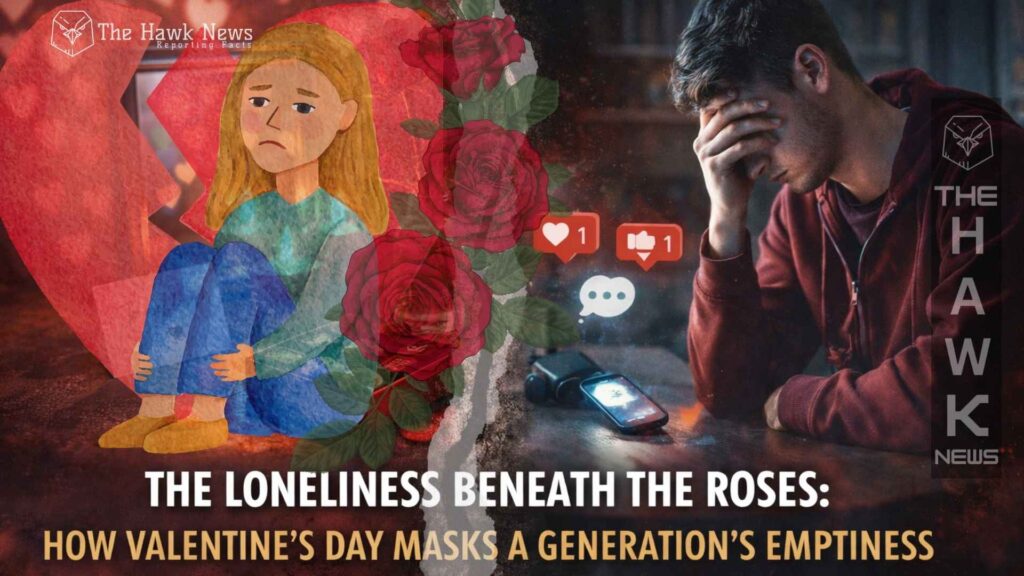
We post, we gift, we perform — yet somehow we feel less connected than ever.
Valentine’s Day has become a mirror to our digital loneliness, but it can still be redeemed — if we dare to love differently.
The Perfect Picture, The Quiet Ache
On February 14, the world blooms in red.
Cafés overflow, timelines shimmer, and every couple looks radiant — at least on screen.
But somewhere beneath those roses lies a quiet ache, a generation struggling to feel what it so confidently performs.
We say “love you” faster than we feel it.
We capture moments before we live them.
And in chasing validation, we’ve forgotten intimacy — the sacred silence between two souls that no camera can frame.
“We live in a world where showing love is easier than feeling it.”
— Editorial reflection, The Hawk News
The Hollow Heart of Connection
Sociologists call it “the age of hyper-connection.”
We have more ways to communicate than any generation before us — and yet loneliness is at an all-time high.
Digital affection has replaced depth with speed, conversation with comments, presence with pixels.
Valentine’s Day, once about sincerity, has become a stage — where the world performs affection under the spotlight of algorithms.
Every post becomes a proof. Every gift, a gesture of status.
And behind it all, countless people scroll through feeds, comparing their unseen lives to the highlight reels of others.
“The tragedy of our time is not that we don’t have love — it’s that we’ve forgotten how to recognize it.”
The Psychology of the Mask
Psychologists suggest that performative affection stems from a deep need to be witnessed.
We post not only to share — but to be seen.
Because attention, in the digital world, feels like acceptance.
But this exchange — likes for love, visibility for validation — slowly empties the human experience.
Love turns measurable.
And what should free us begins to enslave us.
That’s the loneliness beneath the roses — the quiet realization that connection has been replaced by performance, and performance mistaken for proof.
The Way Out: Love That Breathes Again
If Valentine’s Day has become a mirror to our emptiness, maybe the cure is not rejection — but redemption.
We don’t need to stop celebrating; we need to reclaim the meaning.
Here’s how:
- Choose Presence Over Performance.
Don’t post everything. Live something. Be fully where your heart is, even if no one is watching. - Love in Plural, Not Just Pair.
Valentine’s Day doesn’t belong only to couples. It’s for friends, family, the forgotten, the overlooked. Expand your circle. - Gift Meaning, Not Merchandise.
A handwritten note lasts longer than a discount bouquet. Meaning is the new luxury. - Turn Attention Into Action.
Visit the lonely. Forgive someone. Call your parents. Love that does something always heals something.
“The smallest act of love is greater than the grandest display of it.”
— Anonymous
Reflection: When Roses Root Again
Love has survived empires, wars, and ages of confusion. It will survive this, too — even through screens and filters.
Because somewhere behind the noise, every human heart still whispers the same truth:
we were made not just to connect, but to belong.
“Let all that you do be done in love.” — 1 Corinthians 16:14
Valentine’s Day will regain its meaning the moment we stop trying to be seen —
and start learning how to see each other again.
The Quiet Redemption
Love is not lost — only misplaced in the noise. Beneath every post, every fleeting scroll, the human heart still aches to be known, not noticed.
“Be still. The heart will remember how to feel.”
Perhaps Valentine’s Day isn’t broken; perhaps we are — tired of pretending, afraid of pausing.
And yet, that pause is where love begins again — in stillness, not spectacle.