The Chair as a Silent Co-Worker
Most professionals spend between 6 to 10 hours a day seated.
Over a year, that adds up to nearly 1,800 hours in a single position — more time than spent sleeping, talking, or eating.
So, when the chair fails the body, the consequences echo far beyond the spine.
The office chair isn’t just about comfort; it’s a structural influence on our physical and mental performance.
Good posture enhances breathing, circulation, and attention. Poor posture compresses organs, strains muscles, and silently drains energy.
“The body you sit in is the body you work with,” says physiotherapist Dr. Meena Krishnan, Apollo Health City.
“Every decision, every creative thought passes through how well oxygen flows through your system — and posture controls that.”
The Physiology of Sitting
The human body was designed to move, not to fold for hours.
When seated improperly:
- The spine curves unnaturally, stressing discs and ligaments.
- Hip flexors tighten, shortening stride and causing back pain.
- Neck muscles strain, leading to chronic tension headaches.
- Circulation slows, increasing risks of varicose veins and swelling.
- Metabolism drops, making calorie regulation harder.
Prolonged sitting also disrupts insulin function — a phenomenon doctors call “sitting disease.”
Even those who exercise after work can’t fully offset the damage of continuous sitting without movement breaks.
The Ergonomic Equation
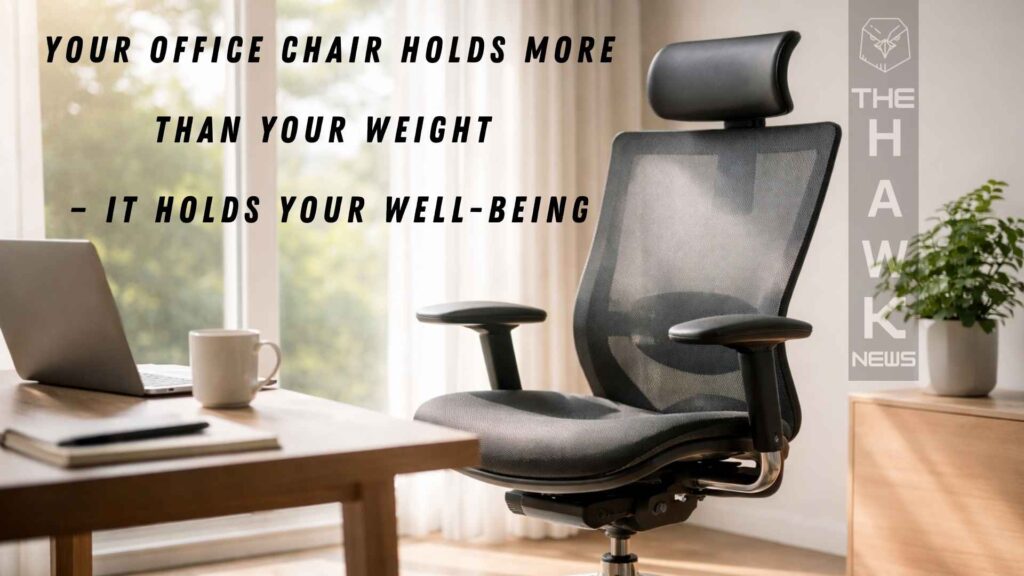
A proper chair supports the body’s natural curves, distributes pressure, and allows micro-movement.
Ergonomics is not a luxury — it’s preventive healthcare.
Key design principles for a health-positive chair:
- Lumbar Support: Keeps the lower spine (L3–L5) aligned, reducing disc compression.
- Adjustable Height: Knees should rest at a 90° angle, feet flat on the floor.
- Seat Depth: Enough space (2–3 fingers) between edge and knees to prevent nerve pressure.
- Backrest Tilt: 100–110° recline reduces spinal load and encourages natural posture.
- Armrest Alignment: Should allow shoulders to relax, not lift.
“Think of an office chair as a moving system, not a static seat,” explains ergonomist Dr. Vikram Anand.
“It must adjust to you — not the other way around.”
Health Chain Reaction — How a Chair Affects More Than the Spine
A supportive chair improves respiration (by keeping lungs open), blood flow (by reducing compression), and mental clarity (by easing physical fatigue).
Conversely, a poor chair causes a domino effect:
Pain → Distraction → Low focus → Irritability → Decline in creativity and morale.
A Harvard study in 2024 found that employees using ergonomic seating and taking posture breaks reported 17% higher concentration and 21% fewer stress-related symptoms than those with generic office chairs.
The chair, it seems, is both therapist and tool.
Psychological Health — The Body-Mind Loop
Physical comfort translates directly into emotional balance.
When posture collapses, so does confidence.
When the spine lifts, so does alertness.
“Good posture is a silent self-affirmation,” says occupational psychologist Dr. Rhea Thomas.
“It signals the brain that you are capable, composed, and present.”
A poor chair, by contrast, can subtly encourage fatigue, disengagement, and even mild depressive symptoms.
Because discomfort is not just physical — it is cumulative distraction.
Practical Health Tips for the Seated Professional
- Follow the 20-8-2 rule: Every 30 minutes — sit for 20, stand for 8, move for 2.
- Adjust lighting and monitor height — top of screen should align with eye level.
- Stretch hourly: Shoulder rolls, neck tilts, and ankle flexes reset circulation.
- Hydrate regularly: Even mild dehydration amplifies muscle fatigue.
- Invest, don’t improvise: A well-designed chair costs less than long-term physiotherapy.
The Chair as an Investment in Well-Being
A good chair is not a sign of privilege; it’s a tool of sustainability — for the spine, mind, and productivity of every worker.
Companies that understand this invest not just in output, but in longevity.
“Ergonomics is where empathy meets design,” Dr. Anand adds.
“Every supportive chair says, ‘We expect you to create — not endure.’”
Closing Reflection
The next time you sit down to work, remember: your chair isn’t just holding you up — it’s shaping how you think, breathe, and age.
Good posture is not vanity; it’s vitality.
And perhaps, in a world of screens and deadlines, the greatest kindness a workplace can offer is a seat that lets the body breathe while the mind builds.