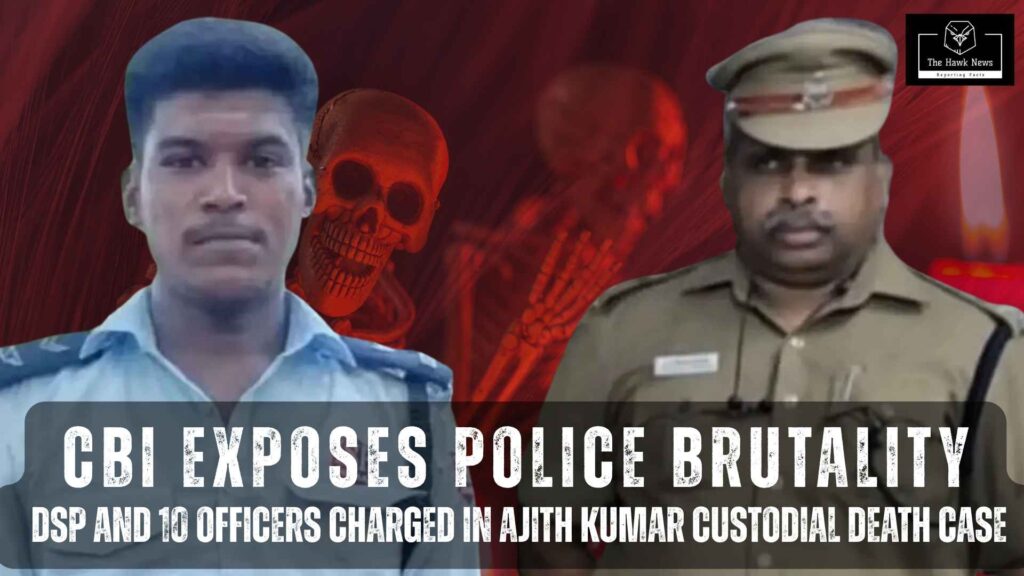
The custodial death of Ajith Kumar has now crossed the line from allegation into documented state violence.
After months of investigation, the Central Bureau of Investigation has placed on record that Ajith Kumar was innocent of the crime for which he was detained and that ten police officials, including a Deputy Superintendent of Police, were directly involved in custodial torture that led to his death. The same investigation also establishes that the jewellery theft complaint filed by Nikitha, which triggered Ajith’s arrest, was false.
These are not activist claims or political accusations. These are conclusions drawn from forensic evidence, witness testimonies, CCTV analysis, medical reports, and structured interrogation by India’s premier investigative agency.
What emerges is not a story of procedural error, but of institutional brutality enabled by hierarchy, silence, and delayed accountability.
Ajith Kumar’s Arrest Was Based on a Fabricated Complaint
Ajith Kumar was employed as a temple security guard in Sivaganga district. On June 27, 2025, he was taken into police custody following a complaint filed by Nikitha alleging that her jewellery had been stolen. Within twenty-four hours of that detention, Ajith Kumar was dead.
In the immediate aftermath, authorities attempted to frame the death as a medical incident, suggesting that Ajith collapsed during questioning. That narrative began to unravel almost instantly when video footage surfaced and preliminary medical findings showed extensive injuries. Public outrage forced judicial scrutiny, eventually leading to the transfer of the investigation to the CBI.
What the agency uncovered fundamentally altered the nature of the case.
Through examination of CCTV footage, vehicle movement records, and eyewitness accounts, CBI investigators established that Nikitha’s car never left the temple parking area on the day she claimed the theft had occurred. This directly contradicted her original version. Further questioning of Nikitha and her mother produced statements that did not align with each other or with the physical evidence collected.
The conclusion was unavoidable. There was no substantiated jewellery theft. The complaint itself was false.
Ajith Kumar, therefore, was illegally detained for a crime that never happened. His arrest had no factual basis. Every act that followed, including interrogation and physical custody, was rooted in fabricated allegations.
Yet, despite this finding, Nikitha has not been formally prosecuted for filing a false complaint that directly set in motion a chain of events ending in custodial death. This absence of action remains one of the most troubling aspects of the case.
Medical Evidence Confirms Prolonged Custodial Torture
The post-mortem examination revealed more than forty injuries across Ajith Kumar’s body. These included blunt-force trauma, deep bruising, and internal bleeding. Medical experts consulted during the investigation confirmed that the injuries were consistent with repeated assault and could only have been inflicted while Ajith was in police custody.
These were not superficial marks or isolated blows. The pattern of injuries indicated sustained violence over a period of time. Such harm requires prolonged access to the victim and the involvement of more than one individual. It also implies an environment where excessive force was either authorised or silently accepted.
CBI forensic assessments ruled out any possibility that these injuries predated Ajith’s arrest. The cause of death was directly linked to custodial assault.
This medical record removes any remaining ambiguity. Ajith Kumar did not suffer an accidental death. He was beaten while in custody until his body failed.
Ten Police Officials Named, Including a Deputy Superintendent
Initially, six police personnel were chargesheeted for their role in Ajith Kumar’s detention and interrogation. A supplementary chargesheet later added four more officers, bringing the total accused to ten. Among them was the then Deputy Superintendent of Police N. Shanmugasundaram, along with inspectors, sub-inspectors, and constables.
According to CBI findings, these officers either directly assaulted Ajith Kumar or knowingly facilitated the violence by supervising, permitting, or failing to intervene during the torture.
The inclusion of a DSP is critical. Custodial deaths are often explained away as misconduct by junior staff. That argument collapses here. Senior leadership was present within the operational chain. Authority existed on site. Oversight failed not through absence, but through participation.
This was not a rogue incident. It was structured brutality operating within the police hierarchy.
Judicial Intervention and the Limits of Administrative Action
The investigation was transferred to the CBI following directions from the Madras High Court, after mounting evidence and public pressure made a state-level probe untenable. The Tamil Nadu government announced compensation for Ajith Kumar’s family, and the CBI completed its investigation, filing both final and supplementary chargesheets before the trial court.
Procedurally, the case has moved forward. Substantively, accountability remains incomplete.
Some of the accused officers have been arrested and remanded. Others were earlier suspended or transferred. Departmental inquiries are ongoing. But none of the ten officers named by CBI have been dismissed from service. None have been convicted.
Suspension is temporary. Transfer merely relocates responsibility. Departmental inquiries move slowly and often conclude quietly. Meanwhile, Ajith Kumar’s family continues to navigate court hearings and legal formalities, while the accused remain embedded within the system.
This gap between legal process and moral accountability is where public confidence erodes.
The Unanswered Question of Institutional Protection
Beyond the ten named officers lies a deeper institutional concern. Who authorised Ajith Kumar’s detention based on an unverified complaint? Who ensured that Nikitha’s allegation received immediate police action? Who attempted to project Ajith’s death as a medical incident? Who delayed decisive action in the first critical hours after his death?
Custodial violence rarely survives without internal protection. Lower-ranking officers do not engage in prolonged torture unless they believe that consequences will be managed from above. That protective layer has not yet been publicly exposed.
Until those mechanisms are examined and addressed, the accountability remains partial.
Nikitha’s Legal Responsibility Cannot Be Ignored
CBI has already established that the theft complaint was false. Without that complaint, Ajith Kumar would never have entered police custody. Yet there has been no visible criminal action against Nikitha for initiating a fabricated case that culminated in death.
This selective pursuit of justice undermines the credibility of the entire process. If false complainants face no consequences while innocent citizens die in custody, the system becomes complicit in violence.
Her role must be examined under law, not treated as a peripheral detail.
Dismissal and Conviction Are the Only Meaningful Outcomes
This case cannot end with chargesheets and prolonged trials. Every officer named by CBI must face immediate dismissal from service, criminal prosecution under murder provisions, and fast-track judicial proceedings. Convictions must follow based on the extensive medical and forensic evidence already on record.
Anything less sends a dangerous message across the policing system. It suggests that custodial violence carries survivable consequences, that time will dilute outrage, and that institutional loyalty outweighs civilian life.
That message must be decisively dismantled.
Ajith Kumar Must Become a Precedent
Ajith Kumar was innocent. Nikitha’s complaint was false. Ten police officials, including a DSP, participated in custodial brutality. These are no longer disputed claims. They are documented findings.
The responsibility now rests entirely with the state and the judiciary. Dismiss the accused. Convict the guilty. Ensure that this case becomes a precedent for police accountability.
Because if these officers quietly return to normal life, Ajith Kumar will not merely become another statistic in India’s long list of custodial deaths. He will stand as evidence that uniforms still overpower law, and that institutional silence remains stronger than justice.
Justice delayed here will not only betray one family. It will send a message to every citizen about what truly awaits them inside a police station when power operates without consequence.