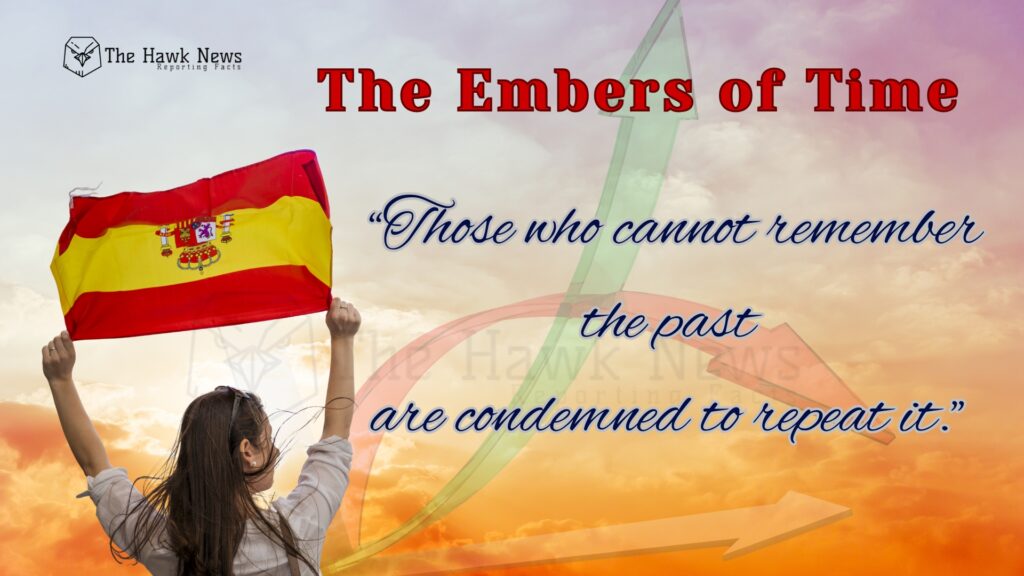
“History never really says goodbye. History says, ‘See you later.’”
— Eduardo Galeano
Some say history is a dead language, spoken only by old textbooks and scholars. Yet, if you listen closely, you’ll hear it breathing beneath everything we are — in our cities, our politics, our pride, and our silence.
The past doesn’t vanish; it cools into embers, glowing faintly under the surface, waiting for those with eyes to see and hearts willing to learn.
We, the children of modernity, stand atop centuries of forgotten lessons. The danger isn’t that we don’t know history — it’s that we no longer observe it.
The Embers Beneath Civilization
Take Spain — a nation that rose to the heavens of empire and fell to the dust of self-deception, only to rise again in humility.
Once, the Spanish crown ruled vast continents, fueled by gold from the Americas and power from the Church. The empire’s reach was unmatched; its arrogance, too, unparalleled.
But like every civilization that burns too brightly, the fire turned inward. Wealth became greed, conquest became decay, and faith became fanaticism.
When the embers cooled, what remained was a quiet lesson written in ruins — that no power, no matter how divine it claims to be, can outshine the truth of its own humanity.
And yet, Spain’s story didn’t end in ashes. From the Moors’ brilliance to the monarchs’ grandeur, from dictatorship under Franco to democracy reborn, it stands today as a nation that reflects — scarred, wiser, and beautifully human.
If we look closer, we’ll see that Spain’s journey isn’t its own. It’s a mirror of us all. Every empire, every movement, every generation rises thinking it has broken the cycle — until the same embers it ignored ignite again beneath its feet.
History’s Echo in the Modern Mind
Ours is an age of forward motion — data, progress, and speed. But beneath the hum of innovation, the old patterns remain. We build new empires of technology, influence, and ideology, each convinced of its permanence.
Scroll through social media, and you’ll see it: the same tribal thinking that divided nations centuries ago, now dressed in hashtags and headlines.
Every age believes it is smarter than the one before — yet every downfall begins with that belief.
The lesson history keeps offering — and we keep rejecting — is painfully simple: arrogance blinds civilizations long before they fall.
We saw it in Rome’s pride, in the British Empire’s overreach, in the Cold War’s paranoia. We see it now in digital echo chambers that mistake visibility for wisdom. The settings change, but the script remains eerily familiar.
Why the Embers Matter
History’s value isn’t in memorizing kings or wars; it’s in tracing the why. Why did societies collapse? Why did people turn cruel, or silent, or proud? Why did good intentions spiral into destruction?
When we fail to ask why, we repeat what.
Every generation inherits more than genes — it inherits patterns. The arrogance of comfort. The blindness of progress. The ease of moral forgetting.
Learning history isn’t about nostalgia; it’s about navigation. It’s how we learn to walk without falling into the same unseen pits.
The embers beneath us don’t burn to punish — they burn to warn.
Spain as a Parable of the Present
Look again at Spain — its story unfolds like a prophecy for the digital age.
During its imperial peak, Spain expanded faster than it could sustain. Its gold from the New World made it rich but hollow. The empire, swollen with pride, ignored the quiet decay beneath — until it imploded.
Isn’t that what we see now in our modern empires of information?
The flood of data makes us feel powerful, informed — yet underneath, our attention fractures, our values blur. Like Spain, we risk mistaking possession for progress.
History whispers the same warning across centuries:
“The wealth that blinds is the one that burns.”
Observation: The Lost Art
Today, the word observe has lost its meaning. We scroll, we consume, but we rarely see.
To observe is not to collect information but to connect understanding. It is to ask, “What does this remind me of?” “Where have I seen this before?”
When we observe, we recognize that dictators rarely start with violence — they start with language. That decline begins not with collapse but with comfort. That truth doesn’t disappear — it gets ignored.
History rewards those who notice the pattern before it repeats.
The Embers Within Us
Every society carries the seeds of its future in the habits of its present. And every individual does, too.
We like to think we’re free of the past — that modernity has outgrown its ancestors. But history lives within us: in how we love, judge, follow, and fear. We carry our own personal empires — of ego, of memory, of silence.
The same arrogance that built castles can now build echo chambers. The same curiosity that discovered continents can discover cures. Which one wins depends on whether we remember where we came from.
The embers are not only in ruins; they are in our hearts — the quiet reminders of choices made and choices yet to be made.
Before It Burns Again
We often quote the saying: “Those who cannot remember the past are condemned to repeat it.” But remembering isn’t enough. We must interpret it, internalize it, and let it humble us.
In the speed of modern life, we’ve mistaken awareness for wisdom. But history teaches that knowing is not the same as understanding.
We can only understand if we slow down — if we watch, listen, and reflect.
The past is not a museum; it’s a living manuscript. And right now, our generation is writing another chapter — one that future eyes will study with the same mix of wonder and warning.
The Final Reflection
There’s a reason old cities feel sacred. Beneath every cobblestone lies the dust of decisions, the remains of dreams, the quiet persistence of human lessons. History is not behind us; it is beneath us — glowing, patient, waiting for us to kneel and notice.
Perhaps the wisest act in our restless age is not to rush forward but to look back — not with nostalgia, but with understanding.
Because the embers of time don’t fade. They only wait — for eyes brave enough to see,
and hearts humble enough to learn.