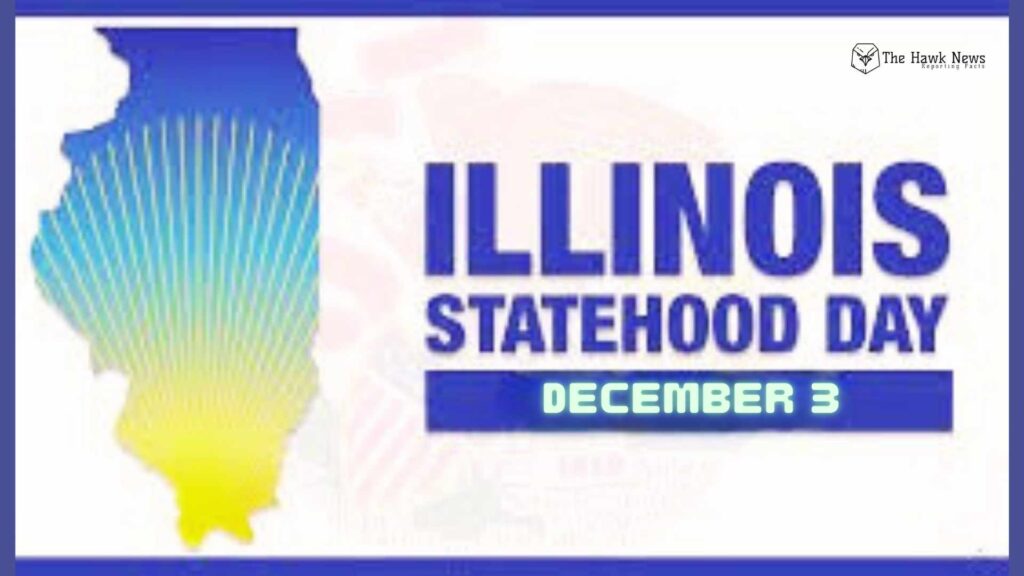
On December 3, 1818, a frontier territory carved from prairie, riverbanks, and raw ambition became the 21st state of the United States.
At the time, Illinois was more hope than infrastructure — sparsely populated, largely agrarian, and still negotiating what kind of identity it would have in the expanding American map.
Two centuries later, Illinois is no longer a frontier — it is a force.
A state whose history has shaped the nation; whose cities, especially Chicago, have influenced architecture, industry, politics, arts, and the American character itself.
Statehood Day arrives quietly every December 3.
No fireworks. No national headlines.
Yet Illinois’ story is one of the most dramatic arcs in American history — a rise from wilderness to powerhouse, from prairie state to cultural capital.
Today, as the nation grapples with change, migration, urban transformation, and political division, Illinois’ journey offers something rare: a blueprint for how places — and people — can grow, reinvent, and endure.
I. Born in a Moment of Change
The Illinois Territory of 1818 looked nothing like the Illinois of today.
This was the American West before the West existed:
- fewer than 35,000 settlers,
- endless expanses of untouched prairie,
- Indigenous communities whose presence stretched back centuries,
- and a population scattered around fertile soil and flowing rivers.
But Illinois had geography on its side:
the Mississippi to the west, the Wabash to the east, and the Great Lakes to the north. A place positioned to become a crossroads long before America had highways or railroads.
The Congress saw potential.
So did the settlers.
So did the dreamers.
When Illinois earned statehood on December 3, it wasn’t just entering the Union — it entered the American imagination.
II. The State That Built a Nation
Illinois’ next hundred years were not quiet.
It became the place where America learned to build — and rebuild:
Chicago: The Phoenix City
After the Great Chicago Fire of 1871 flattened nearly everything, Illinois birthed:
- the skyscraper,
- modern architecture,
- a new breed of engineers and designers,
- and a city that would soon rival the global greats.
Chicago became a living thesis:
Destruction is not final — it is a beginning.
The Railroads and the Rivers
Illinois became the beating heart of American logistics — rail, river, trade, and industry moving like veins into and out of the center of the nation.
Lincoln’s Illinois
Perhaps the greatest symbol of Illinois’ moral legacy is Abraham Lincoln — attorney, legislator, president — whose politics and philosophies grew from its soil.
Illinois didn’t just produce leaders.
It produced ideals.
III. The Illinois That Emerged in the 20th Century
The 1900s transformed Illinois into a global player.
A Cultural Engine
- Jazz and blues found a second home in Chicago.
- The world’s first major world’s fair (1893) reshaped modern urban planning.
- Writers like Gwendolyn Brooks, Carl Sandburg, and Saul Bellow put Illinois on the literary map.
A Political Power Center
For better or worse, Illinois also became one of the most politically influential states. From mayors to presidents (including Barack Obama), the state’s political pulse is often a prelude to national shifts.
Industry, Innovation, Identity
Aircraft, manufacturing, engineering, medicine — Illinois moved from frontier to factory to future-maker.
The state became a reflection of America:
diverse, imperfect, resilient, ambitious.
IV. Why Illinois Matters Now
Illinois today is a place caught between past and future:
- Rural towns facing depopulation
- Cities reinventing themselves
- A political landscape that mirrors the nation’s polarization
- An economy transitioning from old industry to tech, logistics, and research
Yet Illinois still holds a unique place in the American psyche — not because it is perfect, but because it is symbolic.
Illinois is the story of reinvention.
It burned and rebuilt.
It industrialized and adapted.
It led, stumbled, polarized, united — and survived.
Illinois is the story of middle America.
A place where identity is neither coastal nor isolated — but collective, practical, and self-made.
Illinois is the story of American complexity.
Urban but rural. Industrial but agricultural.
Diverse but traditional.
Liberal but deeply conservative at the roots.
Illinois teaches us this:
A nation is not a fixed identity — it is a layered one.
And growth is rarely linear.
V. Statehood Day: Why It Still Matters
December 3 is not a holiday of spectacle — but of memory.
A reminder of what it takes to build a place:
- ambition
- resilience
- reinvention
- courage to imagine a future beyond what exists
In a year where the world debates borders, governance, democracy, migration, economy, and identity, Illinois’ story is strangely relevant.
It reminds us that:
- states evolve,
- cities rebuild,
- people adapt,
- and history is not a monument — it is motion.
Illinois is a living argument for the idea that the middle matters — geographically, politically, culturally.
VI. What Illinois Represents at 206
If Illinois were a person, December 3 would be their annual reminder that:
- growth takes time,
- identity takes struggle,
- reinvention takes courage,
- and influence is built, not gifted.
Illinois is not just a state.
It is a narrative:
A story of what America was,
what it became,
and what it still wants to be.
That is why Statehood Day still resonates — not with fireworks, but with meaning.
VII. Closing Reflection: The Story in the Center of the Map
In the end, Illinois represents a simple truth:
Greatness often emerges from the middle — not the edges.
Not from where the spotlight is brightest, but from where effort is honest and persistence is quiet.
The state that joined the Union on December 3, 1818, reminds us that:
- every place has a story,
- every community has potential,
- every nation needs a heartland,
- and sometimes the center of the map is also the center of its character.
Illinois is both.
And that is worth celebrating — today and always.