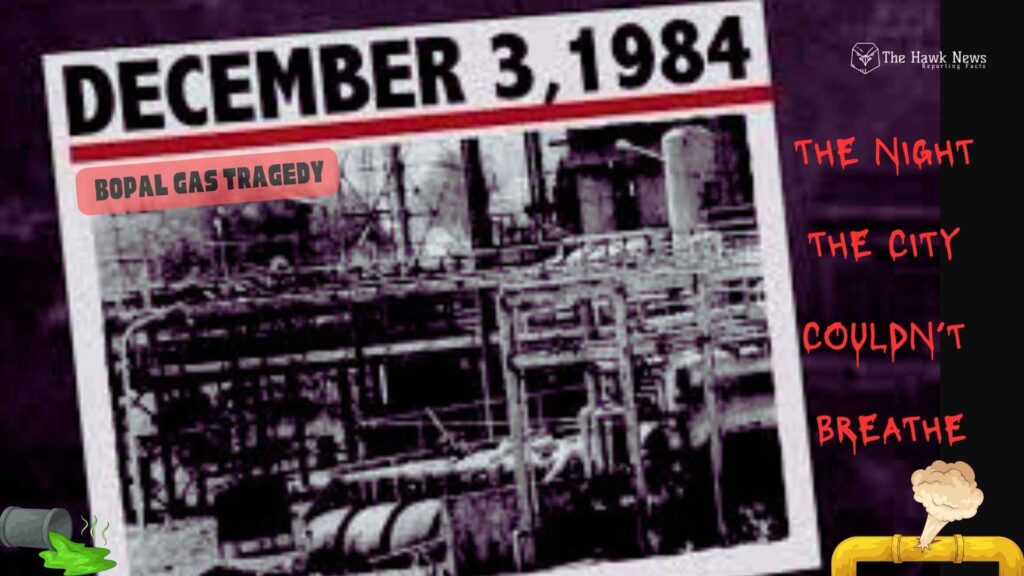
A disaster born not from fate, but from decisions — human, corporate, and catastrophic.
On the night of December 2–3, 1984, Bhopal became the epicenter of the worst industrial disaster the world has ever witnessed.
While most of the city slept, 40 tons of methyl isocyanate (MIC) silently escaped from a tank inside Union Carbide’s pesticide factory. Within minutes, the gas turned into a deadly cloud — invisible, fast-moving, and unforgiving.
People woke up choking, their eyes burning, lungs collapsing. Streets filled with screams, confusion, and chaos. Entire families were wiped out in the span of a single night.
By sunrise, thousands lay dead.
By the end of the week, the death toll was in the tens of thousands.
And for hundreds of thousands more, the suffering had only begun.
This was not an accident. It was a failure — of systems, of oversight, of ethics.
THE PERFECT STORM OF NEGLIGENCE
The Union Carbide plant had long been surrounded by warnings:
- Leaking valves
- Corroded pipelines
- Disabled safety systems
- Undertrained staff
- A refrigeration unit shut down to save money
- MIC stored in unsafe quantities
- Warning alarms turned inward — so only workers could hear them
What should have been an industrial red flag became business as usual.
Multiple reports before 1984 had pointed to “inevitable disaster” if safety systems weren’t restored.
Yet cost-cutting continued. Regulations were ignored. Workers were silenced. The local government underestimated risks. The corporation underestimated human lives.
A chain of small decisions — each dismissed as insignificant — aligned into a catastrophe.
THE NIGHT OF THE GAS
Shortly after midnight, water seeped into a tank containing MIC, triggering a violent chemical reaction. Pressure built. Temperature soared.
At around 12:40 am, the tank burst open.
The gas spread silently across Bhopal — especially the densely populated slums around the plant.
As people inhaled it, MIC began reacting with the moisture in their lungs, forming hydrochloric acid and other deadly chemicals.
Victims described the sensation as:
“Breathing fire.”
“Swallowing razor blades.”
“Like your lungs were collapsing from the inside.”
Children died in their sleep, mothers on the roadside, entire families in minutes.
The horror was indescribable. The silence afterward was worse.
AFTERMATH: GENERATIONS STILL PAYING THE PRICE
The immediate death toll was staggering, but the long-term effects were even more heartbreaking.
Survivors suffered:
- Chronic respiratory disease
- Vision impairment
- Neurological damage
- Immune disorders
- Musculoskeletal problems
- Mental health trauma
And for many women, recurrent miscarriages and reproductive complications became haunting reminders of the night the gas came.
Even today, nearly four decades later, babies are born with deformities linked to the exposure.
Toxic waste still lies in and around the abandoned factory, leaking into soil and groundwater.
The land remembers, even if the world forgets.
ACCOUNTABILITY OR THE LACK OF IT
Union Carbide Corporation (UCC) paid a settlement of $470 million in 1989 — a figure widely criticized as grossly inadequate for the scale of the tragedy. Legal battles dragged on for decades, leaving survivors fighting for compensation, healthcare, and justice.
The plant site remains one of the biggest reminders of corporate negligence and regulatory failure in the global industrial age.
The question remains:
If a disaster this large still couldn’t bring full accountability, what will?
THE HUMAN COST OF INDUSTRIAL PROGRESS
The Bhopal disaster wasn’t just about chemicals.
It was about priorities.
It showed the danger of development without responsibility, industry without safety, and profit without humanity. It revealed the moral cost of placing affordability above safeguard, speed above inspection, and economics above ethics.
And most importantly, it showed that:
When corporations gamble with human lives, the poorest always pay the highest price.
THE LESSON THAT MUST OUTLIVE US
Bhopal’s legacy is not only one of loss — it is also one of warning.
A warning written in the breathless gasps of victims, in the grief of families, in the soil still contaminated today.
A warning that says:
➡️ Safety is not a cost — it is a responsibility.
➡️ Regulations are written in blood — ignore them, and history repeats itself.
➡️ Transparency saves lives; secrecy destroys them.
The world needs Bhopal’s story not as a chapter in history books, but as a moral compass for every industrial nation.
A CITY THAT REFUSES TO BE DEFINED BY TRAGEDY
Bhopal’s spirit did not die that night.
Survivors rebuilt their lives.
Activists marched for justice.
Doctors, journalists, and volunteers stood with the suffering.
The city rose, not in defiance of its pain, but with it.
Bhopal today is more than a site of tragedy — it is a symbol of human resilience.
Because the people who lost the most chose not to lose their voice.