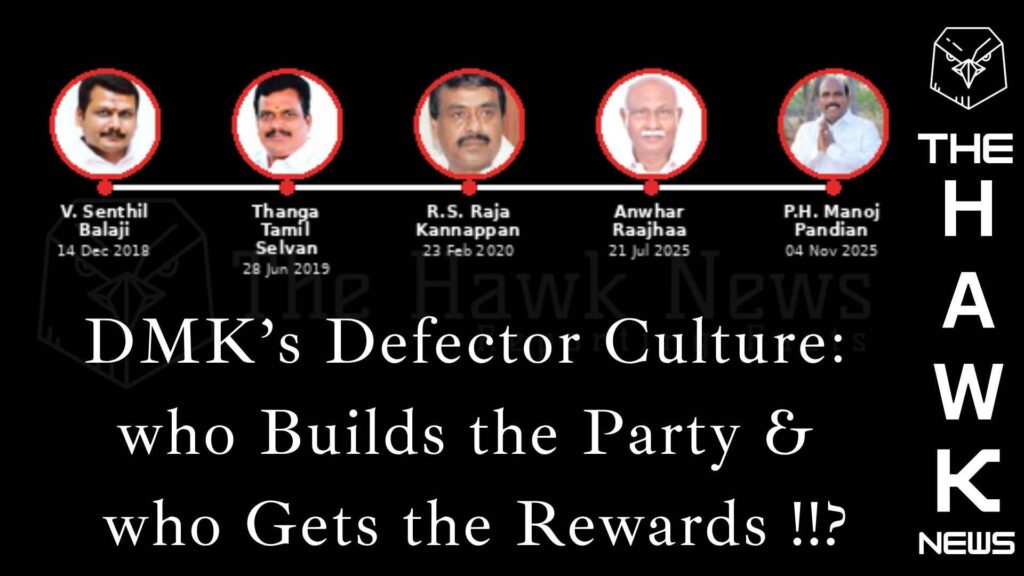
“When the Newcomer Rises, Who Remains in the Shadows?”
On 4 November 2025, P. H. Manoj Pandian — once a loyalist of the rival All India Anna Dravida Munnetra Kazhagam (AIADMK), aligned with the O. Panneerselvam faction — walked into the Dravida Munnetra Kazhagam (DMK), handed in his MLA resignation, and began his next chapter.
But beneath the surface applause lies an under-reported political fissure: what happens to the party-workers who stayed?
And: will loyalty soon become obsolete in Dravidian politics?
A pattern that repeats
For decades the DMK has championed “cadre culture” — the belief that those who sweat in the trenches, who build party presence in villages and towns, should rise. But the recent wave of defections suggests a different calculus: convert the rival, and reward him immediate power.
This is not simply politics—it’s signalling.
“We built the base. He walks past us.”
For every newcomer handed a posting, a long-standing worker watches from the sidelines.
“Those who stayed, fought, suffered — and still believe their time will come… but their time… never comes.”
This is the silent testimony of dozens of DMK cadre across constituencies I spoke to in Tamil Nadu’s southern districts. Their message: loyalty is invisible.
One former district secretary asked me “I risked midnight raids, I carried posters in rain. He switches parties and gets a seat. Where is our reward?”
That question matters, because when a party devalues internal loyalty, it weakens its foundation.
Why DMK does it anyway
From the leadership vantage the argument is simple: winnability trumps loyalty. If a strong local figure from AIADMK or another party can bring votes, the DMK will absorb him.
Manoj Pandian’s entry is a textbook case: an AIADMK MLA resigns, joins DMK, gives a blow to a rival, brings symbolic value. But the cost is borne by the men and women who stood untouched through party winters.
The long-term risk — erosion of internal morale
The calculus may work in the short term, but the long-term risk is subtle and severe: cadres stop believing in promotion through loyalty.
When career-incentives flip—when switching becomes the fast-track rather than steadfast work—the morale of the ground-game collapses.
And when a party loses its soul, only its structure remains. And structure without soul is brittle.
Does this shake the party’s roots? Absolutely.
Because the true defence of any party during opposition years is its loyal cadre—not the stranded defector who arrived with fanfare. When the music stops and power slips, those who stayed are the ones left to fight.
The DMK looks strong on paper — but beneath it, the ground-level trenches are hollowing.
“You rewarded him, you ignored us,” is the whisper in village halls, in panchayats, on long bus rides between campaigns.
When you systematically hand power to newcomers and neglect internally built talent, you say to your sole constant: “Loyalty is optional.” And when loyalty becomes optional, the bones of the organisation crack.
So what happens now?
In each constituency where a defecting leader is placed ahead of home-grown talent, expect simmering resentment. That resentment may not hit headlines now—but it will manifest in weakened canvassing, lower morale, fewer volunteers, silent absences.
And in 2026, when power may slip, the DMK will find itself: a strong-looking party with weak roots.
Final word
If defection is the new qualification… then ask this:
Does loyalty have any value left in Dravidian politics?