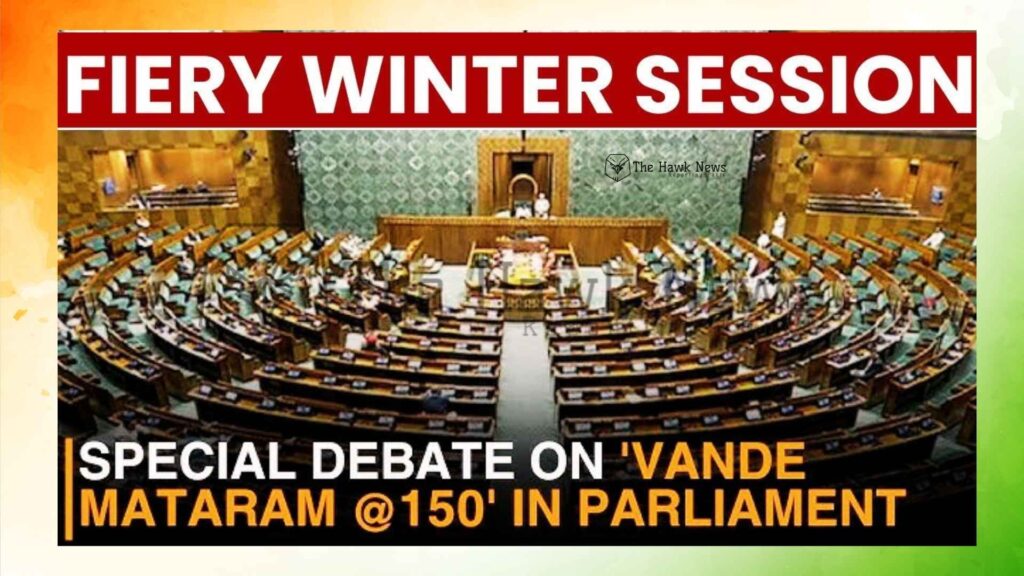
The Winter Session of Parliament was expected to move through legislative business, economic updates, and long-pending policy discussions.
Instead, it quickly turned into a charged national moment — a 150-year commemoration of Vande Mataram that escalated into a full-scale identity debate.
What unfolded inside both Houses was not just a cultural reflection. It exposed a deeper shift in Indian politics: symbolic and identity-based issues increasingly taking center stage, while structural economic questions remain in the background.
This article examines that shift — not to judge it, but to document it.
A Debate Meant for History — But Charged by Politics
The government introduced a special discussion commemorating 150 years of Vande Mataram, calling it a tribute to India’s freedom struggle.
The emotional weight of the moment was clear.
But the debate quickly expanded beyond history and literature.
What Amit Shah Said
Home Minister Amit Shah described Vande Mataram as an
“immortal creation that reflects the nationalist and traditional values of India and the dedication towards Mother India.”
He also sharply criticised historical decisions made during the freedom movement era.
Referring to the 1937 Congress decision to officially approve only the first two stanzas of the song, he said:
“On the 50th anniversary of Vande Mataram, Nehru divided it into two and limited it to two stanzas. This was the way Congress honoured Vande Mataram.”
He went further, asserting that the act of “dividing” the song was part of “appeasement politics,” adding that this mindset “led to the partition of India.”
Shah also addressed speculation that the debate was politically timed. He said:
“Some people want to diminish its importance by linking it to the West Bengal elections. This is an immortal creation… discussion will help future generations understand its true importance.”
The Opposition’s Response
Opposition benches raised concerns on constitutional grounds and political priorities.
AIMIM chief Asaduddin Owaisi reiterated that compelling anyone to recite Vande Mataram would infringe on “freedom of expression and conscience” guaranteed under the Constitution.
Other opposition MPs questioned the timing, calling the debate a political diversion. One MP described it as a “divide-and-rule tactic”, arguing that Parliament should focus on pressing economic issues.
The Pattern: Identity Politics Rising as Economic Politics Recedes
The emotional intensity of the Vande Mataram debate reflects a broader political pattern.
1. Symbolism Is Easier to Mobilise Than Economics
Economic discussions demand data, budgets, and accountability.
Cultural symbolism demands emotion — and emotion is politically powerful.
A debate on inflation requires explanations.
A debate on identity requires applause or outrage.
2. Symbols Can Reframe Political Narratives
Revisiting cultural icons like Vande Mataram allows parties to:
- reaffirm ideological positions
- energise their core voters
- redirect national discourse toward history and identity
Policy debates rarely produce this kind of immediate political energy.
3. The Public Gets Pulled Into Symbolic Battles
Millions may not track fiscal deficits or industrial policy.
But they instinctively react to debates on:
- national songs
- national heroes
- national symbols
Identity politics works because it feels personal — and is therefore easier to weaponise or celebrate.
Risks of Shifting Focus From Policy to Identity
The Vande Mataram session was powerful, but it also raises structural questions.
1. Polarisation Intensifies
Cultural debates often split society into camps — “for” or “against” — even when the reality is more nuanced.
Minority groups may feel alienated; majority groups may feel emboldened.
2. Economic Issues Lose Visibility
India continues to face:
- youth unemployment
- inflation concerns
- unequal recovery across sectors
- rural distress
A Parliament session dominated by symbolic issues means less floor space for these challenges.
3. Governance Can Become About Emotion Instead of Delivery
If electoral politics rewards symbolic stands more than practical governance, parties may prioritise symbolism over solutions.
What Citizens Should Watch — Without Bias or Assumptions
As journalists, our job is not to close debates.
It is to reveal what they represent.
This debate signals that:
- Identity issues may dominate the political climate leading to upcoming elections.
- Historical reinterpretation is becoming a frontline political tool.
- Symbolism is increasingly driving Parliament’s agenda.
- The gap between public sentiment and policy priorities may widen further.
None of this is about who is right or wrong.
It is about understanding what the shift means.
A Nation at a Crossroads
India is in a moment where cultural pride, historical memory, and political identity are reshaping the public conversation.
But the economic realities remain.
The social realities remain.
The governance demands remain.
The Vande Mataram debate is more than a commemoration.
It is a mirror — reflecting what our politics chooses to amplify, and what it may be choosing to postpone.
As the session continues, one question stays open:
Will Parliament balance identity with economy — or will symbolism continue to overshadow substance?
That is a question only future debates will answer.