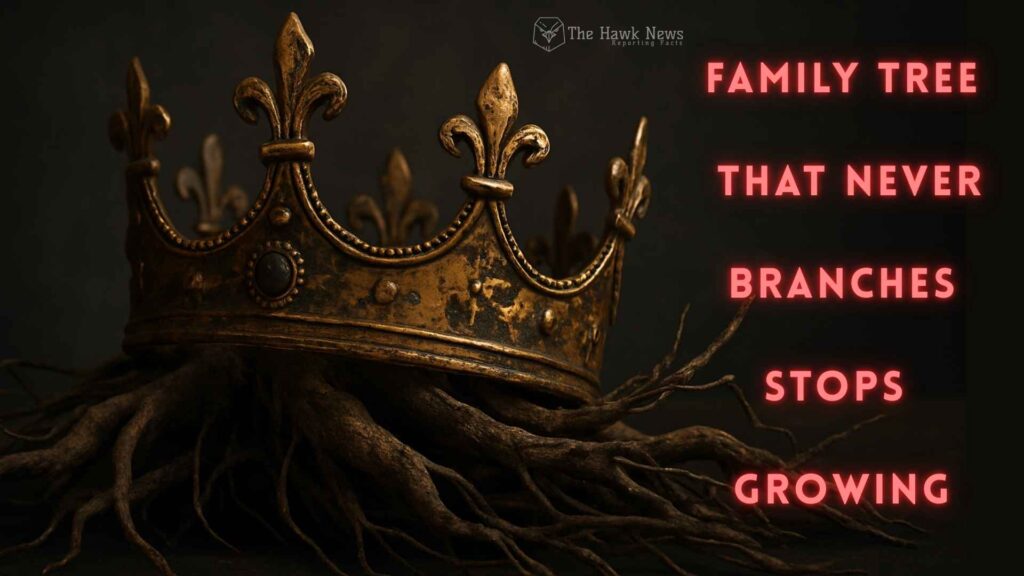
Once upon a time, power ran in blood — and sometimes, it refused to let any new blood in.
In the cold, dim corridors of Madrid’s Alcázar Palace, a young king sat — pale, trembling, and alone. His name was Charles II of Spain, the last of the mighty Habsburg line. He was born into royalty, yet his body was a battlefield of history’s decisions.
He struggled to chew food, to walk without pain, to speak without effort. At his death in 1700, an autopsy revealed a heart “no bigger than a peppercorn,” lungs corroded, intestines rotten, and a skull filled with fluid.
But his true tragedy wasn’t just biological — it was generational. His father had married his niece. His family tree had folded in on itself so many times that it became a noose.
The empire that once ruled half the world died not by sword or revolt — but by its own reflection.
The Bloodline That Refused to Branch
The Habsburg dynasty was one of Europe’s most powerful families — rulers of Spain, Austria, the Holy Roman Empire, and beyond.
They were obsessed with “keeping the blood pure.” To preserve power, they married cousins, nieces, even uncles. Over centuries, that closed loop of unions became a genetic echo chamber.
Science would later reveal the cost. Researchers analyzing the royal genealogy estimated that Charles II had an inbreeding coefficient of 0.25 — the same as a child born to siblings. His genes were trapped in a loop, repeating flaws instead of evolving strength.
But in their time, the Habsburgs believed purity equaled power. That belief became their curse.
A Body That Spoke the Truth
Charles II’s frail body became a living metaphor for a dying empire. He suffered from epilepsy, stunted growth, infertility, and what historians called “bewitchment” — a word that masked genetic collapse.
He was not a villain, not even a failed ruler by choice — he was simply the product of decisions made generations before his birth.
Each ancestor’s choice to marry within the bloodline added another thread to the web that would finally strangle the dynasty.
Even in his loneliness, he carried the weight of empires. “The bewitched,” they called him — but the spell was of their own making.
When Charles II died childless, the Spanish branch of the Habsburg dynasty ended. The bloodline that had conquered half the world now had nowhere left to go.
The Collapse of a System
The death of Charles II sparked the War of Spanish Succession, plunging Europe into chaos. But his death also carried a quiet warning — systems that refuse to renew themselves eventually rot from within.
The Habsburg obsession with keeping power “in the family” became their undoing. Their story is a biological lesson, yes, but also a moral one. Diversity — of genes, of ideas, of connections — is not weakness. It’s survival.
Empires crumble when they echo only themselves.
Echoes in Our Time
You don’t need a crown to repeat their mistake.
Today, our world mirrors the Habsburgs in subtler ways.
We build echo chambers — online, at work, in our social lives. We follow those who think like us, agree with us, look like us.
Algorithms feed us comfort; communities reward sameness. We scroll through worlds that never challenge us, only reflect us.
And like royal bloodlines, ideas can inbreed too. When we close ourselves to new perspectives, our thinking weakens. When we silence difference, our collective imagination shrinks.
It’s not just biology that collapses without diversity — it’s truth, culture, and humanity itself.
The lesson from Charles II’s pale reflection reaches through centuries: what you’re connected to may also trap you.
The Science of Fresh Blood — and Fresh Thought
In nature, genetic diversity is essential for resilience. It prevents disease, strengthens species, and allows adaptation to new environments. The same principle applies to society. When fresh perspectives enter — whether it’s in science, art, politics, or relationships — systems evolve.
But when we cling to our own “bloodlines” of belief, tradition, or ideology, we risk decay. The comfort of sameness feels safe — until it starts suffocating.
The Habsburgs believed their blood was sacred. In truth, it became sterile.
Breaking the Loop
There’s a reason every healthy tree branches out.
Each branch risks wind, weather, and breakage — but without branching, the tree can’t grow.
Our generation stands at a similar crossroad. We can either repeat the old cycles of closed circles and inherited bias — or break them. We can learn from history not by memorizing dates, but by decoding its patterns.
Every time we open up to difference — listen to someone from another culture, ideology, or background — we add new genes to the collective future. Every time we question, instead of just inherit, we keep evolution alive.
The Habsburg story isn’t just about kings and queens. It’s about all of us — about the danger of worshipping what we already know.
A Kingdom of Mirrors
In the end, Charles II’s palace wasn’t full of enemies — it was full of mirrors.
Every face around him looked familiar because it was. Every voice carried the same tone, the same last name, the same DNA. And in that sameness, silence grew.
The mirrors were meant to reflect greatness, but they only reflected exhaustion.
Our world today, flooded with screens that show us our own preferences back at us, isn’t too different. We’re living in digital dynasties where our feeds crown us kings — of our own bubbles.
And just like the Habsburgs, we might one day wake up to find the empire of our minds gasping for air.
The Final Reflection
When Charles II died, Spain mourned the end of a dynasty. But history mourned something deeper — the price of purity, the cost of isolation.
The Habsburgs built walls to protect their power, their faith, their blood. But walls don’t just keep others out — they keep you in.
The lesson is simple, but it echoes through time: growth begins where repetition ends.
So whether in families, friendships, or nations — let the blood mix, let the ideas clash, let the world evolve.
Because even the purest empire turns to dust if it refuses to breathe new air.
Pull Quote:
“If the family tree never branches, it stops growing.”