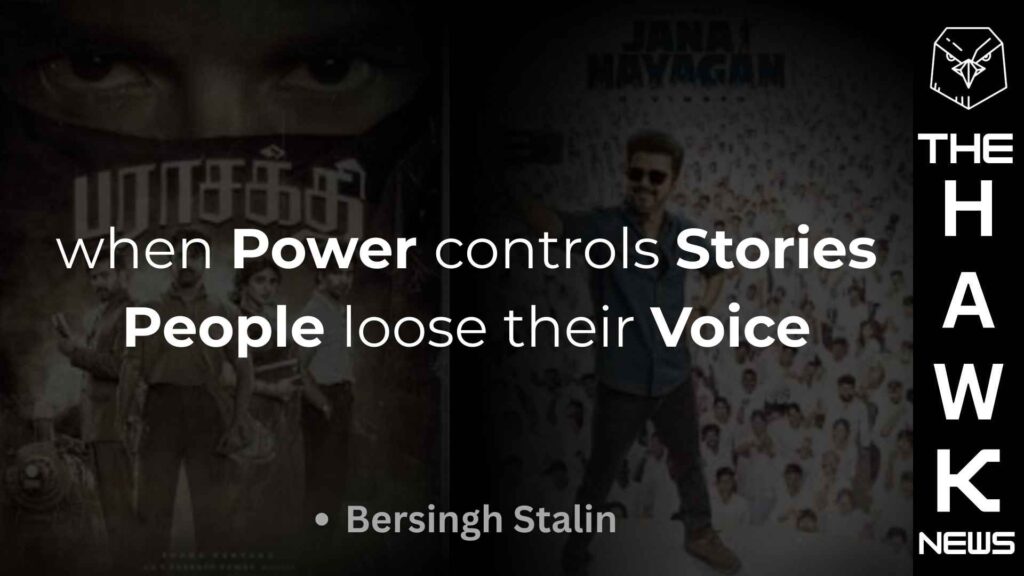
When the Central Power Becomes the Controller:
Jananayagan, Parasakthi, and the Dangerous Collapse of Democratic Space in India
Two films.
Two rival political camps.
One censor board.
One central power.
That is not coincidence.
That is control politics exposed.
The ongoing pressure on Jananayagan, a film associated with Tamilaga Vettri Kazhagam, and Parasakthi, linked to the Dravida Munnetra Kazhagam, is not merely a dispute over certification.
It is a democratic stress test and India is failing it.
Because when both sides of a political divide are throttled by the same central mechanism, the issue is no longer ideology.
It is authority weaponised.
Cinema in Tamil Nadu: Not Entertainment, But Power
To understand the gravity of what is happening, one must first understand Tamil Nadu’s political DNA.
Cinema here has never been escapism.
It has always been a political classroom.
From C. N. Annadurai writing reformist screenplays, to M. Karunanidhi scripting ideological monologues, to MGR and Jayalalithaa translating cinematic charisma into electoral dominance—Tamil cinema has functioned as:
- A mass political university
- A narrative battlefield
- A direct line to the working class
Tamil films don’t just reflect politics.
They manufacture political consciousness.
That is precisely why control over cinema has always been the ultimate temptation for any authoritarian power.
What the Censor Board Was Meant to Be
The Central Board of Film Certification was never meant to be a moral police force.
Its legal mandate is narrow:
- Classify films based on age suitability
- Flag extreme obscenity or violence
- Ensure public order is not directly incited
It was never empowered to:
- Enforce political comfort
- Protect ruling parties from criticism
- Stall narratives before elections
- Apply informal pressure without written orders
Certification is a legal function.
What we are witnessing now is extra-legal intimidation.
The Red Flag Moment: When Both Sides Are Targeted
Here is the most dangerous detail that many are missing.
- Jananayagan is aligned with TVK, a party not in power.
- Parasakthi is linked to DMK, a ruling state party with deep roots, money, cadre strength, and mass following.
Ideologically, they are not allies.
Politically, they are competitors.
Yet both are facing:
- Delays
- Unofficial objections
- Vague demands
- Unwritten instructions
That tells us one thing clearly:
The censorship is not ideological.
It is hierarchical.
It is not about what is said.
It is about who controls the permission to speak.
The Centralisation of Power: BJP and Narrative Control
Let us stop pretending this is accidental.
India today is governed by a highly centralised political structure under the Bharatiya Janata Party.
This centralisation has three defining characteristics:
- Narrative intolerance
- Institutional obedience
- Election-time sensitivity
Cinema, especially in Tamil Nadu, threatens all three.
Elections are approaching.
Narratives are being drafted.
Political memory is being shaped.
Every party has the democratic right to present its story to the public.
That includes:
- The ruling party
- The opposition
- New political entrants
But when the central ruling power uses institutions to decide which narratives are too risky, democracy shifts into managed consent.
Historical Pattern: This Is Not New
This is not the first time cinema has been targeted.
The Emergency Era (1975–77)
During Indira Gandhi’s Emergency:
- Films critical of authority were stalled
- Press was censored
- Art became suspect
That period is now universally acknowledged as a dark chapter.
The Difference Today
Back then, censorship was declared.
Today, it is denied.
No official ban.
No written order.
Just delays, pressure, and uncertainty.
That is more dangerous.
Because invisible censorship cannot be legally challenged easily.
It thrives on fear, not law.
Why This Is a Democratic Alarm
Let us ask the most uncomfortable question.
If:
- A ruling party like DMK
- A powerful new entrant like TVK
- High-budget films
- Star power
- Money
- Media attention
can all be pressured simultaneously !!
What chance does a common citizen have?
What happens to:
- Independent filmmakers
- Documentary creators
- YouTubers
- Journalists
- Whistleblowers
When the state demonstrates that permission is political, silence becomes survival.
That is how democracies don’t collapse overnight.
They slowly suffocate.
Mob Power + Institutional Power = Authoritarian Equation
India today is facing a dangerous convergence:
- Mob power on the streets
- Institutional power in offices
- Narrative power in media
When these three align under one political belief system, dissent is no longer debated—it is discouraged structurally.
This is not about BJP vs DMK.
This is not about TVK vs Dravidian politics.
This is about whether the state allows competing stories to exist.
The Illusion of “Procedure”
Supporters of censorship often hide behind one word: procedure.
But procedure without transparency is coercion.
When:
- Objections are oral
- Guidelines are flexible
- Decisions are delayed without explanation
Procedure becomes a weapon, not a safeguard.
Democracy does not die when laws are broken.
It dies when laws are selectively applied.
Why Tamil Nadu Matters to India
Tamil Nadu has historically acted as:
- A counter-narrative state
- A federal pressure point
- A cultural outlier
Controlling narratives here is not symbolic—it is strategic.
If cinema can be tamed in Tamil Nadu, it can be tamed anywhere.
That is why this conflict must not be dismissed as “film industry drama”.
It is constitutional politics playing out through art.
The Core Question Democracy Must Answer
This entire episode boils down to one unavoidable question:
Who owns public imagination in India?
- The people?
- Or the power centre?
If a central authority can decide when, how, and whether political stories reach the public, elections become administrative rituals, not democratic choices.
Final Warning
This is not about defending any one film.
This is about defending the right to narrate.
Today it is Jananayagan and Parasakthi.
Tomorrow it could be:
- A book
- A speech
- A post
- A protest
When certification turns into control, democracy turns into permission.
And permission is the opposite of freedom.
This is brutal.
This is unacceptable.
And this is an alarm India cannot afford to ignore.