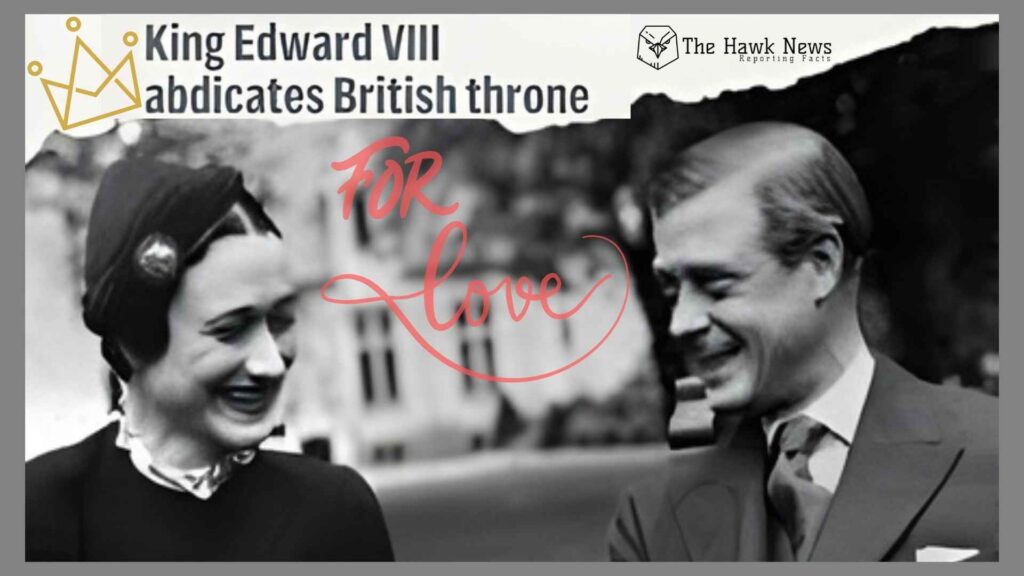
On December 11, 1936, a man born to rule the British Empire chose to step away from it.
King Edward VIII, sovereign of a quarter of the world’s population, abdicated the throne after less than a year as monarch.
His reason was unprecedented in royal history: he wanted to marry Wallis Simpson, an American woman twice divorced.
The marriage was forbidden under the conventions of the British monarchy and the Church of England, of which the king was the Supreme Governor.
What followed was shock, confusion, and a reordering of the monarchy that would echo through the 20th century—and into the present day.
This was not just a love story. It was the first modern collision between personal authenticity and institutional power.
A World That Expected Obedience
In 1936, monarchy was not symbolic theater. It was authority. Tradition was not optional; it was survival. Kings were not expected to want happiness—only continuity.
Edward VIII, however, was different.
He was charismatic, informal, and visibly uncomfortable with royal rigidity. He disliked ceremony, resisted protocol, and showed little patience for the machinery of empire.
His popularity among the public masked deep unease within the political establishment, which questioned his temperament and judgment.
Edward was a king shaped by a world that was changing faster than the institution he inherited.
Wallis Simpson and the System’s Breaking Point
Wallis Simpson quickly became the focal point of the crisis—but history has often simplified her role.
She was not politically powerful. She did not demand a crown. She represented something far more unsettling to the monarchy: a challenge to its moral and cultural authority.
As a twice-divorced American, Wallis embodied modernity, independence, and social mobility—qualities the monarchy found threatening.
The Church of England forbade remarriage while former spouses were alive. Parliament feared scandal. The empire feared instability.
The issue was never just Wallis Simpson.
It was whether the crown could bend to human choice.
The Abdication Speech: Vulnerability Before Power
Edward VIII addressed the public by radio—a medium that brought his voice directly into homes across Britain and beyond.
“I have found it impossible to carry the heavy burden of responsibility,” he said, “without the help and support of the woman I love.”
For the first time, a reigning monarch openly acknowledged emotional need.
To modern ears, this sounds almost ordinary. In 1936, it was revolutionary.
Kings did not speak of love as necessity. They spoke of duty.
Edward’s words humanized him—but also sealed his fate.
A Decision That Reshaped History
Edward’s abdication triggered a chain reaction few could have predicted.
His younger brother, George VI, ascended the throne reluctantly. Plagued by self-doubt and a severe speech impediment, he was thrust into leadership just as Europe edged toward war.
Yet George VI would become a steady wartime king—symbolizing resilience during Britain’s darkest hours.
His early death in 1952 elevated his daughter, Elizabeth II, to the throne at just 25 years old. Her reign would become one of the longest and most defining in history.
In stepping aside, Edward VIII unintentionally created the monarchy the modern world recognizes today.
Reframing Edward VIII: Failure or Foresight?
History has struggled to place Edward.
Was he selfish? Romantic? Weak? Honest?
The truth is more complex.
Edward exposed a flaw that institutions often hide: leadership imposed without alignment is unstable. He did not lack power—he lacked conviction in the role itself.
For a generation raised to question inherited paths, his story resonates differently now.
He chose to leave.
Why This Story Speaks to Today’s Generation
For Gen Z and Gen Alpha, Edward VIII feels less like a historical curiosity and more like a case study in modern identity.
- Burnout before the term existed
- Mental strain masked as privilege
- Choosing personal truth over public expectation
This was a man who had everything and discovered that misalignment can make even power feel like captivity.
The Real Conflict: Individual vs Institution
The abdication was not a triumph of romance. Nor was it a collapse of duty.
It was a system test.
Edward’s choice forced the monarchy to confront its rigidity. The institution survived—but only because it adapted, tightened its protocols, and clarified its expectations.
Progress often begins not with revolution, but with refusal.
The Takeaway: Walking Away Can Be Leadership
We are taught to admire those who rise. We rarely examine those who step aside.
Edward VIII’s abdication offers enduring lessons:
- Power without purpose is hollow.
- Institutions demand sacrifice—but must reckon with human limits.
- Choosing differently is not always failure; sometimes, it is clarity.
Edward did not lose a throne.
He revealed its cost.
A Quiet Ending to a Loud Moment
Edward VIII lived the rest of his life as the Duke of Windsor—removed from power, watched with suspicion, remembered with debate.
Yet his single decision altered the monarchy more profoundly than decades of ceremonial rule.
In an age that prizes authenticity, his abdication feels unexpectedly contemporary.
History remembers kings who ruled.
It rarely remembers those who chose not to.
Perhaps that is why Edward VIII still matters.