Creativity in a Copy–Paste World
Scroll through any social feed today, and you’ll notice something strange. Everything looks… the same. The same poses. The same filters. The same “minimalist flat-lay desk aesthetic.”
The same reels with the same audios, repeated a million times until the originality melts into static. Creativity has never been more widely celebrated — yet, paradoxically, never more manufactured.
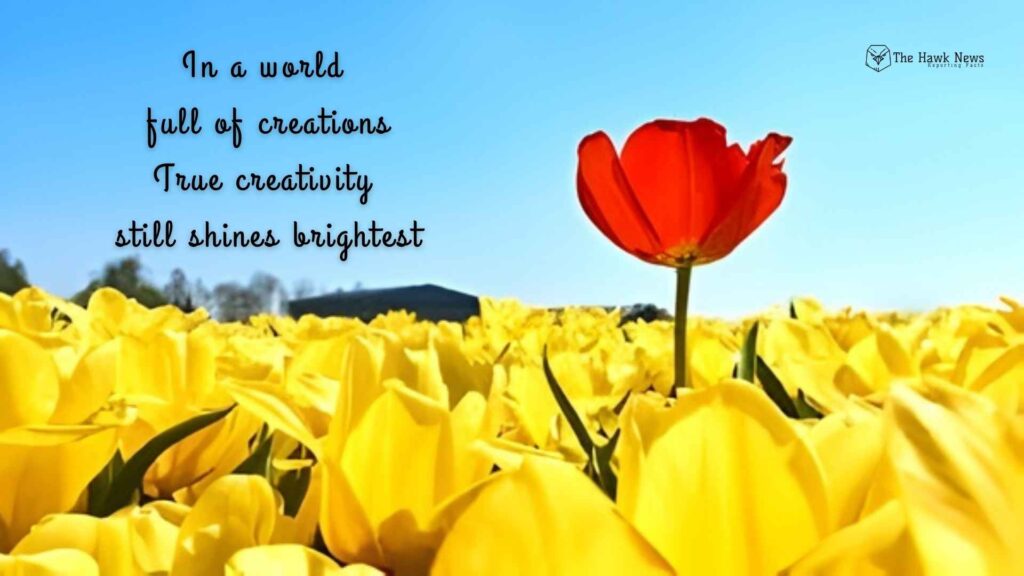
And that’s exactly why a single red flower rising above a field of perfect yellow blooms feels so arresting. It breaks the pattern. It interrupts the expected. It demands attention simply by refusing to blend in.
That lone red flower is the perfect metaphor for true creativity in a copy-paste world, especially for the younger generation growing up in the era of algorithms and AI.
Because standing out today isn’t easy. The world is optimized for sameness. But the world still aches for originals.
This article explores why authentic creativity is becoming rare, why it matters more than ever, and what it means to be “the last original” in a world dominated by templates.
THE AGE OF TEMPLATES
We live in the most templated era in human history.
Not because people lost imagination — but because everything around us encourages uniformity:
- Trends tell us what style is acceptable
- Algorithms boost what already exists
- Templates make creation faster but predictable
- AI tools reproduce patterns from existing data
- Virality rewards imitation, not innovation
Platforms scream “be creative,” but their systems whisper, “stay safe.”
And the younger generation—digital natives who grew up in this environment—struggle between:
- the urge to express themselves
- and the pressure to conform to what performs well online.
Creativity hasn’t disappeared.
It’s just been… streamlined, packaged, and optimized into something formulaic.
Which is why the world feels saturated with content yet starved for real originality.
THE RED FLOWER: A SYMBOL OF DEFIANCE
In the image, the red flower isn’t taller, bigger, or more dramatic than the yellow ones.
It’s just different.
Different because it had the courage to be different.
And that’s the core truth about modern creativity:
Originals aren’t always the loudest — they’re simply the ones who refuse to become copies.
The younger generation is the most critically aware group alive — they know when something is staged, filtered, curated, or algorithm-driven. They crave authenticity because they grew up drowning in digital decoration.
So the red flower becomes more than just a visual contrast — it becomes a reminder:
- Not everything that stands out is loud.
- Not everything that blends in is comfortable.
- And not everything that goes viral is valuable.
AI: THE GREAT EQUALIZER OR THE GREAT FLOOD?
AI is brilliant — a revolution.
But it also creates a tidal wave of content that looks (and feels) eerily similar.
AI reproduces patterns by design.
And while it accelerates creativity, it also dilutes it.
For the younger generation using AI tools daily:
- It makes creation faster
- But also makes originality harder
- Because everyone can produce “good enough” ideas instantly
Which means the value of originality skyrockets.
In a world where anyone can create, only the truly creative can stand out.
The red flower, in this sense, is not anti-AI — it simply represents a creator who uses tools without losing their identity in the process.
THE RISE OF THE AESTHETIC INDUSTRY
Here’s the truth:
Aesthetics have become a currency.
People no longer post moments — they post aesthetic categories:
- Cottagecore
- Dark Academia
- Clean Girl
- Old Money
- Soft Boy
- Beige Minimalism
- Maximalist Chaos
Each aesthetic becomes a template.
A pattern.
A set of rules.
But the younger generation is slowly pushing back.
They’re saying:
- “Let me mix aesthetics.”
- “Let me customise trends.”
- “Let me express my real self, not the algorithm-friendly version.”
And that rebellion — subtle but powerful — is the beginning of a new creative era.
THE PRESSURE TO PERFORM CREATIVITY
Ironically, creativity today is visible.
Permanent.
Public.
Measured.
It’s liked, shared, judged, saved, and compared.
This creates a strange tension:
People want to be creative, but they’re afraid of creating something “bad.”
So they stick to safe formats.
The ones they know will work.
The yellow flowers, not the red.
But here’s the twist:
What resonates most is not the perfect idea — but the personal one.
Perfection is everywhere.
Personality is rare.
THE YOUNGER GENERATION: THE RETURN OF REAL CREATIVITY
Despite the pressures, the younger generation is redefining creativity in remarkable ways.
They’re:
- mixing vintage and futuristic styles
- bringing back analogue photography
- rediscovering handmade crafts
- writing raw, unpolished captions
- producing experimental music
- embracing imperfect fashion
- rejecting symmetry and standardisation
- blending cultural influences
- blurring the line between digital and real
They’re not trying to be flawless.
They’re trying to be human.
And humans — unlike templates — are unpredictable.
That unpredictability is creativity.
THE BEAUTY OF THE RED FLOWER
Think about it:
Every yellow flower is beautiful.
But the red flower is unforgettable.
It’s memorable because it breaks expectation.
That’s what true creativity does — it disrupts patterns so subtly that you don’t realize how loud the silence was until someone spoke differently.
The younger generation is filled with red flowers waiting to bloom.
Not louder.
Not bigger.
Just different.
And in the era of infinite copies, the value of difference is priceless.
HOW TO BE THE LAST ORIGINAL
Here are simple principles for staying authentic in a template world:
1. Don’t chase trends — study them and twist them
Trends aren’t bad.
Blind conformity is.
2. Use AI as a tool, not an identity
Let AI build the structure.
You add the soul.
3. Create imperfectly
Perfection is predictable.
Imperfection is personal.
4. Mix influences — build your own pattern
Every original is born from unexpected combinations.
5. Dare to be the red flower
Even if the world around you is yellow.
THE WORLD IS READY FOR ORIGINALS AGAIN
We’re entering a new creative cycle.
People are tired of:
- filters
- repetition
- curated lives
- predictable aesthetics
They’re looking for something that feels real, whether online or offline.
One honest idea can outperform a thousand polished templates.
One original voice can cut through a million echoes.
One red flower can redefine a field.
If you’re reading this, my fren — remember this:
You don’t need to be the brightest.
You just need to be the one who refuses to become a copy.
In a world full of templates, be the exception.
Be the red flower.
The last original.