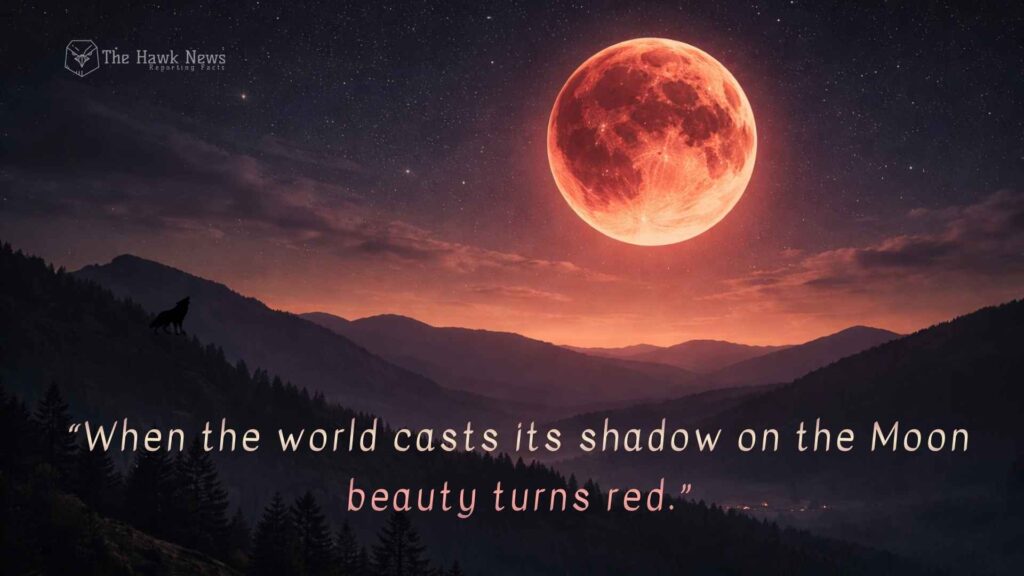
The heavens declare the glory of God; the skies proclaim the work of his hands – The Bible
When the Sky Blushed
It began quietly — a silver coin in the night sky dimming into rust.
For a few moments, the world seemed to hold its breath.
The moon, pale and familiar, turned red.
Across cities, deserts, and oceans, people lifted their eyes — some in wonder, some in superstition, others simply in silence.
A Blood Moon, rare and radiant, had risen.
It wasn’t the end of the world.
It was, perhaps, the world reminding us that even the heavens have their seasons of shadow.
The Science Behind the Spectacle
A Blood Moon occurs during a total lunar eclipse, when the Earth stands directly between the Sun and the Moon.
As sunlight bends around Earth’s atmosphere, shorter blue wavelengths scatter — leaving behind the longer red and orange rays.
These crimson threads of light, filtered through dust and clouds, gently bathe the Moon’s surface.
The result is a sphere glowing like a fading ember — neither dead nor dark, but transfigured.
“It’s not the Moon that changes — it’s the Earth’s shadow that tells a different story.”
Every shade — from burnt orange to deep wine — is determined by the air we breathe.
The more dust and particles suspended in Earth’s atmosphere, the deeper the hue.
In other words, the Blood Moon carries a fingerprint of our own planet —
the sky’s reflection of what we’ve exhaled into it.
The Myths and the Meanings
Long before telescopes and timelines, civilizations gazed upon the red moon and trembled.
In Babylon, kings feared it as a sign of rebellion among the gods.
In China, it was said that a celestial dragon had swallowed the moon, demanding drums to scare it away.
To the Incas, the blood moon meant the Moon goddess was under attack — and the people cried out, shooting arrows into the sky to defend her.
And in ancient Hebrew prophecy, it was written:
“The sun will turn to darkness and the moon to blood before the great and terrible day of the Lord.” — Joel 2:31
Yet across cultures, one truth lingered: the Blood Moon was not simply fearsome — it was sacred.
A reminder that light and shadow are not enemies, but dance partners in creation’s rhythm.
“The same God who paints the moon red also brings back its silver.”
The Modern Gaze — Science Meets Spirit
Today, astronomers predict Blood Moons with mathematical precision —
their timings measured down to the second, their orbits charted centuries ahead.
Yet even with all our instruments and apps, when the Moon turns red, we still fall silent.
Something ancient stirs — an awe that neither progress nor physics can erase.
It’s not just about optics; it’s about order and mystery coexisting.
We understand the how, but the why still humbles us.
“Science explains the eclipse; wonder explains the silence.”
What the Blood Moon Teaches Us
The Blood Moon is more than a phenomenon — it’s a parable in the sky.
It tells us that even when Earth blocks the light, reflection endures.
That beauty is not erased by shadow; it’s refined through it.
That sometimes the most radiant moments happen when we are hidden, not seen.
“When the world casts its shadow upon you, remember — even the Moon glows red before it shines white again.”
In the language of faith, the Blood Moon speaks of cleansing and renewal.
In the language of science, it speaks of alignment and precision.
In both, it whispers of harmony — that darkness and light are not rivals, but reminders.
Sayings That Glaze the Sky
“The moon is a friend for the lonesome to talk to.” — Carl Sandburg
“Yours is the light by which my spirit’s born; you are my sun, my moon, and all my stars.” — E. E. Cummings
“The moon is a loyal companion.
It never leaves.
It watches, it knows us in our light and in our dark.”
— Tahereh Mafi“Even the Moon has scars, and that’s what makes it shine.” — Unknown
“The Blood Moon is not a symbol of fear, but of faith ;
a reminder that creation still listens to its Creator.” — The Hawk News
Each quote becomes a lantern in the night — not to explain the moon, but to feel it.
When Heaven and Shadow Meet
As the Blood Moon fades and the sky resumes its calm, something remains —
a stillness that lingers in the soul.
Perhaps we look at the heavens not to escape Earth, but to understand it better.
The Blood Moon, glowing like a wound that heals itself, reminds us:
every shadow is proof that there’s still light behind it.
“And when the red turned back to white,
the world remembered —
it’s not the absence of light that makes beauty,
but its persistence.”