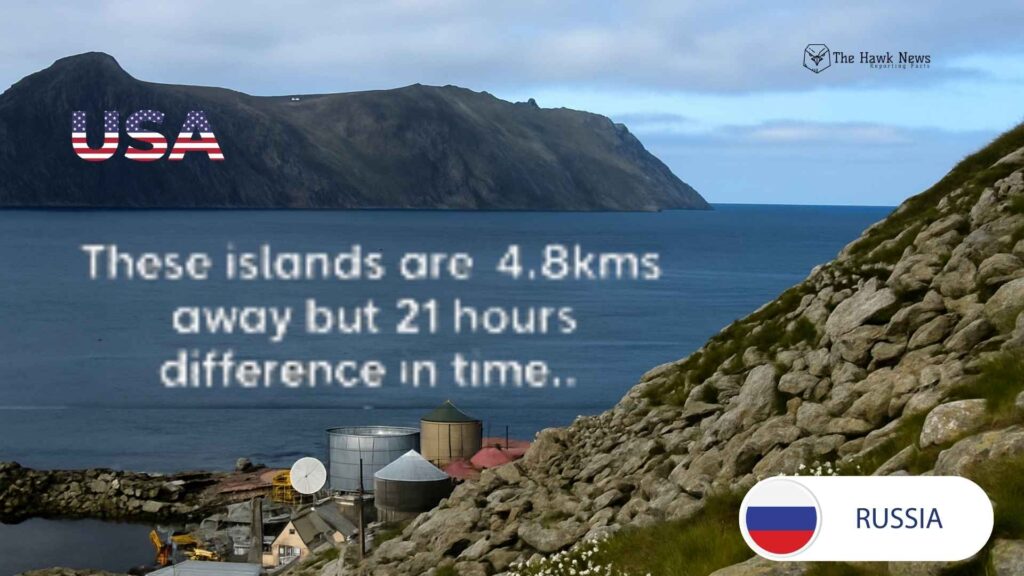
If you stand on the rocky cliffs of Little Diomede Island, Alaska, and gaze across the icy waters of the Bering Strait, you will see another island—Big Diomede—belonging to Russia.
The distance between the two is just 3.8 kilometers, short enough that, on a clear day, you can make out the small structures on the opposite shore. And yet, they exist nearly a full day apart in time.
Separated by the International Date Line, Big Diomede is perpetually tomorrow, while Little Diomede remains today.
Between them runs not just a current of cold Arctic water but a line that has come to symbolize one of humanity’s oldest illusions—that proximity means connection, and distance means division.
The irony could not be sharper. Two islands, so close they could almost touch, belong to two nations that have stood as global opposites for generations.
On one side—the United States, beacon of liberty and capitalism. On the other—the vast expanse of Russia, fortress of history and endurance.
Between them lies a strait that has seen everything: migration, war, espionage, and now, quiet observation.
Yet beyond the politics and geography, the Diomede Islands remind us of something deeper: that time itself can be a border, and borders—no matter how small—often reveal how divided we’ve become in heart and understanding.
Yesterday, Tomorrow, and the Space Between
The International Date Line may sound like a technical convenience, but here it becomes a philosophical question.
The invisible line between the Diomedes means that someone standing on Big Diomede is already living in the next day, while someone on Little Diomede remains in the previous one.
Just a few kilometers—and twenty-one hours—apart.
It’s as if humanity itself is split between yesterday and tomorrow, always reaching across the water, never quite in sync. One side wakes while the other sleeps; one speaks, the other echoes.
In this frozen stretch of ocean, we find a mirror of our modern world. We scroll through feeds, message across continents, and pride ourselves on being more connected than ever before.
Yet, like these two islands, we often exist in different “days” of understanding. Our ideologies, our media, even our truths—each shaped by the timezone of our own making.
The Diomede Strait becomes a symbol not of geography but of human dissonance. We live close enough to see each other’s faces, yet far enough apart to misread each other’s hearts.
The Cold War in Microcosm
During the Cold War, the Diomede Islands became a living metaphor for the ideological divide between East and West.
The Soviets evacuated the residents of Big Diomede, turning it into a military base.
The American side, Little Diomede, remained home to a small Inupiat community—a few dozen people living between two worlds, separated from their relatives across the water.
Families could see the land of their kin, but they could never cross. The stretch of sea that once connected them became a wound—a reminder that politics can turn oceans into walls.
It’s chilling to think that the very line that divides time also divides people. The same sun rises on both islands, yet its light arrives to different clocks, under different flags.
For all our progress, humanity still struggles with this paradox: how easily we let boundaries of our own design dictate who belongs and who does not.
The Bering Strait, then, is not just a geographical border. It is a lesson in humility—a reminder of how small the Earth is, and how vast our divisions remain.
Borders of the Mind
Look closely, and the Diomede divide is not limited to nations—it exists within us. Between what we know and what we refuse to learn. Between empathy and ego. Between connection and convenience.
We are, in many ways, our own islands. We build invisible borders of belief, time, and thought. The echo chamber becomes our strait—keeping us safe from opposing ideas while convincing us we’re connected.
The Bering Strait’s 3.8 kilometers are physical, measurable. But the distances between hearts, between communities, between truths—those are harder to measure and far harder to cross.
And yet, every once in a while, nature offers us this quiet parable. Two islands—one called Tomorrow, one Today. Standing across from each other, waiting for someone to bridge the waters in between.
Perhaps that’s what our generation must learn: that progress isn’t only about moving forward in time, but also about reaching across divides of understanding. To build bridges not of steel and trade, but of perspective.
Time as a Teacher
What makes the Diomedes extraordinary is not their separation but their symbolism.
The fact that two nations divided by ideology can exist side by side, in view of each other, suggests that conflict is not born of distance—it’s born of perception.
Time, after all, is relative. It is we who decide what is past and what is future, who is ahead and who is behind. The International Date Line may draw its curve across maps, but it cannot define the rhythm of human progress.
Standing on the shores of Little Diomede, the realization strikes you—while the people across the water live in tomorrow, you can still wave to them from today.
It’s a paradox, yes—but also a profound metaphor for coexistence. We can occupy different timelines and still share the same horizon.
A World Within Four Kilometers
In that narrow channel between Russia and America lies the geography of human contradiction: proximity without connection, separation without distance, difference without understanding.
It’s easy to think that the Bering Strait belongs to the realm of geopolitics or geography textbooks. But perhaps it belongs to philosophy.
It’s the physical embodiment of what divides us—not just as nations but as people who think we are always right, always “ahead,” while the other is perpetually “behind.”
The truth is, both islands share the same wind, the same sea, and the same sun. What separates them is merely the clock—and the minds that hold on to it.
Between Yesterday and Tomorrow Lies Us
If there’s one message the Diomede Islands whisper through the Arctic wind, it’s this: the lines we draw—on maps, in minds, in hearts—are not as real as we think.
Between yesterday and tomorrow stands today—the only moment we can use to bridge understanding.
Humanity doesn’t need more borders; it needs more bridges of perception. The question is not how far we are from one another, but how willing we are to reach across.
The Diomede Strait may be small, but it holds the world’s oldest truth: separation is often an illusion, and connection—when we choose it—is always within sight.