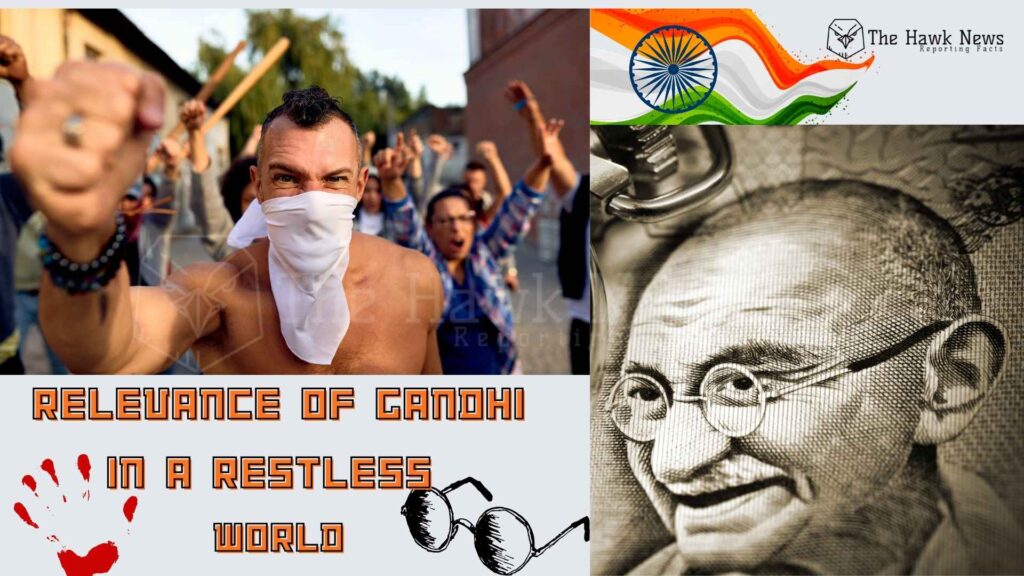
“You must be the change you wish to see in the world.” – Mahatma Gandhi
The world today is restless. Nations are polarized, societies divided, and individuals weighed down by stress, noise, and speed.
We scroll endlessly yet feel emptier, we connect instantly yet grow lonelier, we achieve more yet live with less peace.
In this environment of restlessness, the quiet voice of Mahatma Gandhi—India’s “Father of the Nation”—still speaks. His life, his principles, and his vision remain not only relevant but urgently needed.
Gandhi’s Context and Ours
Gandhi lived in a world of upheaval: colonial oppression, social injustice, and violent uprisings. His methods, rooted in simplicity and moral conviction, often seemed impractical, even foolish, to his contemporaries. Yet history proved otherwise.
With the power of truth (satyagraha) and non-violence (ahimsa), Gandhi moved masses, shook an empire, and redefined the meaning of resistance.
Our world today may not face the exact same battles, but the restlessness is strikingly familiar.
Violence persists in wars, intolerance grows in communities, greed drives economies, and individuals wrestle with inner unrest. Gandhi’s principles, far from being relics, offer us a compass to navigate this turbulence.
Non-Violence in a Violent Age
“An eye for an eye makes the whole world blind.” – Gandhi
Violence dominates headlines—from international conflicts to street crime, from online abuse to the quiet violence of discrimination. Retaliation and hatred only fuel cycles of destruction.
Gandhi’s principle of ahimsa calls us to break that cycle. Non-violence is not weakness—it is strength under control, the ability to resist injustice without becoming unjust.
Imagine if social movements today, instead of being fueled by outrage alone, were powered by disciplined non-violence. Imagine if conflicts between communities were approached with the courage to forgive and the will to seek peace.
Gandhi reminds us that non-violence is not passive surrender—it is active, transformative resistance.
Truth in an Age of Deception
“Even if you are a minority of one, the truth is the truth.” – Gandhi
We live in a time when truth itself is contested—fake news spreads faster than facts, propaganda replaces honest dialogue, and personal gain often outweighs integrity. Gandhi’s lifelong devotion to satya—truth—was not just about speaking honestly; it was about aligning one’s life with truth at every level.
For Gandhi, truth was divine, something greater than personal opinion or convenience. To follow truth meant to live authentically, to match words with actions, and to be willing to stand alone if necessary.
In a restless world filled with deception, his example calls us back to the foundation of trust: truth spoken, lived, and defended.
Simplicity in an Age of Excess
“The world has enough for everyone’s need, but not enough for everyone’s greed.” – Gandhi
Modern restlessness often springs from excess—too much to consume, too many distractions, too many comparisons. Gandhi’s life of simplicity, symbolized in his spinning wheel and plain attire, was not poverty but freedom. By reducing dependence on material excess, he discovered clarity, strength, and focus.
Our world desperately needs this wisdom. Minimalism, sustainable living, and slow living are trends that echo Gandhi’s timeless call: simplify to live deeply. Simplicity is not deprivation—it is liberation from the chains of greed and comparison.
Self-Discipline in a Distracted Age
Gandhi understood that no one can transform the world without first transforming the self. His practice of fasting, silence, and restraint was not ritualistic—it was training. He knew that self-discipline is the foundation of inner peace.
Today, in a distracted digital world, self-discipline may be the rarest virtue. Endless scrolling, constant stimulation, and unchecked desires feed restlessness.
Gandhi’s example reminds us that true freedom comes not from indulging every impulse but from mastering them. As he put it, “The best way to find yourself is to lose yourself in the service of others.”
Leadership Through Service
In an age where leadership is often equated with power, Gandhi redefined it as service. He did not command from above but walked among people, listening, learning, and sharing their burdens. His leadership was not about ambition but about vision rooted in humility.
For restless societies today, craving authentic leadership, Gandhi’s model is a beacon. A leader is not one who rules but one who serves; not one who divides but one who unites.
Why Gandhi Still Matters
Critics may argue that Gandhi’s ideals are too idealistic for today’s ruthless world. But it is precisely because our world is restless, violent, and divided that his message is so urgent.
We do not need more cynicism—we need more courage. We do not need more speed—we need more stillness. We do not need more hatred—we need more love.
Gandhi’s relevance is not in political tactics alone but in the values he embodied:
- Non-violence as power
- Truth as foundation
- Simplicity as freedom
- Self-discipline as strength
- Service as leadership
These are not outdated—they are eternal.
A Gentle Call for Today
In remembering Gandhi, we are not asked to replicate his life but to embody his spirit. The restless world does not need another Gandhi, but it does need millions who carry his values into their homes, workplaces, and communities.
Gandhi himself said, “In a gentle way, you can shake the world.” Perhaps that is the deepest relevance for us today. Change does not always require noise, aggression, or spectacle.
Sometimes, it begins with a gentle, disciplined, truth-filled life that refuses to conform to the chaos around it.
Conclusion
As we navigate a restless 21st century, Gandhi’s message stands as a quiet revolution waiting to be lived. In the noise, he offers stillness. In the hatred, he offers forgiveness. In the greed, he offers simplicity. In the deception, he offers truth. In the violence, he offers peace.
His relevance is not in the past but in the present. The question is not whether Gandhi still matters—but whether we will dare to live as if his principles do.
“My life is my message.” – Mahatma Gandhi
May his message find new life in restless hearts today.