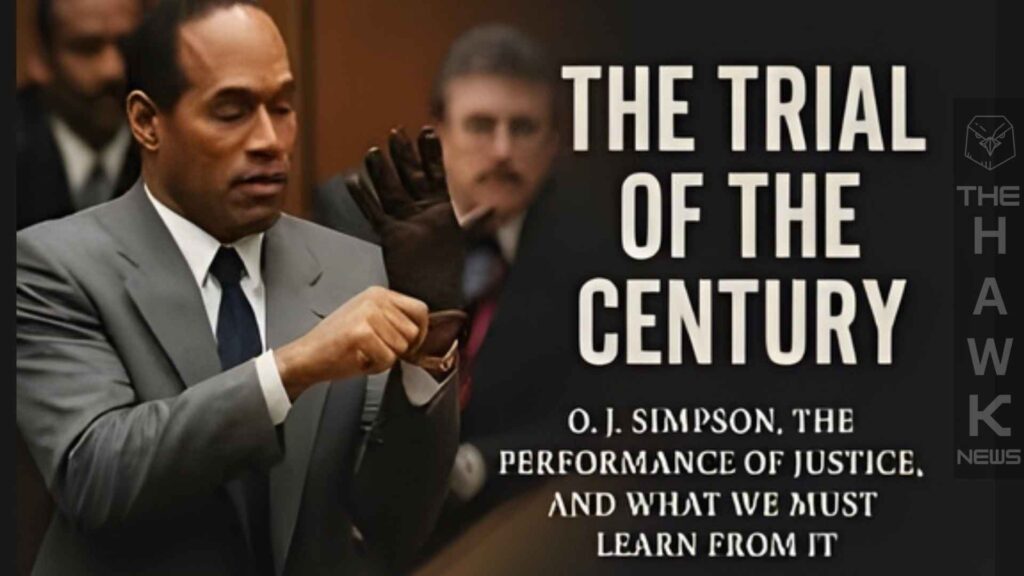
In February 1997, a civil jury found O.J. Simpson liable for the deaths of Nicole Brown Simpson and Ronald Goldman — a verdict that reopened America’s deepest wounds and questioned what justice really means in the age of spectacle.
The Night That Began It All
On the night of June 12, 1994, Los Angeles was cloaked in silence — until it wasn’t.
Nicole Brown Simpson and her friend Ronald Goldman were found brutally murdered outside her Brentwood condominium.
The scene was chaos in flesh: blood on the walkway, silence where laughter used to live.
The suspect was not a stranger. It was Orenthal James “O.J.” Simpson — once a football legend, a movie star, a cultural hero.
America had watched him rise from poverty to fame. Now, it watched him fall from grace.
The Trial of the Century
When O.J. was charged with double murder, the courtroom became an arena.
The cameras came first — networks circling like vultures over a nation’s fascination with guilt and glamour.
His legal team, dubbed the “Dream Team” — Johnnie Cochran, Robert Shapiro, and F. Lee Bailey — turned defense into performance art.
They didn’t just argue; they choreographed. Every word, every glance, every pause was calculated to shift perception.
The prosecution, led by Marcia Clark and Christopher Darden, had DNA evidence, blood samples, footprints — science that should have sealed the case. But in a trial driven by emotion and television, science often loses to story.
Then came the glove.
The bloody glove found at the crime scene — prosecutors claimed it was Simpson’s.
But when O.J. was asked to try it on in court, he struggled. It appeared small. Too tight.
Johnnie Cochran seized the moment and spoke the line that would echo through legal history:
“If it doesn’t fit, you must acquit.”
With those words, logic became rhythm. Evidence became theatre.
And the jury, moved by doubt, delivered the verdict: Not Guilty.
The Civil Reckoning
But justice, though delayed, often seeks another door.
Two years later, in a civil court in Santa Monica, the families of Nicole Brown Simpson and Ronald Goldman filed a wrongful death lawsuit.
The courtroom was quieter this time — no live broadcasts, no chants outside. Only evidence, laid bare without spectacle.
The burden of proof was lower — “preponderance of evidence,” not “beyond reasonable doubt.” And this time, the scales tipped.
On February 4, 1997, the civil jury found O.J. Simpson liable for the wrongful deaths. He was ordered to pay $33.5 million in damages — a verdict symbolic more than financial, a quiet echo of accountability after the roar of acquittal.
It was not vengeance. It was a faint whisper of justice in a system struggling to remember its own purpose.
The Mirror America Didn’t Want to See
The O.J. Simpson trials were not just about guilt — they were about America itself.
Race, class, celebrity, and media fused into one volatile narrative.
To some, his acquittal was vindication against racial injustice.
To others, it was the collapse of truth under celebrity pressure.
Every side saw its reflection in the verdict — and recoiled.
It became the trial that said as much about the country as it did about one man.
“The law is reason free from passion,” wrote Aristotle.
But in the O.J. Simpson case, reason had to compete with ratings.
The Legacy of the Line
“If it doesn’t fit, you must acquit” — it was more than a rhyme. It was a spell.
It turned the language of defense into performance, turning courtroom logic into poetry that seduced a jury.
In those seven words, the world saw the danger of persuasion divorced from truth.
Justice became entertainment.
The courtroom became a stage.
And America learned that sometimes, truth can lose to charisma.
Reflection: The Weight of Spectacle
O.J. Simpson’s fall was more than personal tragedy; it was cultural prophecy.
He embodied a time when fame began to eclipse integrity — when what was seen mattered more than what was true.
The civil verdict, though corrective, could not erase the wound left by the first trial.
Today, that story still whispers a warning to journalists, lawyers, and citizens alike:
When justice becomes content, truth becomes collateral.
“He who speaks truth tells what is right,
but a false witness, deceit.” — Proverbs 12:17
And yet, even in deceit’s shadow, truth remains patient — waiting for the noise to fade so it can be heard again.