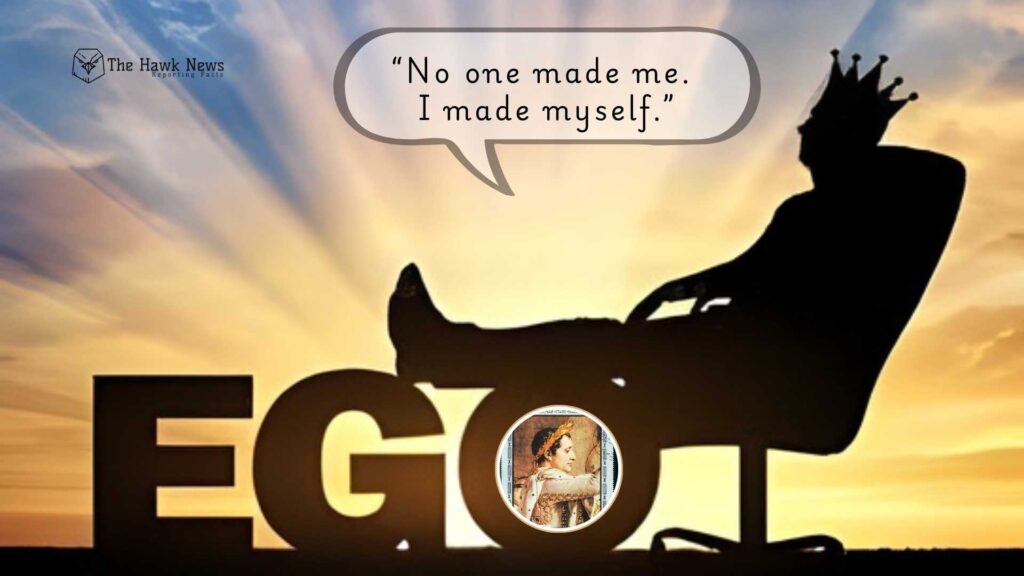
On December 2, 1804, inside the grand arches of Notre-Dame Cathedral, the world watched a moment that would echo far beyond the marble floors of Paris.
As the Pope stood ready to crown Napoleon Bonaparte Emperor of France, Napoleon took the crown into his own hands and placed it on his own head.
No hesitation.
No ritual.
No permission.
It was a message shouted silently across centuries:
“No one made me. I made myself.”
In that moment, he didn’t just coronate himself —
he coronated a mindset.
A mindset that still rules many corners of our world today.
The Birth of the Modern “Self-Made” Myth
Napoleon’s gesture was not just political rebellion; it was the crystallization of ego into ceremony. It birthed a myth that dominates our time:
The myth that greatness is self-created, self-defined, and self-entitled.
This story — of the lone conqueror who owes nothing to anyone —
has shaped CEOs, presidents, influencers, rebel movements, and even everyday individuals trying to prove they are “enough” by standing alone.
But the truth history whispers is this:
No empire is built alone.
No power exists without cost.
No crown sits weightlessly.
Napoleon’s self-coronation was independence turned into arrogance.
Today, we see the same metamorphosis everywhere.
The Leadership Crisis That Mirrors 1804
Look around at our era:
- Leaders who reject accountability
- Corporations acting as sovereign kingdoms
- Influencers declaring themselves authorities without expertise
- Nations turning inward, elevating ego over unity
- Individuals confusing loudness with leadership
Napoleon’s act has become a template —
self-appointed rulers rising in every sphere.
In 1804, it was a crown.
In our time, it’s followers, platforms, titles, and unchecked authority.
History may not repeat itself, but ego certainly does.
Why the Self-Coronation Mindset Is Dangerous
When someone crowns themselves, something else always gets uncrowned:
- Dialogue.
- Accountability.
- Shared power.
- Truth.
- Community.
Napoleon believed he was invincible — until winter, war, and time proved otherwise.
Self-coronation feels powerful, but it rarely ends peacefully.
It leads to:
- Empires stretched too thin
- Leaders isolated at the top
- Workplaces ruled by fear
- Families dominated by one voice
- Societies fractured into “me versus you”
The world Napoleon created fell apart — because no structure built on ego can survive weight.
The Modern Crown: Recognition, Authority, Validation
Today, the throne is digital.
The crown is visibility.
The scepter is attention.
You don’t need a cathedral — you need a platform.
You don’t need a crown — you need likes.
You don’t need a coronation — you need an audience.
And like Napoleon, today many believe:
“If I can claim it, I deserve it.”
But claiming power is not the same as earning it.
And earning it is not the same as sustaining it.
The Forgotten Lesson Napoleon Left Behind
What most people don’t remember is this:
After crowning himself, Napoleon didn’t ascend —
he began to decline.
Within a decade, his empire crumbled.
His army froze.
His allies disappeared.
His reputation collapsed.
He was exiled — twice.
His self-coronation was not the beginning of his legacy —
it was the beginning of his downfall.
This truth matters now more than ever.
So What Does This Mean for Us Today?
This article is not about Napoleon.
It’s about us —
our workplaces, our friendships, our politics, our online lives, and our internal battles with ego.
Because every person faces this question:
Do I chase the crown…
or do I build a legacy?
One is loud.
One is quiet.
One is quick.
One is slow.
One is shallow.
One is deep.
The world doesn’t need more self-made emperors.
It needs more grounded leaders.
Leaders who listen.
Leaders who share power.
Leaders who accept correction.
Leaders who don’t crown themselves —
but are crowned by the trust of others.
The Call for Today’s Generation
In an age where everyone is urged to “brand themselves,”
Napoleon’s story offers a warning we desperately need:
If you put yourself on a throne,
you also isolate yourself on one.
True leadership is not self-coronation.
It is service.
It is humility.
It is accountability.
It is partnership.
Greatness that stands alone will eventually fall alone.
But greatness that grows through others becomes unshakeable.
The Final Mirror
December 2, 1804 was not a coronation —
it was a mirror.
A mirror we still look into today.
It asks us:
- Do you seek the crown or the calling?
- Do you want to be obeyed or understood?
- Do you want to conquer or uplift?
- Do you want power or purpose?
History has already given its verdict:
Ego builds empires.
Humility builds worlds.
And one of them always outlasts the other.