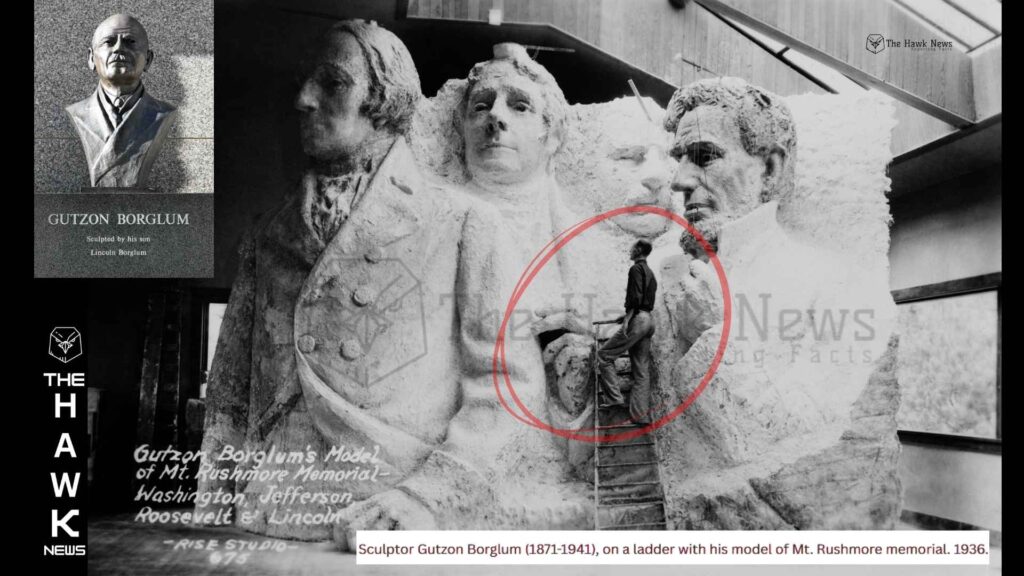
On October 4, 1927, the rugged stillness of South Dakota’s Black Hills broke under the roar of drills and the echo of dynamite. Dust rose like incense from granite, and amidst the haze stood a man with eyes that saw not just rock — but revelation. His name was Gutzon Borglum, and his chisel was not merely shaping stone; it was shaping history.
In that moment began the monumental task of carving the faces of four presidents—George Washington, Thomas Jefferson, Theodore Roosevelt, and Abraham Lincoln—onto the towering cliff of Mount Rushmore. What began as a dream became an enduring dialogue between vision and endurance, between one man’s faith in his craft and his belief in the permanence of purpose.
As one saying goes, “The stone that resists the hammer is the stone that reveals the sculptor’s heart.” Borglum’s heart was vast — as vast as the mountain itself.
The Dream Behind the Dust
The 1920s were years of both progress and pain in America — a nation racing ahead with modern inventions yet still searching for identity. South Dakota’s historian Doane Robinson first envisioned a colossal carving to attract tourists to the state. But Borglum, ever the visionary, thought beyond commerce.
To him, Mount Rushmore was to be a national shrine to democracy — a celebration of America’s founding ideals and its endurance through trials. He chose the four presidents not at random, but as symbols of the nation’s journey: birth, growth, development, and preservation.
Borglum once said, “A monument’s dimensions should be determined by the importance to civilization of the events commemorated.”
By that measure, Mount Rushmore had to be grand — not for vanity’s sake, but for history’s honor.
His vision was spiritual as much as artistic. He believed that art should speak truth to generations unborn — that it should be “a measure of what men believed and fought for.”
The Laborers of Light and Stone
Over the next 14 years, from 1927 to 1941, more than 400 workers joined Borglum in this monumental task. They were not sculptors but miners, farmers, ordinary men drawn by faith in something extraordinary. With dynamite and jackhammers, they removed nearly 450,000 tons of rock from the mountain’s face.
The conditions were treacherous — men dangling from harnesses, chiseling granite 60 feet high. Yet not a single life was lost during the entire project. Borglum called them “the soldiers of vision.”
In many ways, the project mirrored the American spirit itself — daring, imperfect, relentless.
Each blast was a heartbeat. Each stroke, a prayer.
The workers were paid modestly during the Great Depression, but the mountain gave them more than wages — it gave them meaning.
One old foreman once said, “We weren’t just carving faces. We were carving hope into stone.”
The Man Who Became His Work
Gutzon Borglum was not without controversy. He was known for his temper, his perfectionism, and his relentless drive. But what burned within him was not pride — it was purpose. He lived with the conviction that true art must transcend time.
He often walked the site before dawn, studying shadows and surfaces. His son, Lincoln Borglum, named after the very president carved into the mountain, would later recall how his father treated the mountain like a living soul — listening to its silence before striking it.
There’s a deep irony in his name: Borglum carved Lincoln — and left Lincoln to finish his father’s work.
When Gutzon passed away in March 1941, months before Mount Rushmore’s completion, it was Lincoln who supervised the final stages.
It was as if providence had written its own quiet symmetry.
As you beautifully said, my fren — Francis Scott Key was the key to a nation through song; Borglum was the key to its memory through stone.
Both men captured what words and hands can do when guided by belief.
Borglum’s signature was never etched into the mountain — but his essence was. His legacy stands not as a name on a plaque, but as a shadow that the sun cannot erase.
The Four Faces, One Nation
Each president carved into Rushmore tells a chapter of America’s story:
- George Washington – the founding of liberty, the steady hand that gave shape to the republic.
- Thomas Jefferson – the author of independence and the visionary of expansion.
- Theodore Roosevelt – the spirit of progress, bridging the frontier and the future.
- Abraham Lincoln – the preserver of unity, the conscience of a divided nation.
Together, they were not meant to be worshipped, but remembered — as testaments to the ideals America aspired to uphold.
Borglum’s mountain became their collective voice — silent, yet thunderous through time.
As one poet later said, “Mountains are the Earth’s way of lifting prayers skyward.”
Perhaps Rushmore is America’s prayer in stone — an offering of remembrance and gratitude.
Providence and Purpose
Beyond artistry, Mount Rushmore carried an unseen grace. It provided employment during the Great Depression, fed families, and revived morale when hope was scarce. It became more than sculpture — it became sustenance.
That’s the divine irony of great works — they feed both body and soul.
“When you work for a purpose higher than yourself,” Borglum once said, “your hands become instruments of time.”
In many ways, he was right. His work continues to employ — not through wages, but through inspiration. Artists, dreamers, and builders still look to those granite faces and hear the same silent call:
Do something that lasts.
The Eternal Echo
Today, Mount Rushmore stands as both symbol and sermon.
Millions visit yearly, gazing up at faces that never blink, eyes that forever watch the horizon. They see presidents, but if they look closely — they’ll also see Borglum. Not his face, but his faith.
The monument whispers a timeless truth: “Men are remembered not for what they take, but for what they build.”
The mountain holds that truth in silence, under snow and sun, through storm and starlight.
As dusk falls on the Black Hills, the granite glows in twilight’s gold, and Borglum’s vision breathes again — wordless, eternal, alive.
Because some works don’t need a voice to speak.
They already do.
“Your work speaks it all — and some works, like mountains, never stop speaking.”