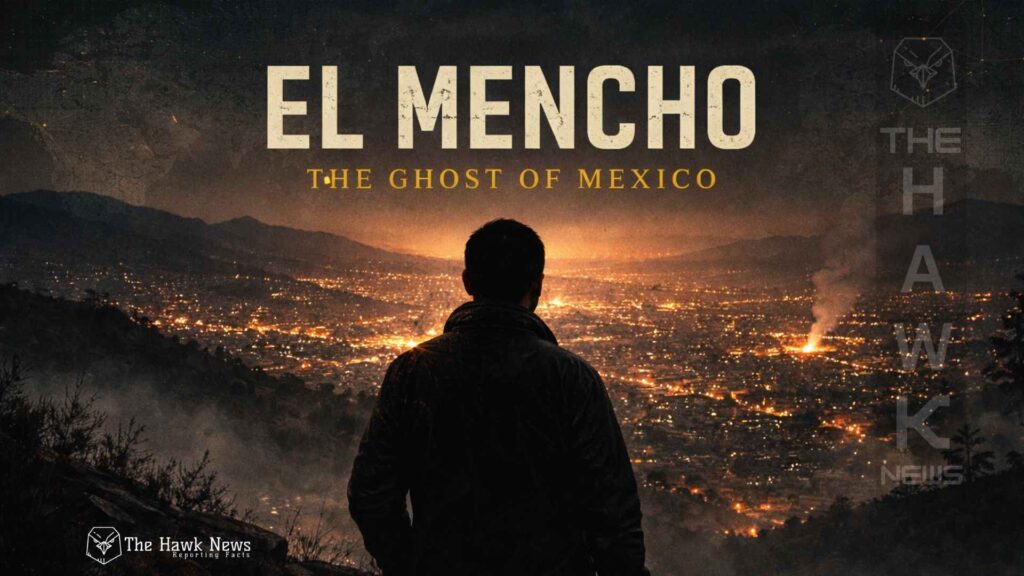
The Man No One Sees
In the dark corridors of Mexico’s drug war, his name is spoken quietly — not in reverence, but in survival.
Nemesio Oseguera Cervantes, known as El Mencho, has become one of the most powerful and feared figures in global organized crime.
While figures like Joaquín ‘El Chapo’ Guzmán turned crime into spectacle, El Mencho turned it into silence.
He rules not through fame, but through absence — a ghostly general commanding an empire of violence from the shadows.
“Where others sought the camera, he sought the camouflage — and that made him unstoppable.”
II. From Avocado Fields to Firepower
Born in Michoacán, Mexico, in the late 1960s, El Mencho’s beginnings were ordinary — a farmer’s son harvesting avocados.
But in the soil of poverty and instability, he grew something far more enduring: ruthlessness.
After spending years in the U.S. and facing imprisonment for drug trafficking, he was deported back to Mexico — hardened, trained, and aware of the billion-dollar industry waiting in chaos.
There, amid collapsing cartels and political cracks, he founded what would become the Cártel de Jalisco Nueva Generación (CJNG) — a group that would rewrite the DNA of organized crime.
“El Mencho didn’t just exploit Mexico’s weakness — he understood it better than the government did.”
III. CJNG — The Cartel of the 21st Century
Unlike older, family-run drug networks, El Mencho’s CJNG is structured like a corporation and fights like an army.
It operates across 25 Mexican states, extends its reach into North America, Europe, and Asia, and manages everything from methamphetamine and fentanyl production to cyber-fraud and weapons trafficking.
The CJNG is known for its discipline, militarization, and digital strategy.
Drones monitor law enforcement, encrypted networks manage logistics, and propaganda videos circulate online to intimidate rivals and reassure locals.
In a single decade, El Mencho transformed CJNG from a regional player into one of the most dominant narco-empires in history.
“In the age of technology, El Mencho turned crime into an algorithm.”
IV. The Strategy of Silence
Perhaps his greatest weapon is his invisibility.
While El Chapo relished the limelight, El Mencho vanished into the hills — rarely photographed, never flamboyant, almost mythical.
That absence became armor.
His cartel operates with ruthless local control, often enforcing its own “law” in regions abandoned by the state — collecting taxes, distributing aid, and executing justice.
To communities worn down by corruption, CJNG’s order can seem like stability, even if it’s stained with fear.
“He doesn’t just control people. He replaces the government they stopped believing in.”
V. Violence as Language
Under El Mencho, violence became communication.
CJNG’s signature tactics — public displays of brutality, ambushes on police convoys, drone-dropped grenades — aren’t just warfare; they’re messaging.
Each act says: We are here, and no one can stop us.
The cartel’s rise also exposed Mexico’s deeper fracture — a system where power and protection are negotiable.
In towns where the law is absent, fear becomes governance.
“The cartel doesn’t need to conquer — it only needs to be believed.”
VI. A Global Shadow
Today, El Mencho is wanted by the U.S. Drug Enforcement Administration, which has offered a $10 million reward for his capture.
Yet despite the global manhunt, he remains untraceable — allegedly protected by a network of loyalists, corrupt officials, and communities dependent on his organization.
His operations feed the fentanyl crisis devastating the U.S., linking addiction in American suburbs to terror in Mexican villages —
a grim equation of demand and despair.
“Every overdose across the border is an echo of power from a man who never leaves his mountain.”
VII. The Anatomy of a Vacuum
El Mencho’s story is not just about crime — it’s about absence.
Where justice collapsed, he rose.
Where poverty deepened, he recruited.
Where government failed, he ruled.
He is not the cause of Mexico’s chaos, but its reflection — a mirror showing what happens when a system forgets its citizens.
“When institutions fail to protect, crime learns to govern.”
VIII. The Enduring Ghost
In recent years, rumors have circulated that El Mencho may have died — whispers that ripple through cartel territories like ghost stories.
Yet no government agency, in Mexico or abroad, has confirmed it.
The U.S. DEA continues to list him as one of the world’s most wanted fugitives.
Whether living in the shadows or gone from this world, his influence remains — proof that sometimes, power outlives the person who held it.
El Mencho’s empire stands as a reminder that violence is not only born of greed, but of neglect.
Until corruption is challenged, poverty addressed, and justice restored, the world will keep making men like him — and calling them ghosts.
“El Mencho may one day fall, but the silence that made him will rise again.”
— Editorial reflection, The Hawk News