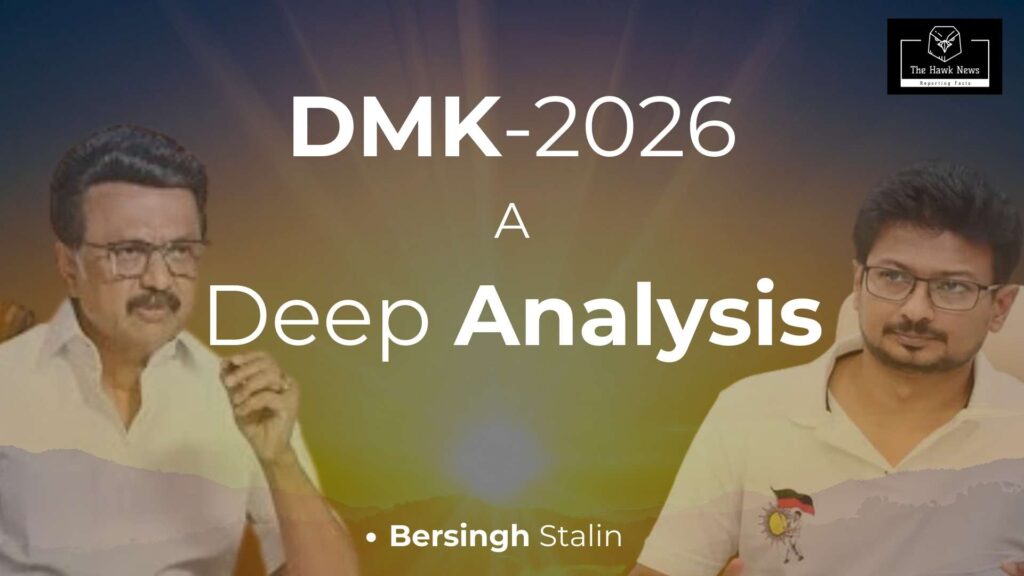
DMK TODAY: STRONG ON THE SURFACE, SHRINKING AT THE ROOTS
(A Deep Analysis as of December 2025)
1. Why DMK looks very comfortable right now
As of late 2025, DMK looks relaxed. They have been in power in Tamil Nadu for about 4.5 years in this term.
No major crisis has exploded into something that could shake the government.
That does not mean they haven’t made mistakes. It means they’ve managed every issue before it became a full-blown public disaster.
The main reason they look comfortable is simple:
- The opposition is extremely weak.
- The anti-DMK vote is scattered across many parties: NTK, TVK, AMMK, PMK, AIADMK splinters (OPS group, Sasikala group, and more small outfits).
- This split ensures DMK wins even without deep enthusiasm on the ground.
On top of that, DMK has one more shield:
- They have mastered media management.
- Front-end: controlled, positive, polished.
- Back-end: highly questionable, but rarely exposed in a big way.
So, today’s picture is this:
DMK looks strong not because it is growing, but because its enemies are divided and weak – and because it controls the narrative.
2. Alliance politics: comfort as a weapon
Another big pillar of DMK’s “strength” is its alliance structure.
Congress, VCK, Communist parties and other allies are all stuck:
- They cannot easily move to the opposition because the main opposition is weak and tied to BJP.
- Ideologically, many of these parties cannot sit with BJP. So they have “zero options” outside the DMK-led front.
Even when DMK’s own bureaucracy has troubled VCK or Communist parties, these allies have not been able to seriously oppose DMK. They simply do not have the strength, or an alternative space to go to.
DMK also plays one more clever game:
- It keeps alliance parties financially comfortable – posts, funds, influence, visibility.
- And historically, the best way to keep your rival powerless is to keep him permanently comfortable.
- Comfort becomes an addiction.
- By the time he realises he’s losing his independent strength, it’s already late.
From 2019 till today, no alliance partner has given DMK serious trouble.
This is not healthy coalition politics. This is a controlled ecosystem where DMK is the only real centre of power.
3. TVK and the 2026 election: a silent gift to DMK
Actor Vijay’s party TVK is being presented as an “alternative”.
But in practical electoral arithmetic, TVK is splitting the anti-DMK vote even further.
For the 2026 Tamil Nadu election, this is a huge indirect benefit to DMK.
- Every anti-DMK voter who moves to TVK instead of consolidating behind a single challenger
- makes it easier for DMK to win with the same or even less rooted strength.
So again, DMK’s comfort is not coming from its own growth, but from the fragmentation of those who stand against it.
4. The saturation point: a party without a next level
If we look beyond today’s numbers and headlines:
DMK has reached a saturation point.
- There is no new big ideological or organisational leap.
- There is no serious plan to take the party to a new level of connection with society.
- There is no fresh “revolutionary” idea that can carry the next 30–40 years.
Instead, DMK is leaning heavily on one survival formula:
“Free” – the politics of endless schemes.
Free schemes do three things in the short term:
- They calm social restlessness.
- They keep people tied to the ruling party as long as the benefits flow.
- They create the illusion of “pro-poor” activism without building real participation.
But in the long run, two serious problems appear:
- Economically, this is a dangerous model. It gives temporary relief, not long-term growth or empowerment.
- Psychologically, people start seeing these “free” benefits as rights, not as favours.
Once that happens, every government has to give more and more for free just to stay where it is.
This is not development.
This is a growing bubble, and every bubble bursts one day.
5. Ideological crisis: the Dravidian tree with weak roots
DMK’s biggest long-term problem is not BJP.
It is ideological decay.
- The upper layer of the party – leaders in posts, ministers, senior cadres – still talks about Dravidian ideology.
- But the root-level cadre and many ordinary DMK voters do not live that ideology.
They vote for DMK because:
- They see themselves as DMK people by habit or identity
- They benefit from schemes,
- They trust DMK as the best shield against BJP.
This is transactional loyalty, not ideological bonding.
At the same time, the wider Dravidian ecosystem itself is shrinking:
- AIADMK, once a powerful Dravidian co-existing force, is weakened and divided.
- MDMK is a minor party and is inside the DMK alliance.
- DMDK is declining.
So DMK today looks like the biggest Dravidian ship simply because all other Dravidian ships are sinking or tied to it.
That doesn’t mean the ideology is strong.
It only means the field is empty.
A movement that began nearly seven decades ago is now at a stage where, if it does not reform and reconnect, it will face sudden collapse – just as many powerful movements in history disappeared once they crossed their peak and refused to evolve.
6. Power vs strength: don’t confuse the two
One more point we must be honest about:
Any party in power will naturally look strong.
It controls:
- State machinery
- Funds
- Police and bureaucracy
- Media access
So DMK’s current “strong” image is partly automatic.
But real strength comes from:
- Deep ideological roots
- Active, connected cadres
- A constant pipeline of new leaders from the grassroots
On these points, DMK is weak:
- The internal party structure is not growing from the roots up.
- Cadres are not being ideologically educated and engaged; they are mostly mobilised during elections or for show-of-strength events.
- For almost two decades, we have not seen many naturally grown leaders emerging from the bottom.
Instead, one visible trend is:
Importing leaders from other parties.
This gives a short-term boost – some vote banks, some media attention.
But it has a heavy long-term cost:
- Grassroots DMK workers have spent years opposing that leader.
- Now, suddenly, they are expected to follow him.
- This creates resentment and distance between the leadership and the base.
Imported leaders will also never have the same emotional bond with DMK as someone who grew inside it.
Over time, this model hollows the party from within.
7. “Free bread” politics: lessons from history
What DMK is doing with freebies has a very old pattern in world history.
Ancient Rome is a classic example:
- In 123 BC, Roman politician Gaius Gracchus introduced a grain law (Lex Frumentaria) that allowed citizens to get subsidised grain from the state.
- Over the following decades, this evolved into regular grain doles, and later even free grain for qualifying citizens.
- Along with grand entertainment in arenas, this became what we now call “bread and circuses” – a model where rulers pacified the public with food and shows instead of solving core problems.
Closer to our time, during the Arab Spring (2011), we saw a similar pattern:
- In Saudi Arabia in February–March 2011, as protests spread across the region, the king announced benefits worth billions of dollars: salary hikes, unemployment support, housing loans, and other welfare spending to “buy social peace” and prevent unrest from exploding at home.
- In Kuwait, in early 2011, the Emir ordered a grant of 1,000 dinars to every citizen along with free food rations for about a year, widely seen as a move to insulate Kuwait from the Arab Spring unrest sweeping the region.
In all these cases, rulers chose cash, food and benefits as tools to control unrest instead of fundamentally reforming their systems.
Tamil Nadu’s expanding “free model” today is not identical, but the pattern is similar:
- Use state resources to calm anger and unrest.
- Cover structural failures with short-term relief.
History shows this strategy buys time.
It does not solve the problem.
And once financial pressure grows or people’s expectations rise, the same model can turn against the ruling party.
8. Minority votes and anti-BJP positioning: DMK’s biggest shield
One of the core reasons DMK survives so comfortably is its position as the primary anti-BJP force in Tamil Nadu.
For many minorities, BJP is seen as a direct threat.
So any party that loudly opposes BJP gains a natural advantage with:
- Muslim voters
- Christian voters
- Other communities who fear majoritarian politics
DMK taps this in a very simple way:
- Front-end: Strong, loud, continuous opposition to BJP.
- Back-end: Complex political deals and understandings.
With this, DMK secures a major chunk of minority votes without having to do the harder work of deep grassroots ideological connection.
This block of votes, plus fragmented opposition, plus freebies, creates the illusion that DMK is unshakable.
9. Organisational bloodline: strength at the top, weakness at the bottom
To be fair, DMK does have one genuine institutional strength:
- Whether in power or in opposition, the top layer of the party is always active – strategising, negotiating, running the machine.
- DMK has functioned as an institution for decades. That continuity is real and it is valuable.
But:
- Root cadres are not treated as co-participants in a movement.
- Citizens are not made partners; they are treated as beneficiaries.
If DMK wants real long-term survival and growth, it has to shift from:
“People as beneficiaries” → to → “People as co-owners of a movement.”
That means:
- A renewed ideology that affects every individual’s daily life, not just a few symbolic identities.
- A model where citizens and cadres work on the ground as volunteers, not just appear during elections.
If it doesn’t, it will slowly go the Congress way:
- For years it will look too big to fail.
- And then, one day, the collapse will look sudden – though the decay was visible long before.
10. Udhayanidhi Stalin: heir or leader?
Udhayanidhi Stalin sits at the centre of DMK’s future question.
If he is seen only as:
“The premium kid who got everything by birth,”
then his political journey will stay weak and resented, no matter how many posts he holds.
To become a real leader, he has to:
- Innovate the ideology
- Not just repeat old Dravidian slogans.
- Build a next-generation vision that speaks to education, jobs, environment, technology, dignity – things every young person feels.
- Connect with root cadres and citizens
- Not just through PR events.
- Through consistent, simple, grounded presence.
- Drop the royal image
- People like simplicity.
- A leader always in luxury cars and elite spaces will feel distant.
- If he deliberately chooses simpler living and travel, people will read that as a serious signal, not a gimmick.
Right now, his PR is trying to show him as a “common man” who mixes with ordinary people.
That is good optics.
But if it is backed by real ideological work and real structural reform, he has a genuine chance to occupy the big political vacuum in Tamil Nadu.
If not, the “birthright” that gave him power will turn into a negative label that will follow him for life.
11. What DMK must do – or face slow collapse
To summarise the core of this analysis:
DMK today is comfortable, not strong.
It survives and wins because of:
- Weak and fragmented opposition
- Alliance partners trapped in comfort and compulsion
- Media management and narrative control
- Free schemes that buy short-term calm
- Minority votes secured through anti-BJP positioning
- A top-level institutional culture that keeps the machine running
But it is shrinking where it truly matters:
- Ideology at the roots
- Organic grassroots leadership
- Real cadre–citizen connection
If DMK wants to avoid the fate of Congress, it has to:
- Stop over-relying on “free” as its main connection with people.
- Stop importing readymade leaders from other parties as a shortcut.
- Build a new, practical, lived ideology that turns every citizen and cadre into a co-participant in a movement, not a spectator.
If it does this, it can revive itself as a genuinely powerful Dravidian force for the next generation.
If it does not, then despite all its current comfort, DMK is already on the path of slow, silent decline – a decline that its own cadres and leaders will only fully see when the collapse becomes impossible to hide.