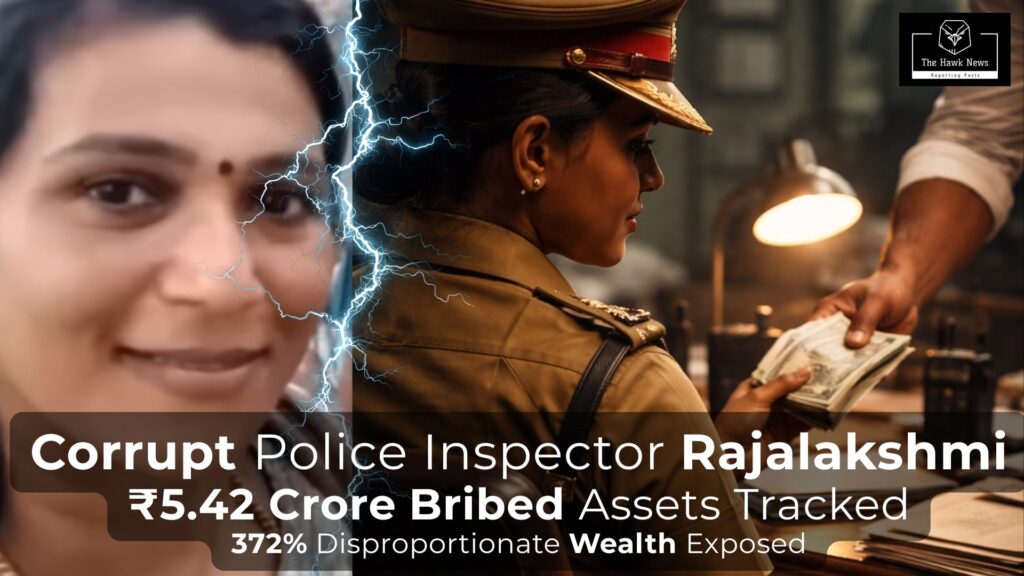
A police uniform represents authority, discipline, and public trust. In Chennai, that uniform now stands accused of becoming a vehicle for personal wealth accumulation.
Inspector Rajalakshmi allegedly amassed ₹5.42 crore in assets that far exceeded her lawful income. The disproportion stands at a shocking 372 percent.
This is not a clerical error or accounting oversight. It is a documented financial explosion over eight years.
The Rise of an Officer
Rajalakshmi joined the police force in 1999 as a Sub Inspector. Over time, she secured postings in influential divisions with direct enforcement authority.
She served in the Anti Vice Squad, Prohibition Enforcement Wing, and Economic Offences Wing. These are units where power intersects with high value investigations.
Such postings demand integrity beyond question. Instead, they now raise questions about opportunity and misuse.
The Financial Trail
Investigators examined her assets between June 2017 and June 2024. At the beginning of this period, her declared assets were just ₹3.64 lakh.
By the end of the same period, her assets had surged to ₹4.62 crore. That jump alone demands scrutiny.
Her recorded income during these years was ₹1.08 crore. Her expenditure crossed ₹2.25 crore, creating an immediate mismatch.
Officials also discovered nearly ₹80 lakh in savings and additional properties. The combined value reached ₹5.42 crore.
The anti corruption department concluded that her assets were 372 percent more than her legal income allowed.
The Raid That Broke the Silence
Last Friday, officials conducted a raid at her residence in Thirumangalam, Chennai. Documents and financial records were seized.
The action followed a secret inquiry initiated after multiple complaints. For months, investigators tracked financial patterns quietly.
The First Information Report details bank entries, property records, and calculated income discrepancies. This is evidence driven documentation.
The Defence of “Personal Vendetta”
Rajalakshmi reportedly claimed that the case was motivated by personal vendetta. That claim now stands against structured financial findings.
An FIR built on bank statements and asset declarations leaves little room for emotional defence. Numbers rarely participate in vendetta.
The scale of wealth accumulation cannot be explained by routine salary increments. It suggests systematic benefit extraction.
Enforcement Wings Under Question
Her tenure in enforcement wings now attracts deeper suspicion. These units deal with vice, liquor violations, and economic crimes.
Every raid creates pressure points. Every investigation creates negotiation space.
Authorities are now examining whether bribes were collected in specific cases. They are mapping which investigations coincided with asset spikes.
This is no longer about isolated misconduct. It is about possible monetisation of policing.
Could She Have Acted Alone?
An inspector functions within a hierarchy. Transfers, postings, and oversight pass through senior officers.
The investigation is exploring whether higher officials were aware of or connected to her wealth rise. Institutional silence often masks complicity.
Eight years of accumulation without detection indicates either systemic failure or deliberate blindness.
If internal asset declarations were reviewed properly, red flags should have appeared early.
The Role of Vigilance
The case is currently being handled by the Directorate of Vigilance and Anti-Corruption Tamil Nadu. The agency is tracking linked accounts and family assets.
Investigators are examining property registrations and transactional flows. The inquiry is expected to widen if connections emerge.
Public confidence now depends on how far the probe travels upward. Stopping at one name will not restore trust.
Chennai and the Larger Question
This case unfolded in Chennai, a major metropolitan city with layered police supervision. Oversight structures exist on paper.
Yet an inspector allegedly multiplied her wealth more than tenfold. That gap between oversight and reality is disturbing.
If this can occur in a major city, the question extends beyond one district.
The Cost of Corruption
Every rupee of bribe money originates from someone under pressure. It comes from fear, coercion, or administrative vulnerability.
Small business owners, accused individuals, and citizens become unwilling contributors. Justice becomes conditional on payment.
When policing turns transactional, law loses moral authority. Citizens begin to negotiate instead of trust.
A Pattern, Not an Exception
Disproportionate asset cases are not new in India. What shocks is the magnitude and duration involved here.
From ₹3.64 lakh to ₹5.42 crore in less than a decade is not incremental drift. It is exponential growth.
Such growth rarely survives without networks of silence. That is why the investigation must expand.
What Happens Next
Authorities are now identifying the specific cases linked to suspected bribe collection. They are calculating amounts tied to each transaction.
The outcome will test institutional sincerity. Accountability must include supervisory responsibility if negligence is proven.
If this case ends with a single suspension, it will only reinforce cynicism.
The Larger Damage
Corruption inside policing erodes more than finances. It weakens the psychological contract between citizen and state.
A uniform should symbolise protection. When it symbolises profit, democracy absorbs quiet damage.
Inspector Rajalakshmi’s alleged ₹5.42 crore empire is not merely a personal scandal. It is a structural warning.
Whether the system treats it as a warning or buries it as an isolated episode will define the credibility of enforcement in the years ahead.