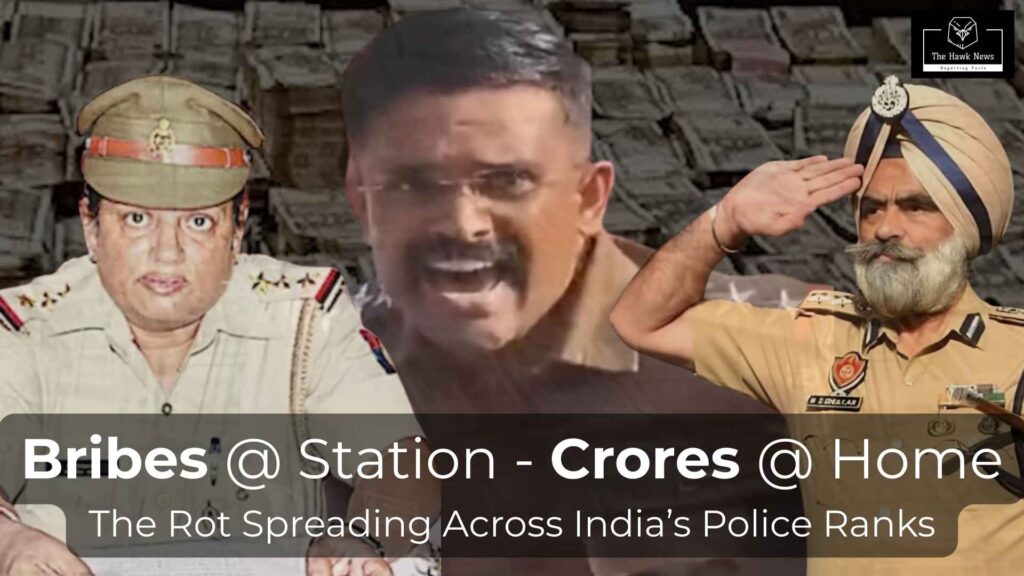
Corruption inside India’s police system is no longer confined to rumours or anonymous complaints. It is now being documented through trap operations, disproportionate asset probes, and court filings across multiple states.
Recent cases from Karnataka, Punjab, and Uttar Pradesh reveal something far more serious than individual misconduct. They expose a pattern where authority repeatedly converts into personal wealth, while institutional oversight arrives only after damage becomes visible.
Governments continue to speak about zero tolerance. What the evidence shows instead is delayed action, selective enforcement, and a system that reacts to scandals rather than preventing them.
Karnataka: From Trap Operations to Multi-Crore Asset Trails
In Bengaluru, anti-corruption officials recently arrested Inspector Govindaraju of KP Agrahara police station after he was allegedly caught accepting ₹4 lakh as part of a ₹5 lakh bribe demand. The money was reportedly sought from a builder facing a cheating case, with assurances that his name would be removed from the FIR.
The operation was conducted by Karnataka Lokayukta using phenolphthalein-coated currency. Govindaraju was apprehended at the City Armed Reserve grounds while receiving the cash. He was booked under the Prevention of Corruption Act.
Within a day, another officer, Sub-Inspector Chetan Kumar SS from Tumakuru Rural police station, was arrested for allegedly accepting ₹40,000 from a complainant seeking the release of a seized vehicle.
Two arrests in quick succession highlighted how routine monetary negotiations had become within local policing.
At the same time, Lokayukta officials raided properties belonging to a former Karnataka Industrial Areas Development Board official and seized assets valued at over ₹26 crore. This parallel action underscored that corruption is not limited to bribes exchanged across desks. It also manifests as long-term accumulation of land, buildings, and financial holdings that vastly exceed known income.
Taken together, these cases showed both ends of the spectrum: immediate cash-for-favour arrangements and extended asset-building enabled by public office.
Punjab: When Senior Leadership Comes Under Investigation
The focus in Punjab shifted sharply upward in the hierarchy with the arrest of DIG Harcharan Singh Bhullar, Ropar Range, by the Central Bureau of Investigation.
Investigators alleged that Bhullar received regular bribes from business interests in exchange for favourable treatment. Searches conducted at his residence reportedly uncovered cash running into crores, along with gold, luxury watches, and documents related to multiple immovable properties.
The inquiry quickly expanded beyond a single officer. Other IPS personnel were questioned, and investigators began examining dozens of suspicious properties allegedly linked to the same network.
What made this case especially significant was not merely the rank of the accused, but what it revealed about enforcement patterns.
Official records show that around 52 police personnel had been dismissed during Punjab’s anti-corruption drive. However, most of those removed were lower-ranking staff, many for absenteeism rather than bribery. Senior officers remained largely untouched until Bhullar’s arrest forced scrutiny at the top.
This disparity has drawn criticism from legal observers and civil society groups. While junior staff face swift disciplinary action, senior leadership appears insulated unless external agencies intervene.
The Bhullar case exposed how corruption at higher levels can operate through sustained arrangements rather than isolated transactions, influencing postings, administrative decisions, and investigations.
Uttar Pradesh: Fourteen Years of Accumulation Without Oversight
In Uttar Pradesh, the case of Inspector Nargis Khan revealed another dimension of systemic failure.
An FIR was registered against Khan for allegedly amassing disproportionate assets worth over ₹10.5 crore during a 14-year service period. According to investigators, her legitimate income during that time stood at approximately ₹5.36 crore.
The asset trail documented houses, plots, shopping complexes, restaurants, bars, petrol pumps, and flats across Meerut, Ghaziabad, and Noida.
Anti-corruption officials stated that the case was registered only after detailed verification of bank accounts, property records, and income statements. Authorities also alleged that Khan used her official position to secure repeated postings in strategically important districts, enabling business expansion and real estate acquisitions.
What stands out here is not only the scale of the assets, but the duration over which they were accumulated.
For more than a decade, substantial wealth grew without triggering internal alarms. There was no routine lifestyle audit. No early intervention. No institutional mechanism strong enough to flag discrepancies in real time.
The system acted only after the numbers became too large to ignore.
A Consistent Pattern Across States
Viewed together, these cases present a consistent blueprint.
In Karnataka, officers allegedly negotiated case outcomes for cash.
In Punjab, senior leadership allegedly ran organised bribery channels.
In Uttar Pradesh, long-serving officers quietly built extensive business portfolios.
Different methods. Same outcome.
Public authority becomes private capital.
These are not isolated scandals. They reflect an environment where postings are treated as opportunities, investigations become bargaining tools, and enforcement remains selective.
Anti-corruption agencies intervene only after whistleblowers come forward or financial footprints become impossible to conceal. By then, institutional damage is already deep.
The Gap Between Slogans and Systems
Every administration promises zero tolerance. Press conferences follow arrests. Statements about accountability are issued.
Yet corruption persists because enforcement remains reactive.
Trap operations catch individuals. Asset probes expose extremes. Neither addresses the deeper architecture that enables misconduct: opaque transfers, discretionary postings, weak internal audits, political protection, and disciplinary frameworks that disproportionately affect the powerless.
Without structural reform, these actions amount to containment, not correction.
Who Monitors the Monitors?
Police officers possess extraordinary power over citizens. They register cases, control investigations, and influence outcomes.
But who tracks their wealth growth?
Who flags repeated postings to lucrative districts?
Who audits lifestyles against declared income?
In most states, internal vigilance units are understaffed or compromised. External oversight appears only after scandals surface.
This is not accountability. It is delayed reaction.
Conclusion: Exposures Are Not Reforms
The recent arrests and asset seizures across Karnataka, Punjab, and Uttar Pradesh should not be mistaken for systemic victories.
They are warnings.
They reveal how corruption operates across ranks and regions, adapting to local conditions while following the same core logic. They show that law enforcement, in parts, has evolved into a parallel economy where power determines profit.
Marked currency notes make headlines. Multi-crore seizures shock the public. But unless transparent posting systems, mandatory wealth audits, and independent oversight become standard practice, these cases will remain episodic.
India does not lack anti-corruption rhetoric.
It lacks sustained institutional courage.
And until that changes, the scanner will keep lighting up, state after state.